Pain Control
Please click on the link below to access the most up-to-date version of this guideline. The content on this page is currently being updated to align with the latest publication. Always check the version number at the bottom of the screen to confirm which version you are using. Click here to access the Primary_Healthcare_Chapter_20_Pain_with_supporting_NEMLC_Report_2025-9_Review_Version_1.0_(26_Fe
Please click on the link below to access the most up-to-date version of this guideline. The content on this page is currently being updated to align with the latest publication. Always check the version number at the bottom of the screen to confirm which version you are using.
R52.0/R52.9
DESCRIPTION
Pain is “an unpleasant sensory and emotional experience associated with, or resembling that associated with, actual or potential tissue damage”.
It is subjective. It is affected by the patient's mood, morale, and the meaning the pain has for the patient. Verbal description is only one of several behaviours to express pain; inability to communicate does not negate the possibility that the patient is experiencing pain.
LoE:IVb1
GENERAL MEASURES
- Enquire about pain at all patient consults.
- General medical history is an important part of a pain history, as it reveals co-morbidities affecting the complexity of the pain condition.
- Culture, gender and language play an essential role in how a patient reports pain.
- Active pain assessment and self-report is the key to effective pain management.
- Different pain assessment scales should be used for different ages and intellectual categories of patients.
LoE:IVb2
Choice of pain assessment tool:
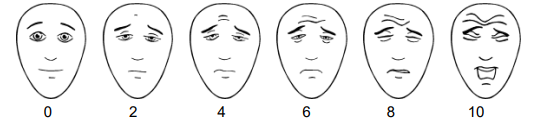
- The gold standard of pain assessment is self-report. Consider using selfreport tools from > 5 years (e.g. revised faces pain scale, visual analogue scales below).
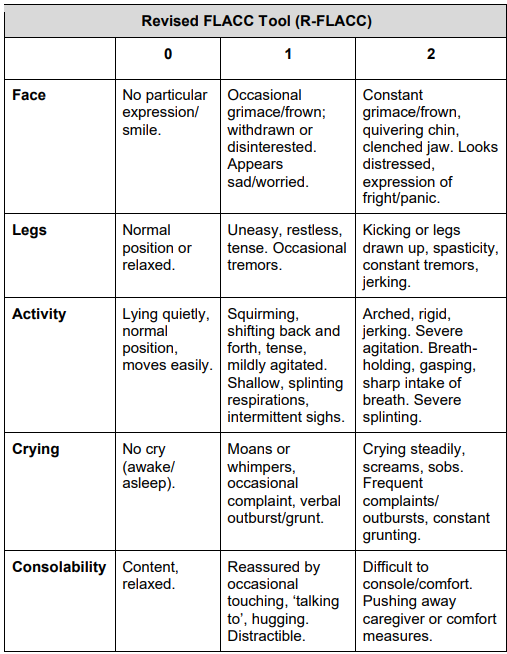
- If the child is unable to self-report, use the revised Face, Legs, Activity, Cry, and Consolability (R-FLACC) scale.
- In non-verbal patients or patients with cognitive impairment, specific tools, e.g. the Abbey pain scale, may be used to assess pain: https://www.mdcalc.com/calc/3627/abbey-pain-scale-dementia-patients
LoE:IIIb3, LoE:IVb4
REVISED FLACC TOOL (R-FLACC)
Infants and children (2 months to 18 years old) - Behavioural pain assessment tool:
This tool can be used in children aged 2 months to 18 years and includes descriptors for cognitively impaired children. The clinician assigns a score to each parameter, and tallies a score out of 10. The final score is used to diagnose 1-3 (mild discomfort), 4-6 (moderate), or 7-10 (severe pain), which must be treated accordingly.
LoE:IIIb5
Click on image to enlarge
Table 1: Revised FLACC tool for assessment of pain severity (R-FLACC)
REVISED FACES PAIN SCALE
- Use in children >4 years of age.
- Ask them to point to the face that best depicts their level of pain.
Click on image to enlarge
Figure 1: Revised faces pain scale
LoE:IIIb6
VISUAL ANALOGUE SCALE
- Use in children over 7 and adults who can communicate.
- Ask: “on a scale of 0-10, ‘0’ being no pain and ‘10 ’being the worst pain, what number are you feeling right now?”
Pain should be assessed by:
- Duration
- Severity, e.g. does the patient wake up because of the pain?
- Site
- Character, e.g. stabbing, throbbing, crushing, cramp-like
- Persistent or intermittent
- Relieving or aggravating factors
- Accompanying symptoms e.g. nausea and vomiting, visual disturbances
- Distribution of pain
- Referred pain
Standard Treatment Guidelines and Essential Medicines List for South Africa, Primary Healthcare, 2020-2024_Version 1.0_07 November 2024
Chapter 20: Pain_20.1 Pain Control