Paracetamol Poisoning
Paracetamol poisoning
Mechanism of toxicity
Toxic dose
Symptoms and signs of poisoning
Special investigations
Management
Mechanism of toxicity
Glucuronidation and sulfation pathways become saturated, so metabolism by CYP450 to toxic metabolite (NAPQI) increases. Conjugation of NAPQI with glutathione is protective, but gluthathione stores are rapidly depleted and NAPQI accumulates.
Toxic dose
≥ 150 mg/kg or 7.5 g (whichever is less)
Symptoms and signs of poisoning
- Gastrointestinal: nausea and vomiting, abdominal pain
- Hepatotoxicity: laboratory abnormalities usually observed within 12–48 h; may be delayed up to 4 days
Special investigations
- Paracetamol blood concentrations: must be taken ≥4 h after ingestion (samples taken earlier don’t represent the peak concentration); repeat samples may be needed for sustained release formulations
Management
| Intervention | Not effective | Consider | indicated |
| Gastric lavage | |||
| Early post-ingestion activated charcoal | |||
| Multiple dose active charcoal | |||
| Dialysis | |||
| Charcoal haemoperfusion |
Antidote: Acetylcysteine
- In a potentially toxic overdose start acetylcysteine without waiting for the plasma paracetamol concentration. Stop it if the concentration is in the non-toxic range.
- Patients with plasma concentrations above the treatment line must be given acetylcysteine. Use the high-risk treatment line for patients taking enzyme-inducing drugs, alcohol abusers or glutathione-depleted patients.
- Patients who present ≥ 24 h after ingestion and have detectable plasma paracetamol concentrations or hepatotoxicity should be given acetylcysteine.
- Dose: IV continuous infusion: 150 mg/kg in 200 mL 5% dextrose over 1 h; then 50 mg/kg in 500 mL 5% dextrose over 4 h; then 100 mg/kg in 1 L 5% dextrose over 16 h.
- In patients who develop hepatic injury, acetylcysteine should be continued until liver functions are normal: 150 mg/kg in 1 L 5% dextrose water over 24 h.
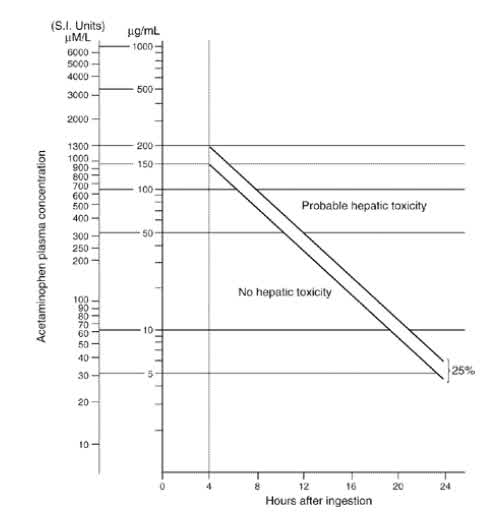
Nomogram reproduced from the Guidelines for the management of Acute Paracetamol Overdose produced by the Medicines Information Centre, UCT.
Symptomatic and supportive:
Treat complications (e.g. liver/renal failure) according to symptoms and signs.
Monitoring:
- Liver function tests: AST, ALT and INR should be done daily if acetylcysteine was given
- Renal function and electrolytes: including glucose should be done daily if acetylcysteine was given