Parenteral Nutrition
Complications of PN Dose and duration of PN infusion Average daily parenteral requirements Parenteral nutrition (PN) should be prescribed and administered under the supervision of a medical specialist and dietician. PN should be used only when it is not possible to meet nutritional requirements enterally or when there is gastrointestinal dysfunction resulting in inability to tolerate enteral nutr
Dose and duration of PN infusion
Average daily parenteral requirements
- Parenteral nutrition (PN) should be prescribed and administered under the supervision of a medical specialist and dietician.
- PN should be used only when it is not possible to meet nutritional requirements enterally or when there is gastrointestinal dysfunction resulting in inability to tolerate enteral nutrition for a prolonged time: > 5 to 7 days.
- PN is the intravenous administration of amino acids (proteins), lipids, carbohydrates, electrolytes, minerals, vitamins, and trace elements necessary for metabolic requirements and growth.
- PN may be total parenteral nutrition (TPN) where all nutrients are administered, usually via a central venous line, until the child is able to tolerate enteral feeds.
- PN may also be partial parenteral nutrition (PPN) where it is used to supplement enteral feeds in children who cannot yet tolerate their full complement of enteral feeds.
- Whenever possible, the enteral route should still be used to deliver small volumes of feed, in order to protect the integrity of the gut mucosal barrier and preserve mechanical function of the gut. This is known as trophic feeding.
- Administer PN preferably via a central venous catheter (CVC), especially when it is expected that the child will require TPN for more than 7 days. A peripheral venous catheter may only be used for anticipated short term (< 7 days) partial parenteral nutrition. Only PN solutions with an osmolarity < 800 mOsm/L (non-lipid containing) and < 1000 mOsm/L (lipid containing) can be safely administered via a peripheral vein.
- Check peripheral vein infusion sites and patency of the catheter regularly for tissue infiltration.
- Transport and store PN solutions at 2–8 ºC. Start administration of the PN solutions within one hour after removal from the refrigerator.
- Do not make additions to a PN bag or decant contents as the stability and/or the sterility may be compromised.
- Do not use the PN catheter/lumen to collect blood samples.
- Administer PN through a dedicated catheter/lumen and do not administer medications, blood, etc. through the PN catheter/lumen.
- Use a 1.2 micron in-line filter for lipid containing PN solutions and a 0.2 micron filter for lipid-free PN solutions.
- Adhere to a strict aseptic technique when administering PN solutions. Check integrity of packaging before starting the infusion.
- PN bags must not be used beyond 24 hours after starting the infusion.
COMPLICATIONS OF PN
- Central or peripheral venous catheter complications, e.g., extravasation, blockage, infection and venous thrombosis.
- Metabolic complications, e.g., hyperglycaemia, hypoglycaemia, electrolyte and mineral disturbances, micronutrient deficiencies and hyperlipidaemia.
- Metabolic bone disease and growth impairment.
- Cholestatic hepatitis and liver failure.
Monitor:
- Vital signs and hydration.
- Blood glucose 12 hourly; maintain blood glucose at 4.0–10 mmol/L.
- Electrolytes, minerals, and acid-base on a daily basis or more regularly if necessary.
- Growth parameters and weight, twice weekly.
- Liver enzymes, bilirubin, lipids, urea and creatinine once weekly or more frequently, as indicated by the condition of the child.
- Regular screening for the presence of infection.
DOSE AND DURATION OF PN INFUSION
The maximum volume of TPN for a child depends on the age, weight and underlying disease and is based on the total daily fluid requirements.
AVERAGE DAILY PARENTERAL REQUIREMENTS
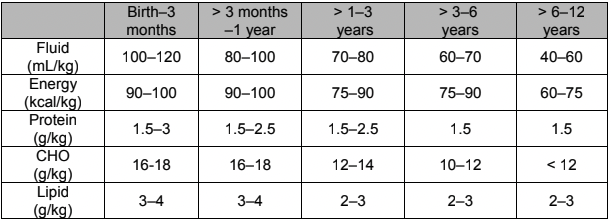
Click on the table to enlarge
The daily nutritional requirements are influenced by age, physical activity and underlying diseases/disorders, e.g., burns, liver failure, etc.
Standard Treatment Guidelines And Essential Medicines List For South Africa, Hospital Level, Paediatrics, 2023 Edition
Chapter 23: Paediatric Intensive Care, 23.3 Nutritional Care In The ICU, 23.3.1 Parenteral Nutrition