Patient Blood Management
SANBS Clinical Guideline, 6th Edition, 2023
Why do we need to implement PMB?
Who is responsible for implementing PBM?
How to monitor a PBM programme
PBM in a resource-constrained setting: Do we wait for "more" or do we start?
Blood and blood products remain a life-saving intervention for the patient who requires a transfusion. The aim of informing the reader on Patient Blood Management (PBM) is to ensure an appropriate, step-wise, multidisciplinary approach to the management of patients so that blood and blood products are used appropriately and patient outcomes are optimised.
Background
In 2010, the 63rd World Health Assembly adopted Resolution WHA63.12 on Availability, safety and quality of blood products. The Director General of the World Health Organization (WHO) was requested ‘to provide guidance, training and support to Member States on safe and rational use of blood products … and patient blood management’.
PBM remained a focus point for WHO, culminating in Strategic Objective 4 of the WHO Action Framework to Advance Universal Access to Safe, Effective and Quality Assured Blood Products 2020 – 2023 being Effective implementation of patient blood management to optimize clinical practice of transfusion.
What is PBM
PBM is a multidisciplinary, patient-centric approach that aims to improve patient outcomes. PBM-based rationales should be applied to both surgical and non-surgical patients to:
- Ensure the appropriate use of blood and blood products
- Minimise risk
- Optimise patient outcomes
Any transfusion decision-making process should show cognisance of PBM principles.
Despite different definitions being used for PBM, the core focus points are similar:
- Timely optimisation of the patient’s own red cell mass (Note: Diagnose and treat anaemia)
- Control/minimise blood loss and bleeding
- Optimise and harness the patient’s physiological reserve/tolerance to anaemia
- Patient empowerment and participation in the decision-making process
- Multidisciplinary approach
In addition, it is imperative to acknowledge the need to apply PBM principles in all phases of a patient’s treatment programme:
- Pre-operative
- Intra-operative
- Post-operative
Why do we need to implement PMB?
There are several well-documented reasons why the implementation of PBM should receive attention – and even be fast tracked – in South Africa.
Anaemia
The global burden of anaemia in 2015 was estimated at ~ 2.4 billion, with iron deficiency anaemia accounting for ~ 1.5 billion of these cases. The negative impact on quality of life due to iron deficiency is well described in the literature and the negative impact on pregnancy outcomes and the cognitive development of children is receiving increasing attention.
In South Africa, at least 2 studies have demonstrated the high prevalence of anaemia in elective surgery (47.8%) and pregnant patients (42.7%). The presence of pre-operative anaemia was also independently linked to poorer patient outcomes (increased morbidity and mortality) in both the South African and several other studies.
Correcting pre-operative anaemia should be a priority, according to the South African Society of Anaesthesiologists as well as several international sources.
Mitigate transfusion risks
While an appropriate transfusion still remains a life-saving intervention, no transfusion is without risk. Transfusion risks are per product transfused, rather than per transfusion episode.
The adverse events related to transfusion, their negative impact on clinical outcomes in certain patient populations and the association between negative clinical outcomes and high-dose transfusions are well described in the literature. Clinically inappropriate transfusions should be avoided at all times.
Improved patient outcomes
Several publications have shown improved outcomes (15% – 31% improvement) when implementing effective PBM programmes. Outcomes include:
- Decreased exposure to allogeneic red cells
- Decreased transfusion-related adverse events (TRAEs)
- Decreased length of hospital stay
- Decreased intensive care unit (ICU) admissions
- Decreased serious morbidity, e.g. infectious and thrombotic complications
- Decreased in-hospital mortality
By applying PBM principles to our daily decision-making processes, we will ensure that the right product reaches the right patient at the right time for the right reason – resulting in optimal patient outcomes.
Cost-effective healthcare
Delivering cost-effective healthcare is imperative for all role-players in a resource-constrained setting. PBM can be a valuable tool to achieve this goal in South Africa as the implementation of effective PBM programmes has been demonstrated to reduce not only the “blood bill”, but also overall transfusion-associated costs.
The cost of PBM interventions (cell salvage, iron supplementation, etc.), can be off-set against the lower transfusion rates, with literature showing that improved patient safety can be achieved in a cost-effective manner.
Click on image to enlarge
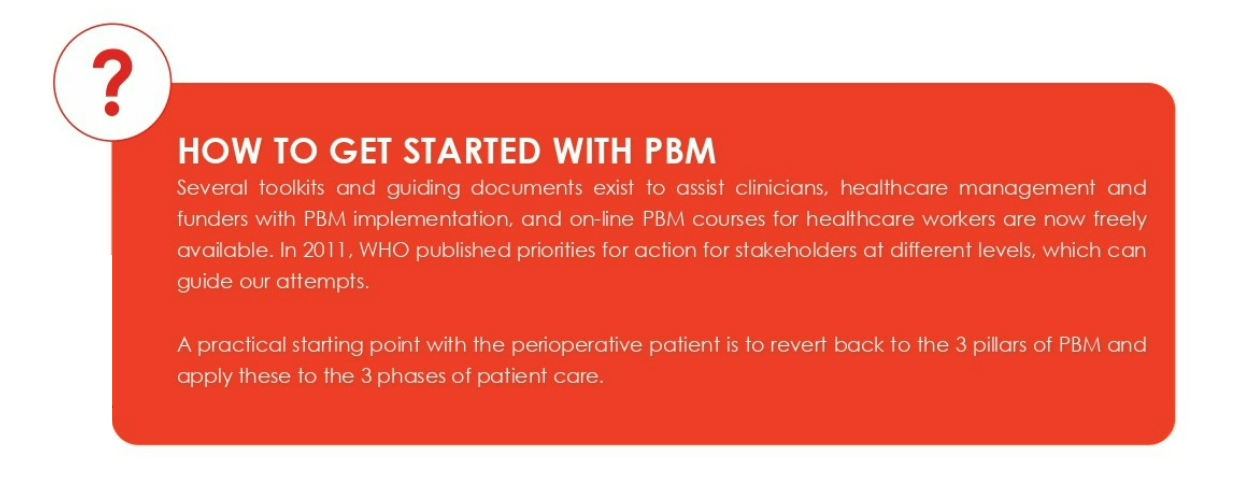
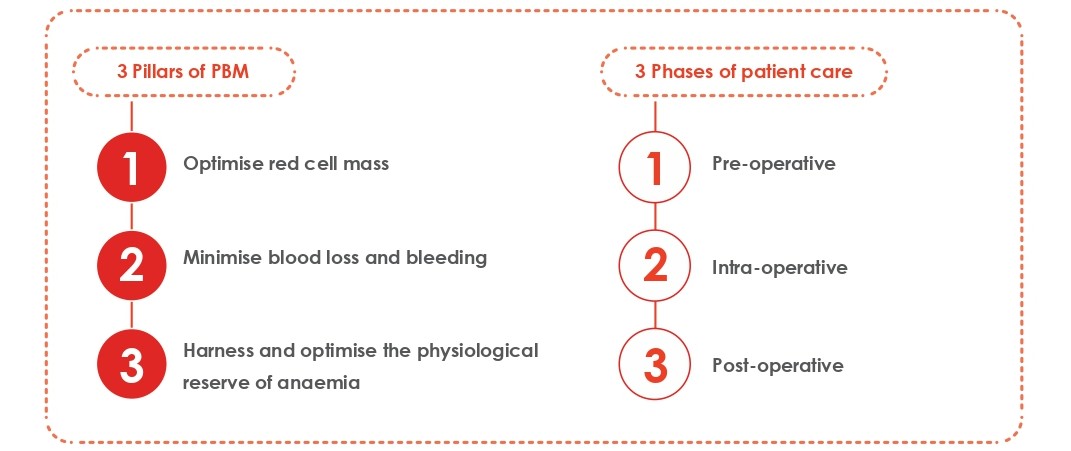
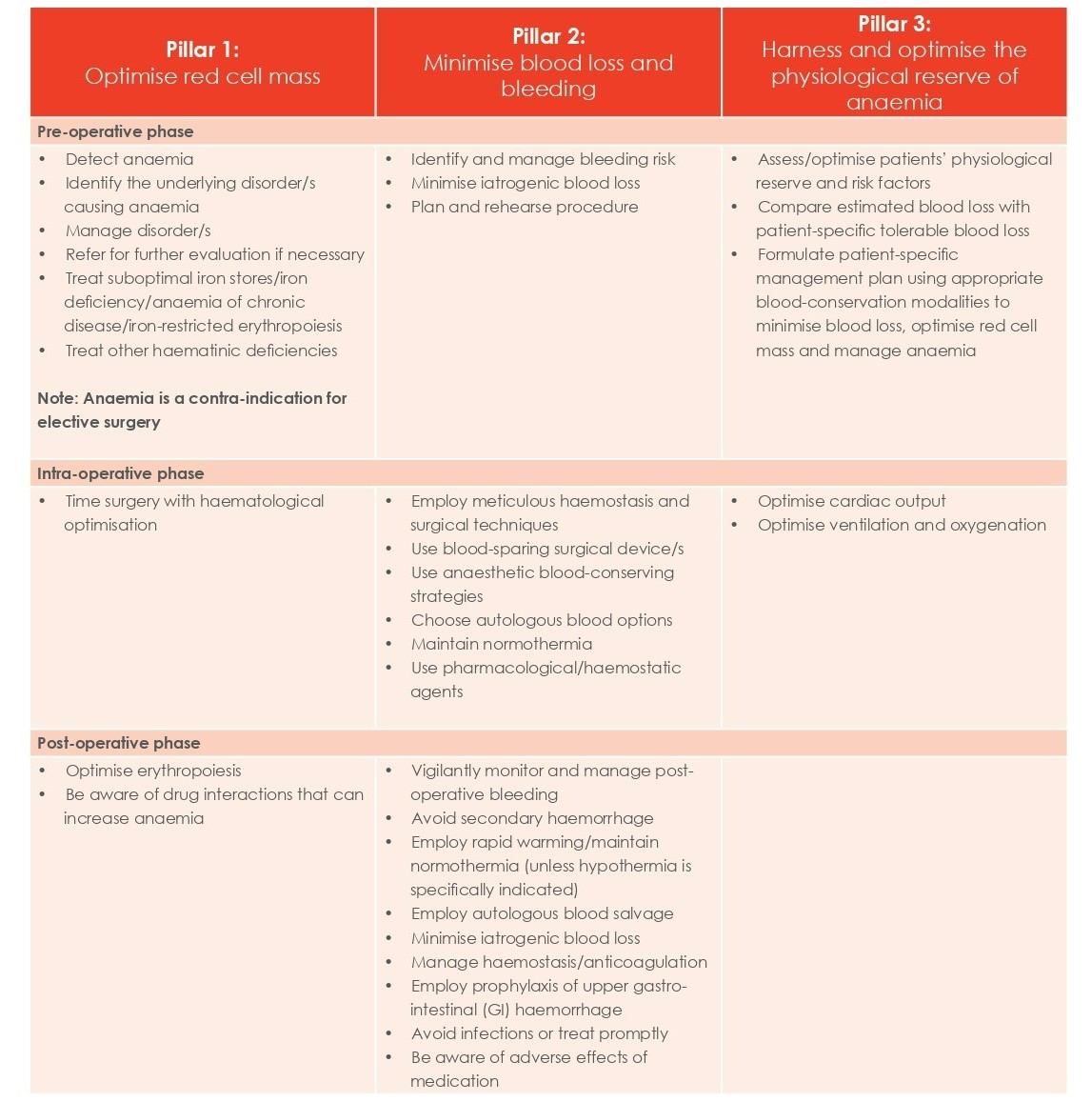
A practical starting point with the perioperative patient is to revert back to the 3 pillars of PBM and apply these to the 3 phases of patient care.
Table 1
Click on table to enlarge
A patient-specific plan, with the individual’s underlying condition/s fully documented, should be developed. One size does not fit all. This patient-specific plan should then be communicated to all role-players and be continuously changed and adjusted throughout the patient’s treatment as required.
Table 2
Click on table to enlarge
Given the importance of anaemia screening, diagnosis and treatment in a successful PBM programme, the value of the primary healthcare level/general practitioners should not be underestimated, nor should they be excluded from the PBM plan.
The availability of alternatives (e.g. cell-saver technology) or pharmaceuticals (e.g. tranexamic acid) should always be considered and strived for, even in rural settings.
Who is responsible for implementing PBM?
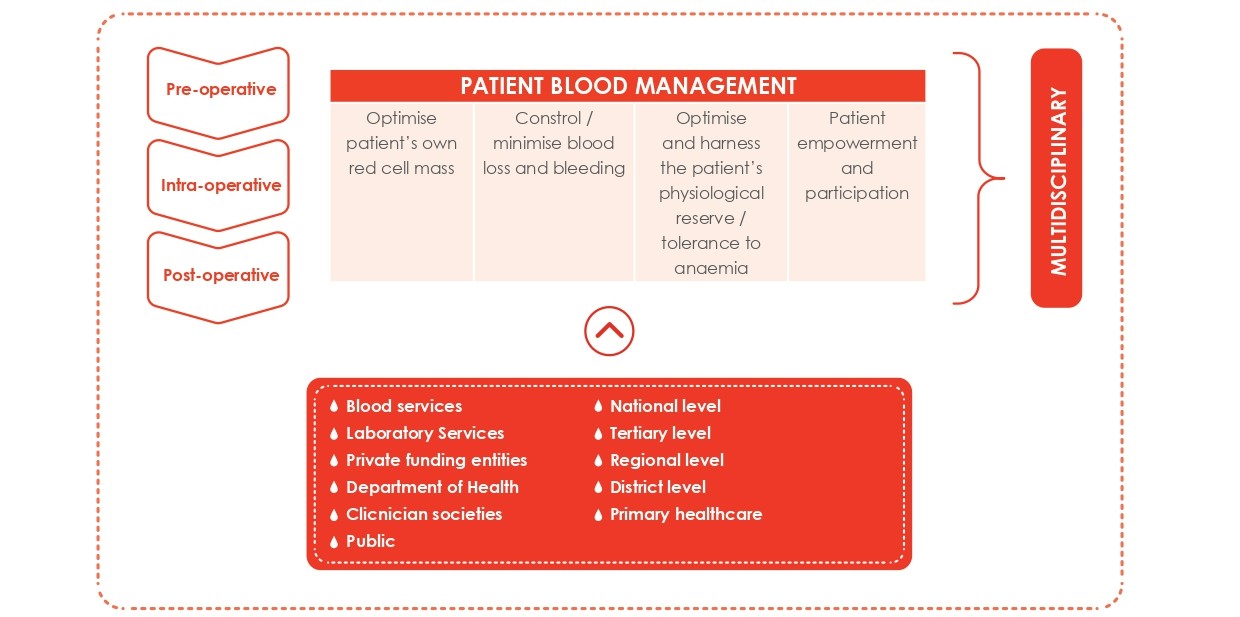
PBM principles and programmes are aimed at improving patient outcomes. As such, it remains the responsibility of all roleplayers in healthcare to contribute to the promotion and implementation of PBM in South Africa.
This is a multidisciplinary, multimodal approach to patient care and involves a variety of role-players, situated at different levels of healthcare:
Click on image to enlarge
How to monitor a PBM programme
Successful PBM programmes look beyond the mere availability of guidelines, to having effective monitoring and feedback systems in place.
The data to be monitored will depend on several factors:
- Which plan/template are you implementing for your PBM programme, e.g. SABM (Society for the Advancement of Patient Blood Management) standards, WHO priorities for action or AABB (Association for the Advancement of Blood & Biotherapies) implementation plan?
- What are the priorities in your specific setting?
- Where are you in your implementation plan – initial stage or advanced stage?
- What resources are available?
- To what extent is data in your setting captured (and available) electronically vs manually?
The quality of the data entered in your monitoring system (whether manual or electronic) will heavily impact on the success of your monitoring efforts. This principle should be communicated to all levels of stakeholders involved in your PBM programme.
Feedback platforms/discussion groups form a crucial part of a PBM programme. Representatives of your blood-using departments, pharmacies, management, nursing services and supply chain should take part in this forum. Representation from your local blood services will also add value to your discussions, as they form part of the multidisciplinary team involved in PBM.
PBM in a resource-constrained setting: Do we wait for "more" or do we start?
Even in a resource-constrained setting, it is possible to start with a simplified PBM programme. The goal is to start small, grow slowly and not leave any stakeholders behind. Even a simplified programme is a start towards improved patient safety and outcomes.
There are ample guiding documents, toolkits and educational materials available to guide you on this important journey.
Further reading
- World Health Organization. Global Forum for Blood Safety: Patient Blood Management: concept paper. March 2011. Accessed March 13, 2023. https://cdn.who.int/media/docs/default-source/biologicals/blood-products/document-migration/gfbs_01_pbm_concept_paper.pdf?sfvrsn=f189661_3
- Sixty-third World Health Assembly. Availability, safety and quality of blood products. 21 May 2010. Accessed March 7, 2023. https://apps.who.int/ gb/ebwha/pdf_files/WHA63/A63_R12-en.pdf
- Action framework to advance universal access to safe, effective and quality-assured blood products 2020–2023. World Health Organization. 19 February 2020. Accessed March 7, 2023. https://www.who.int/publications/i/item/action-framework-to-advance-uasbloodprods-978-92-4-000038-4
- Society for the Advancement of Patient Blood Management. SABM administrative and clinical standards for Patient Blood Management Programs®. 5th edition. 2019. Accessed March 7, 2023. https://sabm.org/wp-content/uploads/SABM-Standards-20196.pdf
- Patient Blood Management resources. International Foundation for Patient Blood Management. Accessed March 7, 2023. https://www.ifpbm.org/knowledge
- Patient blood management. Association for the Advancement of Blood & Biotherapies. Accessed March 7, 2023. https://www.aabb.org/newsresources/resources/patient-blood-management
- Thomson J, Hofmann A, Barrett CA, et al. Patient blood management: a solution for South Africa. S Afr Med J. 2019;109(7):471-476. doi:10.7196/SAMJ.2019.v109i7.13859
- GBD 2016 Disease and Injury Incidence and Prevalence Collaborators. Global, regional, and national incidence, prevalence, and years lived with disability for 328 diseases and injuries for 195 countries, 1990-2016: a systematic analysis for the Global Burden of Disease Study 2016. Lancet. 2017;390(10100):1211-1259. doi:10.1016/S0140-6736(17)32154-2
- Marsicano D, Hauser N, Roodt F, et al. Preoperative anaemia and clinical outcomes in the South African surgical outcomes study. S Afr Med J. 2018;108(10):839-846. doi:10.7196/SAMJ.2018.v108i10.13148
- Tunkyi K, Moodley J. Prevalence of anaemia in pregnancy in a regional health facility in South Africa. S Afr Med J. 2015;106(1):101-104. doi:10.7196/SAMJ.2016.v106i1.9860
- Shander A, Van Aken H, Colomina MJ, et al. Patient blood management in Europe. Br J Anaesth. 2012;109(1):55-68. doi:10.1093/bja/aes139
- Wise R, Bishop D, Gibbs M, et al. South African Society of Anaesthesiologists perioperative patient blood management guidelines 2020. Southern African Journal of Anaesthesia and Analgesia. 2020;26(6):S1-68. https://www.sajaa.co.za/index.php/sajaa/article/view/2496
- Leahy MF, Hofmann A, Towler S, et al. Improved outcomes and reduced costs associated with a health-system-wide patient blood management program: a retrospective observational study in four major adult tertiary-care hospitals. Transfusion. 2017;57(6):1347-1358. doi:10.1111/trf.14006
- Althoff FC, Neb H, Herrmann E, et al. Multimodal Patient Blood Management program based on a three-pillar strategy: a systematic review and meta-analysis. Ann Surg. 2019;269(5):794-804. doi:10.1097/SLA.0000000000003095
- Frietsch T, Shander A, Faraoni D, et al. Patient Blood Management is not about blood transfusion: it is about patients’ outcomes. Blood Transfus. 2019;17(5):331-333. doi:10.2450/2019.0126-19
- Rhamy, J. The benefits of Patient Blood Management for the patient and the health care system. Association for the Advancement of Blood & Biotherapies. Accessed March 7, 2023. https://www.aabb.org/docs/default-source/default-document-library/resources/pbm-the-benefits-ofpbm-for-the-patient-and-the-health-care-system.pdf?sfvrsn=3ccf0957_4
- Meybohm P, Straub N, Füllenbach C, et al. Health economics of Patient Blood Management: a cost‐benefit analysis based on a meta‐analysis. Vox Sang. 2020;115(2):182-188. doi:10.1111/vox.12873
- Meybohm P, Richards T, Isbister J, et al. Patient blood management bundles to facilitate implementation. Transfusion Medicine Reviews. 2017;31(1):62-71. doi:10.1016/j.tmrv.2016.05.012
- Hofmann A, Spahn DR, Holtorf AP, et al. Making patient blood management the new norm(al) as experienced by implementors in diverse countries. BMC Health Serv Res. 2021;21(1):634. doi:10.1186/s12913-021-06484-3
- National Blood Authority Australia. Three pillars of patient blood management. Accessed March 7, 2023. https://www.blood.gov.au/system/files/documents/pbm-3-pillars.pdf
- World Health Organization. Global Forum for Blood Safety: Patient Blood Management: priorities for action. March 2011. Accessed March 13, 2023. https://cdn.who.int/media/docs/default-source/biologicals/blood-products/document-migration/who_gfbs_2011_03_priorities_for_action.pdf?sfvrsn=656b7d95_3
- Mehra T, Seifert B, Bravo-Reiter S, et al. Implementation of a patient blood management monitoring and feedback program significantly reduces transfusions and costs. Transfusion. 2015;55(12):2807-2815. doi:10.1111/trf.13260
Clinical Guidelines for the Use of Blood and Blood Products in South Africa, 6th Edition, 2023