Peritonsillar Abscess (Quinsy)
Peritonsillar Abscess
Basics
Clinical presentation
Physical examination
Dangers and complications
Special investigations
Management
General supportive care
Drainage of pus
Needle aspiration
Consider antibiotics
Whom to admit
Drug doses
Also called Quinsy’s abscess, a peritonsillar abscess (PTA) is a suppurative infection surrounding the tonsillar capsule.
Basics
It is the most common deep neck infection and can affect all ages, but is most common in young adults. It often starts as a streptococcal infection but soon becomes polymicrobial.
Clinical Presentation
Patients usually presents with a sore throat, odyno/dysphagia and a feeling of fullness in the throat. The patient may be systemically ill in more severe cases.
Physical Examination
The typical finding is unilateral peritonsillar swelling that displaces the uvula away from the affected side. The mucosa is usually reddened and you may see yellow pus.
Other findings may include trismus (inability to open the mouth), cervical lymphadenopathy and the inability to swallow leading to drooling. Important findings that may indicate airway compromise are change in voice character and noisy or uncomfortable breathing.
Dangers and Complications
If treated correctly PTA is rarely associated with severe complications. Incorrect diagnosis and delayed / incorrect treatment may lead to life threatening complications.
The most dangerous complications are:
- Airway compromise
- Systemic sepsis
- Deep space neck infection
Other complications include:
- Difficulty eating or drinking
- Recurrent infection
- Local extension
- Jugular vein thrombosis
If you suspect any of the above complications refer the patient to a centre that can deal with it as soon as possible. This usually implies referral to an ENT surgeon.
Special Investigations
The diagnosis of a PTA is usually clinical, with confirmation when pus is aspirated from the abscess.
Occasionally further investigations may be needed.
Discuss with an ENT surgeon if:
- The mouth cannot be opened
- You are concerned about the airway
- You suspect deep neck space sepsis
- You suspect a tumour or other diagnosis
- The PTA is recurrent
- Your initial treatment fails
- The patient is systemically unwell
Also consider referral to a higher centre level of care if the patient exhibits evidence of systemic sepsis. Do NOT delay administration of systemic antibiotics if this is the case.
Investigations that may be considered are CT scan of the neck; ultrasound (intra-oral or trans-cutaneous) of the neck or endoscopy.
CT scanning is useful if there is a suspicion of deep spread of the infection & when the mouth cannot be opened. Intra-oral ultrasound may be used to identify the location of the pus collection, thereby confirming the diagnosis & guiding aspiration.
You should collect a pus sample for culture only if the infection is recurrent or does not clear with conventional therapy.
Management
Management consists of three important components:
- General supportive care
- Drainage of pus
- Antibiotic therapy
General Supportive Care
A PTA can be very painful. Offer your patient strong analgesia. They may need parenteral analgesia with an opiate such as morphine in severe cases.
These patients are often dehydrated due to the difficulty swallowing & increased insensible losses. They often need IV rehydration.
A single dose of steroids has been shown to promote more rapid recovery. Dexamethasone PO or IM is appropriate
Drainage of Pus
Drainage of pus is both diagnostic & therapeutic. You can use needle aspiration or incision & drainage. Cure rates are similar but needle aspiration is usually easier & safer & should be your first line of treatment.
Needle Aspiration
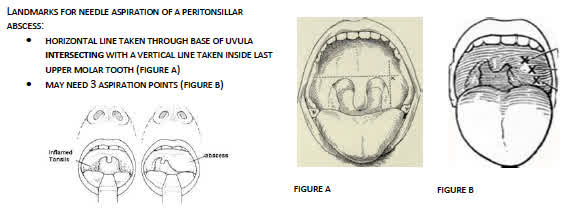
To identify where to insert the needle, look for the area of maximal fluctuation.
Explain the procedure to the patient. Have them seated in a comfortable position with their head back against a solid surface to reduce the chance of involuntary jerking. Anaesthetise the area with lignocaine spray – this can often be found on your resuscitation trolley.
The carotid artery is only about to 2 to 2,5cm away, so make a needle shield by trimming the needle cap as shown, leaving about 0,5 to 1cm of needle exposed.
Insert the needle & aspirate as much pus as you can. This usually provides significant relief.
Consider Antibiotics
Antibiotic therapy is indicated to hasten recovery & reduce the risk of recurrence.
If the patient can swallow:
- Augmentin OR
- PenVK AND Metronidazole OR
- Erythromycin OR
- Clindamycin
If not, admit & use IV antibiotics:
- Same as above
Remember to include good analgesia & an antiseptic throat gargle in the discharge medication.
Whom to Admit
Indications for admission include:
- Inability to swallow / dehydration
- Needs IV fluid or treatment
- Systemically ill patients / Sepsis
- Deep space neck infection
- Airway compromise
Drug Doses
Antibiotic treatment duration should be 10 to 14 days to reduce the risk of recurrence
These doses are a guideline only. Always consult an up to date drug reference like the SAMF.
- Augmentin 1g PO/IV bd
- Penicillin VK 500mg PO (25 - 50mg/kg) q6hr
- Penicillin G 1 -4 MU IV (25000 - 50000 units/kg) q6hr
- Clindamycin 600-900mg PO/IV tds (8-16 mg/kg)
- Erythromycin 500mg (25 – 50mg/kg) PO q6hr
- Metronidazole 400mg PO/PR/IV q 8hr
- Dexamethasone 10mg PO/IM once
References
- Khayr W et al. Management of peritonsillar abscesses: Needle aspiration versus tonsillectomy. Am J Ther. 2005;12(4):344-350.
- Marx JA et al. Rosen’s Emergency Medicine: Concepts and clinical practice, 7th ed. St. Louis, MO: Mosby; 2009