Personal Protection Equipment
SADA COVID-19 Guidelines, May 2020
Key Concerns Regarding the Use of PPE
Key Basic Policies for Use of PPE in Health Care Settings
General Guidelines on Putting on (Donning) and Removing (Doffing) PPE
Sequence for Putting on (Don, Donning) and Removing (Doff, Doffing) PPE
Sequence for Putting on Personal Protective Equipment (Donning) - Non-sterile
Guidance on Use of N95 Respirators
Sequence of Postoperative Removal of PPE (Doffing) - Non-sterile
Guidance for Training of Dental Health Care Providers in Appropriate Use of PPE
Summary PPE: Standards on PPE and Decontamination Procedures Required for COVID-19 Pandemic
The implementation and use of appropriate PPE have been highlighted by the COVID-19 crisis. This is the most rapidly changing and adaptive field in the medical and dental fraternity at present. We aim to provide the most current information and recommendations. It must be borne in mind that this can rapidly change and refer to the latest scientifically tested research, should these be available after the publishing of this document (May 2020). As a general rule, we would caution against any untested or non-scientific evidence. This could not only be harmful or detrimental to you because of a false sense of security wearing inappropriate or standard equipment. It could also damage the profession as a whole, as well as the patients and country we serve. Refer to the accredited suppliers and standards list as an appendix to this document. The updated version of this document on SADA site should be referred to as it needs constant updating—at least until a vaccination is produced and herd immunity is achieved.
Key Concerns Regarding the Use of PPE
Many concerns regarding complying in dentistry to PPE protocols exist. The most compelling being cost, availability and reuse (https://www.ncbi.nlm.nih.gov/pubmed/30738757).
Several studies have reported a lack of compliance among dental care providers for not using appropriate PPE for infection control. Common reasons cited were: (i) policies and practices were inconsistent, (ii) PPE was not available in many facilities and its use was limited to high-risk situations, (iii) face masks and gloves were the most commonly used PPE to protect from respiratory and other infection, (iv) compliance with PPE use was low and reuse was common, (v) lack of training in proper use and knowledge on when and what PPE to use, as well as the cost implications of complying with appropriate PPE use (Chughtai, Khan, 2020; Anagnostopoulos-King, Rodriques, 2020).
PPE supplies are currently constrained due to increased usage, panic buying and closure of borders. To avoid depletion of PPE supplies, we endorse optimal use of the correct safety equipment.
Key Basic Policies for Use of PPE in Health Care Settings
The standard of dental care infection control and associated occupational safety and health regulations worldwide are very similar, although some specific differences exist. These regulations directly impact OHC facilities. In South Africa, this is set by the Department of Health.(https://www.idealhealthfacility.org.za/docs/Manuals-and Handbooks/Practical%20Manual%20for%20implementation%20of%20the%20National%20IPC%20Strategic%20Framework%20March%202020.pdf ). Other, often referred to instances are: CDC (https://www.cdc.gov/mmwr/preview/mmwrhtml/rr5217a1.htm), European Centre for Disease Prevention and Control (https://www.ecdc.europa.eu/sites/default/files/documents/novel-coronavirus-personal-protective-equipment-needs-healthcare- settings.pdf ) and others.
Whilst there are differences in the standard of care for OHC Infection control globally, most countries follow the same basic policies and procedures, namely that of the CDC (Kohn, Collins, Cleveland, 2003), European Centre for Disease Prevention and Control (ECDC, 2020), and Organisation for Safety Asepsis and Prevention (OSAP, 2020) to promote the safety of patients and staff, and OHC providers. The Occupational Safety and Health Administration’s places OHC providers in the very high exposure risk category (CDC, 2020). In South Africa, infection prevention and control policies are defined in the recently approved Practical Implementation Manual (Department of Health, 2020).
Clear guidelines on the availability and use of PPE are needed to avoid inappropriate practices that could result in spread of infection and compromise the safety of patients, staff and dental practitioners. OHCW’s are referred to the linked SADA document.
Clear guidelines do not exist, but we report on our opinion of the world gold standard and how it should be adapted to South African conditions. See below for specific procedural implications.
Our recommendations, based on worldwide scientific evidence and general standard practice opinions, were adapted to the South African dental community. We recognise that there are apparent disparities within the practices of South African dental practitioners. We endeavour to supply a recommendation that should be seen as the standard for the average dentist practising within the limits of South Africa and conclude with a minimum and aspired to levels of PPE use (https://www.gov.uk/government/publications/wuhan-novel-coronavirus-infection-prevention-and-control/managing-shortages-in- personal-protective-equipment-ppe).
We recommend PPE for use in the following categories:
Protection of:
- Head:
a. Skull—The parts normally be covered by hair, inclusive of hair protection
b. Face—Skin normally visible
c. Eyes—Including aids that are generally worn to correct or improve vision (glasses,loupes, microscopes, etc.)
d. Nose
e. Mouth - Neck
- Body—including limbs, but excluding hands
- Hands
Although the best possible options regarding PPE will be provided, these recommendations have no impact if the PPE is not correctly used. OHC providers and staff should be educated on the proper fit, use, cost and disposal of the products used. Always follow the manufacturer’s guidelines, but we also suggest viewing the following links to videos and recommendations, especially for PPE that we are not used to wearing as standard operating procedures pre-covid-19.
https://www.cdc.gov/niosh/npptl/hospresptoolkit/training.html
https://youtube/oxdaSeq4EVU
https://www.cdc.gov/niosh/npptl/hospresptoolkit/training.html.
It is critical that dental health care providers are trained properly so that they (i) know the technical requirements when procuring PPE, (ii) be aware of the critical aspects and known pitfalls when using PPE, (iii) understand staff protection as a combined approach, which is not based on PPE alone, and (iv) strengthen occupational safety and health within the practice setting (ECDC, 2014) (https://www.ecdc.europa.eu/sites/default/files/media/en/publications/Publications/safe-use-of-ppe.pdf).
General Guidelines on Putting on (Donning) and Removing (Doffing) PPE
The correct way to don and doff is essential to secure your safety. This is best illustrated by means of graphics and video. These cannot be accepted as known entities and should be trained and practised (even experienced surgeons need to complete this education)
https://youtube/06u0HyFUhAI
https://youtube/vrrGyWSbEgI
https://www.cdc.gov/hai/pdfs/ppe/PPE-Sequence.pdf
This poster demonstrates the sequence for donning and removing PPE. The poster provides key instructions to reinforce safe practices that to limit the spread of contamination
Sequence for Putting on (Don, Donning) and Removing (Doff, Doffing) PPE
Donning and doffing correctly are essential to secure your safety. This is best illustrated by means of graphics and video. These aspects of putting on and removal of protective clothing cannot be accepted as known entities and should be trained and practised (even experienced surgeons need to complete this education)
https://youtube/06u0HyFUhAI
https://youtu.be/vrrGyWSbEgI
English Version, 8.5′′ x 11′′ size pdf icon [PDF – 2.85 MB]
https://www.cdc.gov/hai/pdfs/ppe/PPE-Sequence.pdf
PowerPoint ppt
Trainers Information
Sequence for Putting on Personal Protective Equipment (Donning) - Non-sterile
- Hand hygiene
- Put on gown
- Put on mask/respirator
- Put on eye protection
- Put on gloves
(Source: Ontario Public Health)
How to Fit a Respirator Mask
Respirator masks must be correctly fitted to be effective. When placing the respirator mask, make sure it has a tight seal. Mould (do not pinch) the respirator mask over the bridge of the nose. Breathe out against the resistance of the respirator and check for any air leaking from the side. Breathe in and again make sure there is no air entering the mask from the side. Facial hair prevents a good seal and should be shaved off (Source: SASA recommendations for appropriate PPE).
Guidance on Use of N95 Respirators
OHC workers treating patients known to be symptomatic or suspected of being infected with SARS- CoV-2 and those performing AGPs are required to use N95 respirators (https://www.osha.gov/Publications/OSHA3990.pdf). Face shields may also be worn on top of a respirator to prevent bulk contamination of the mask.
When disposable N95 respirators are not available, consider using other respirators that provide greater protection and improve worker comfort e.g. R/P95, N/R/P99, or N/R/P100 filtering facepiece respirators or other devices. CDC strategies for optimising supply of N95 respirators, 2020) (https://www.cdc.gov/coronavirus/2019-ncov/hcp/respirators-trategy/index.html).Consider factors such as function, fit, ability to decontaminate, disposal and cost.
Respirator training should address selection, use (including donning and doffing), proper disposal or disinfection, inspection for damage, maintenance and the limitations of respiratory protection equipment (https://www.cdc.gov/niosh/npptl/hospresptoolkit/training.html).
Sequence of Postoperative Removal of PPE (Doffing) - Non-sterile
- Remove shoe covers (last procedure-AGP)
- Remove outer gloves followed by hand hygiene
- Remove disposable plastic gown followed by hand hygiene
- Remove eye protection
- Remove mask/respirator and perform hand hygiene. When removing the respirator, touch
- only the straps and not the respirator itself.
- Remove head cover followed by hand hygiene (source: Ontario Public Health)
- Since the virus tends to remain in airborne particles, it is recommended not to remove PPE
- prior to exiting the contaminated room.
- After each procedure, all PPE should be removed and high-level disinfection performed.
- Disinfection of eye glasses and shields with 70% isopropyl alcohol or HOCL
- Discard disposables and medical waste into appropriate containers.
Adaption To OHC workers
- OHC work requires very fine dexterity to do their normal work. This is very difficult or impossible with two pairs of gloves.
- It is suggested to alter the donning and doffing method to allow an OHC worker to only use a single pair of gloves.
- Only a single pair of gloves is donned, after the procedure, hand hygiene is followed as per normal. A new pair of gloves is donned over the used pair, the doffing procedure is then followed as normal. This would allow the OHC worker to function as normally with a single pair of gloves. (https://www.cdc.gov/coronavirus/2019-ncov/downloads/A_FS_HCP_COVID19_PPE.pdf)
Guidance for Training of Dental Health Care Providers in Appropriate Use of PPE
It is critical that dental health care providers are trained properly so that they: (i) know the technical requirements when procuring PPE, (ii) be aware of the critical aspects and known pitfalls when using PPE, (iii) understand staff protection as a combined approach, which is not based on PPE alone, and (iv) strengthen occupational safety and health within the practice setting (ECDC, 2014).
Extended Use and Reuse
It must be stressed that extended and reuse are applied only according to CDC recommendations in an emergency situation, such as the COVID-19 pandemic coupled with a shortage problem, problems we face currently (https://www.fda.gov/media/135763/download). This should, however, not be seen as a cost- saving measure to circumvent the standard of care.
Extended and reuse is not recommended for any aerosol-producing procedure. In aerosol-producing procedures, N95 respirator masks are indicated as single-use disposable items (https://www.cdc.gov/niosh/topics/hcwcontrols/recommendedguidanceextuse.html#risksextended).
When disposable N95 respirators are not available, consider using N95 equivalent or other respirators that provide greater protection and improve worker comfort (e.g. R/P95, N/R/P99 or N/R/P100 filtering facepiece respirators). CDC strategies for optimising the supply of N95 respirators (2020) can be found at https://www.cdc.gov/coronavirus/2019-ncov/hcp/respirators-strategy/index.html.
Definition of Extended Use
Extended use refers to the practice of wearing the same N95 (or equivalent) respirator for repeated close contact encounters with several patients, without removing the respirators between patient encounters.
Usage Recommendations
Extended use may be implemented when multiple patients infected with SARS-CoV-2 are treated consecutively in a designated high-risk room. We are acutely aware of the different profiles of OHC facilities in South Africa. Those OHC facilities that are limited to the relief of pain and sepsis could qualify for this usage, with the provision of refraining from AGPs. Thus, they should not make use of a hand piece to aid in/simplify the removal of teeth and drainage of abscesses. These procedures should be limited to manual means, thus extraction pinsets and root removals with the use of elevators, periotomes, etc. Removable stitches should be used if possible. The mask must further be protected with a face shield. This is also relevant to dental therapists. These practices would most often also be located in rural or naturally well-ventilated areas, in line with our ventilation recommendations.
Scrutiny of measures—with stringent controls—on the fit and efficacy of these masks must be imposed by the principal OHC provider in charge during the time period; masks must be exchanged once compromised. Many health care deaths are attributed not to contracting the virus but to a very high viral load, such as those that can be attributed to rebreathing. Thus, in the end, they are self- inflicted.
Once the session is completed, the mask must be discarded; as soon as another shift in the same room starts, a new mask best be donned.
Definition of Reuse
Reuse refers to the practice of using the same N95 respirator for multiple encounters with patients, but it is removed (doffed) after each encounter.
Usage Recommendations
The respirator is stored in between encounters to be put on again (donned) prior to the next encounter with a patient. When N95 (or equivalent) respirator reuse is practised or recommended, such as during non-droplet/aerosol-forming procedures, restrictions such as (Refrain from touching the front of the respirator; limit touch during donning and doffing, to the strings only) are put in place that limit the number of times and in which procedures it can be reused. Thus, N95 (or equivalent) respirator reuse is often referred to as ‘limited reuse’. Limited reuse has been recommended and widely used as an option for conserving respirators in times of limited supply (Beckman, Materna, Goldmacher et al., 2013; Hines, Rees, & Pavelchak, 2014; CDC, 2010; Rebmann, Alexander, Cain et al., 2009; IOM, 2006).
Risk of Reuse During Extended and Reuse Scenarios
- The most significant risk is contact transmission from touching the surfaces of the contaminated respirator. Clean hands with soap and water or an alcohol-based hand sanitiser before and after touching or adjusting the respirator.
- A reused mask would decrease filtration efficiency and promote poor fit. The fit can easily be rechecked, but the inferior efficiency will only be noted when the OHC worker is infected.
- Discard N95 respirators when: (i) contaminated with blood, respiratory or other bodily fluids from patients; (ii) following close contact with any symptomatic or suspect COVID- 19 patient or a patient co-infected with an infectious disease requiring contact precautions except as defined in the extended use category (primary dental primary care clinic in a well-ventilated area).
- Cleanable full face, face shield over an N95 (or equivalent) respirator helps reduce surface contamination of the respirator.
- Follow the manufacturer’s guidelines regarding the maximum number of donning or use they recommend. If no manufacturer guidance is available, preliminary data suggest limiting the number of reuses to no more than 5 per device to ensure an adequate safety margin (Fisher & Shaffer, 2014; Bergman, Viscusi, Palmiero, Powell, & Shaffer, 2012).
- It is recommended that if reuse is practised by an OHC worker in close contact with a patient that the mask is gas sterilised by an approved facility, after each patient. Thus, after use, it is safely stored, sent for sterilisation and reused after sterilisation. This would imply that each OHC worker has a few masks at his/her disposal.
- Instrument holding and pre-cleaning: For instrument cleaning, use a neutral or near- neutral
Recommendations for Reuse in Non-Aerosol-Forming Procedures
Use a pair of clean (non-sterile) gloves when donning a used N95 respirator and performing a user seal check. Discard gloves after the N95 (or equivalent) respirator is donned and checked.
Avoid touching the inside and front parts of the respirator. If inadvertent contact is made with the inside of the respirator, discard the respirator and perform hand hygiene. Place each used respirator in its own designated stored in a breathable paper bag until the next week. This will result in each worker requiring a minimum of five N95 respirators/week if they put on, take off, care, and store those properly each day. This amount of time in between uses should exceed the 72-hour expected survival time for SARS-CoV2 (https://www.cdc.gov/coronavirus/2019-ncov/hcp/respirators-trategy/index.html). If no manufacturer guidance is available, data suggest limiting the number of re- uses to no more than five uses per device to ensure an adequate safety margin. Also, important and paramount to take note, re-use of respirators is not permitted when AGP procedures have been executed. The respirators worn by OHCPs in close proximity of the patient must be handled as disposable and disposed of immediately.
Final and Important Remarks
Hand hygiene and PPE use cannot be seen or practised in isolation in terms of safety, nor are one more important than the other. Infection control measures should be practised according to the standard of care at multiple levels to prevent transmission and to protect patients, staff and dental health care providers.
‘This storm will pass. But the choices we make now could change our lives for years to come’ (Yuval Noah Harari).
Dental clinicians can download the free mobile app: ‘CDC DentalCheck’ to access CDC resources and checklists to assess their practice and to ensure they are meeting the minimum standard expectations for safe care (https://www.cdc.gov/oralhealth/infectioncontrol/dentalcheck.html). For local content also refer to(Oosthuysen 2015; Oosthuysen and Fossey 2015) (http://hdl.handle.net/11462/669) and (http://hdl.handle.net/11462/1565).
Summary PPE
Standards on PPE and Decontamination Procedures Required for COVID-19 Pandemic
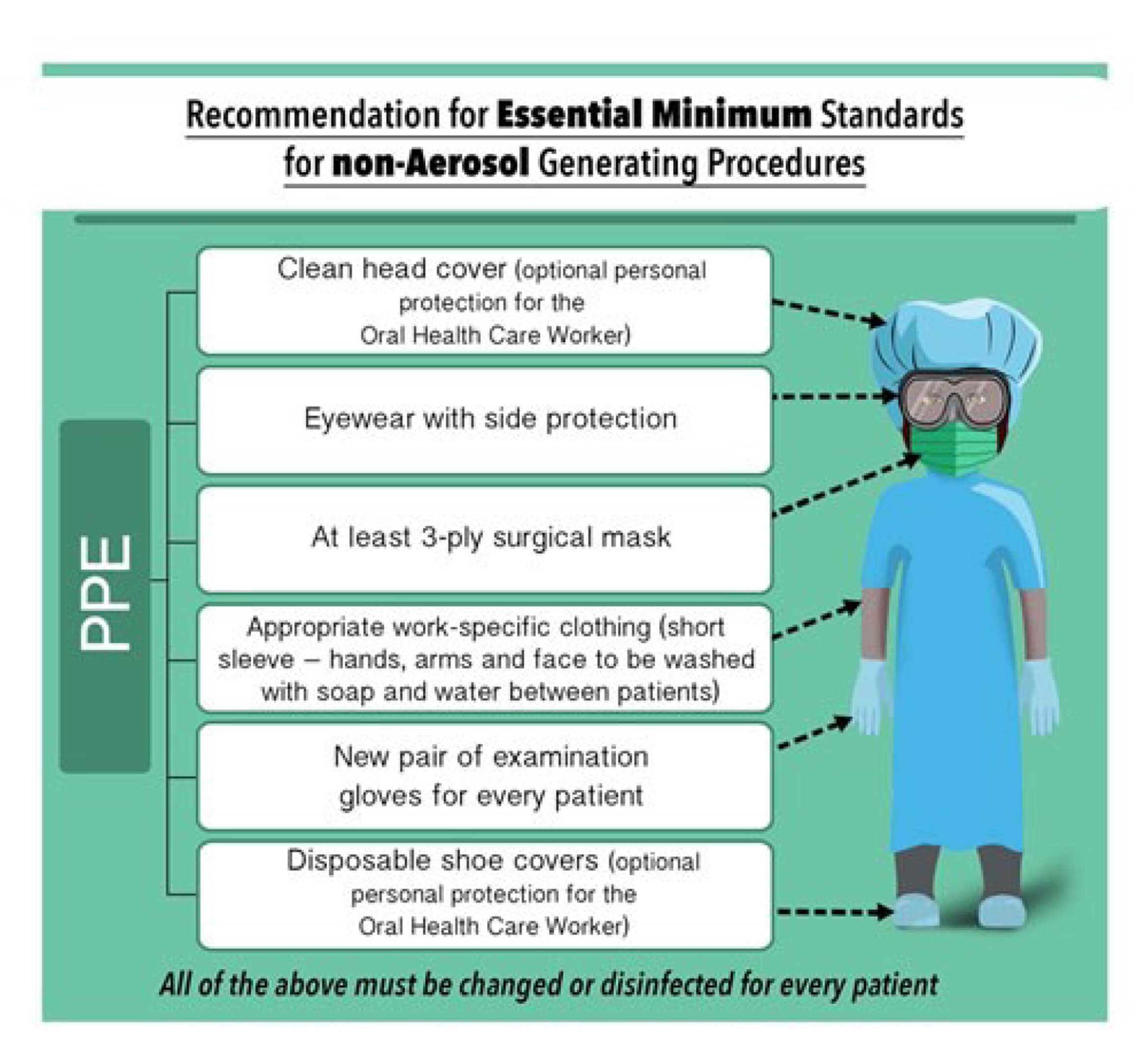
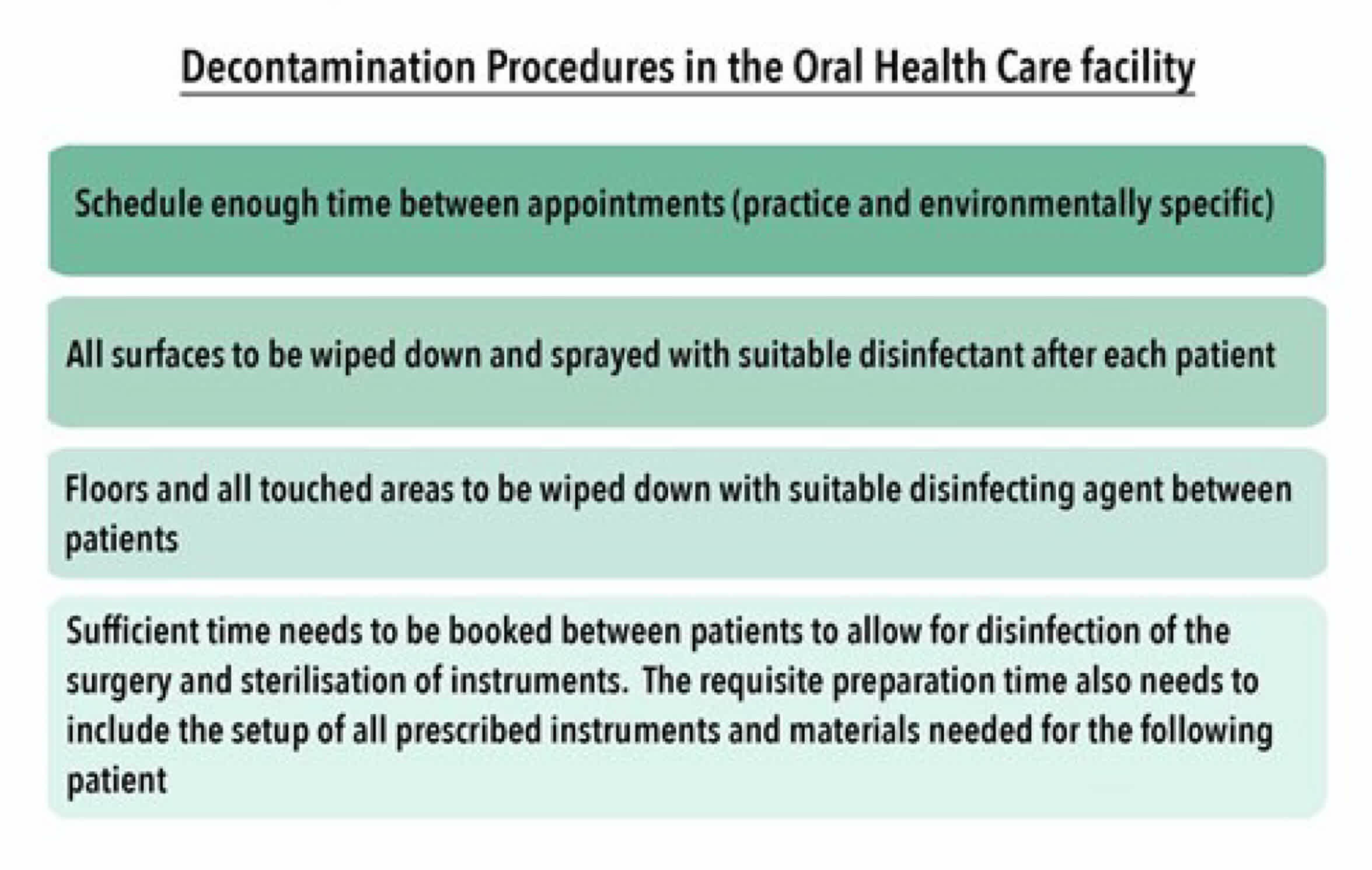
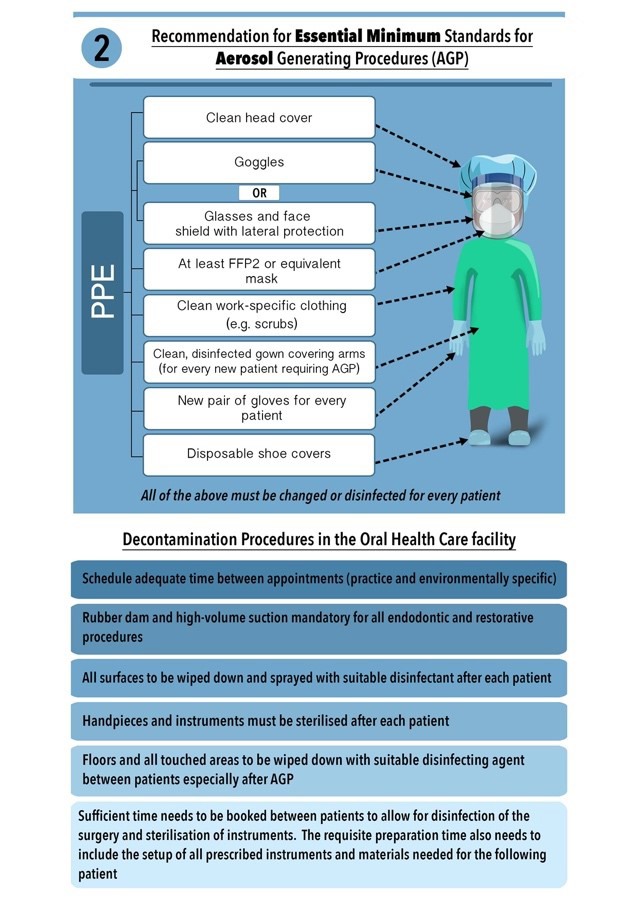
Diagrams 1 and 2 outline the essential minimum standards and decontamination protocols for non- Aerosol and Aerosol procedures. These are the minimum requirements for treating patients during the pandemic in the OHC facility.
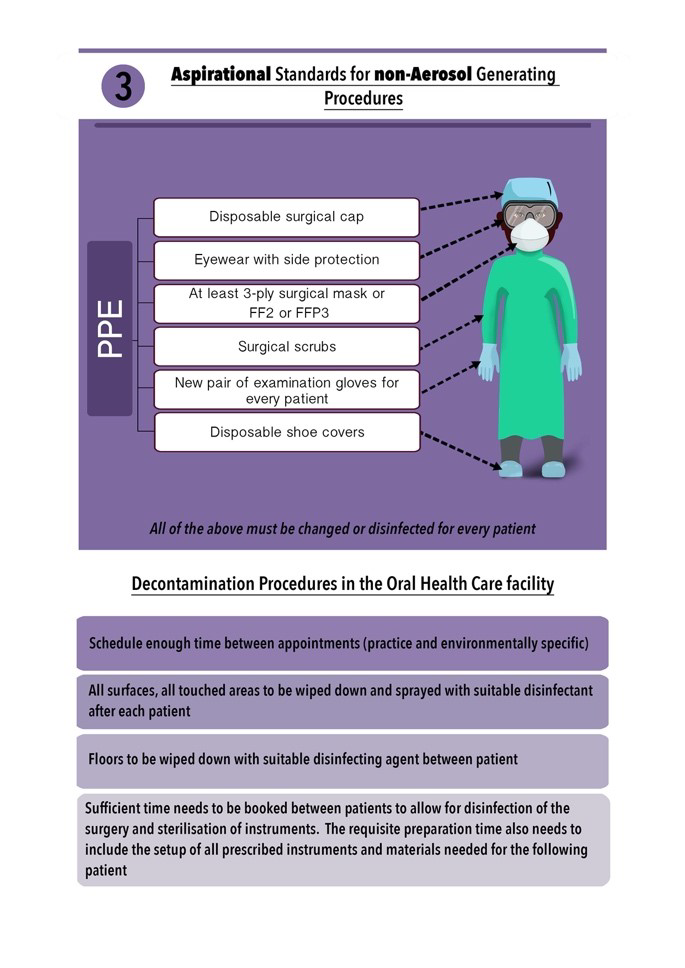
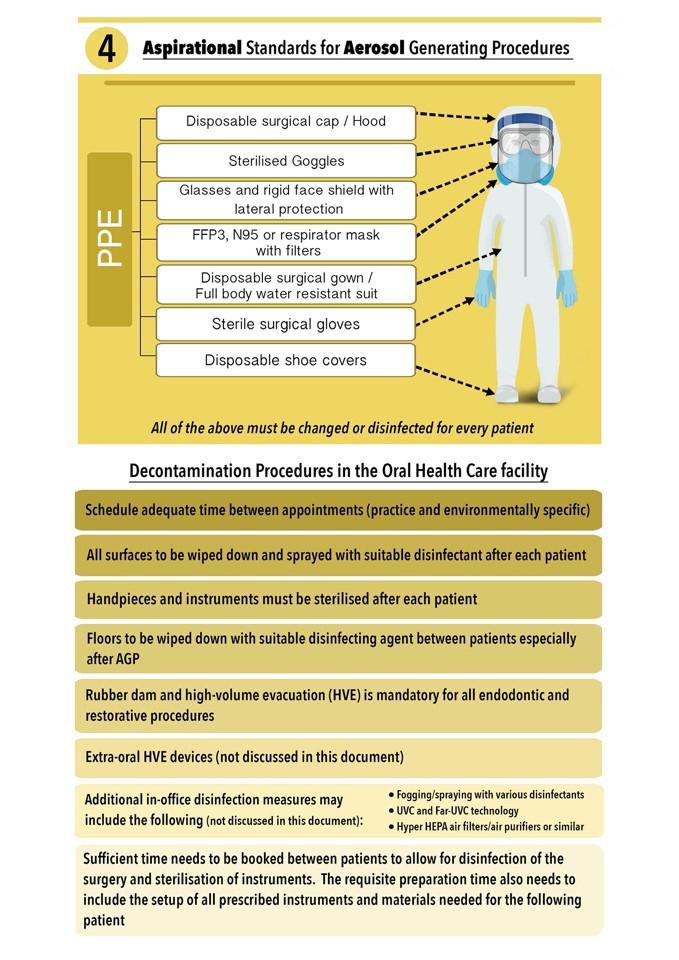
Diagrams 3 and 4 outline aspirational standards and decontamination protocols for non-Aerosol and Aerosol procedures that the OHC facility can employ to upgrade the essential minimum standards for additional personal and patient protection. The reasonable standard of care should be seen between these two levels.
Click on image to enlarge
Diagram 1: Recommendation for essential minimum standards for non-aerosol-generating procedures
Click on image to enlarge
Diagram 2: Recommendation for essential minimum standards for AGPs
Click on image to enlarge
Diagram 3: Aspirational standards for non-aerosol-generating procedures
Click on image to enlarge
Diagram 4: Aspirational standards for AGPs