Pesticides and Rodenticides
Amitraz poisoning Organophosphate poisoning Paraquat poisoning AMITRAZ POISONING T44.4 + (X43.99/X63.99/Y13.99) * Notifiable condition. Poisoning from all pesticides (i.e. agricultural stock remedies) is a notifiable medical condition. Please visit https://nicd.ac.za/nmc-overview/notification-process for further information. DESCRIPTION Amitraz is a pesticide/insecticide with α 2 -adrenergic agon
AMITRAZ POISONING
T44.4 + (X43.99/X63.99/Y13.99)
* Notifiable condition.
Poisoning from all pesticides (i.e. agricultural stock remedies) is a notifiable medical condition. Please visit https://nicd.ac.za/nmc-overview/notification-process for further information.
DESCRIPTION
Amitraz is a pesticide/insecticide with α2-adrenergic agonist properties. It is usually formulated as a tick dip for dogs, cattle, and sheep. Commercial formulations contain up to 20% of amitraz in organic solvents. Poisoning may occur when amitraz is ingested or absorbed via the skin or by inhalation.
A history of an unspecified rat poison or pesticide exposure warrants consideration of other active ingredients such as super-warfarin anticoagulants and organophosphates.
Patients with acute poisoning present with:
- impaired consciousness
- bradycardia
- drowsiness
- respiratory depression
- vomiting
- hypothermia
- hypotension
- generalized seizures
- constricted pupils or rarely, dilated pupils
Other complications include:
- hyperglycaemia
- glycosuria
- mild increase in transaminases
Patients usually regain consciousness within 24 hours.
Note:
Amitraz poisoning can be confused with organophosphate poisoning; whilst amitraz causes central nervous system depression, bradycardia, miosis and respiratory depression, it does not cause excessive sweating and salivation, urinary and faecal incontinence or muscle fasciculation which are seen with organophosphate poisoning. Furthermore, organophosphate toxicity results in reduced serum pseudocholinesterase levels.
GENERAL MEASURES
- Decontamination of skin and clothes where applicable.
- Supportive and symptomatic treatment to maintain patent airway, adequate respiration and circulation.
- Mechanical ventilation may be needed in some cases.
- Keep patient warm.
MEDICINE TREATMENT
- Activated charcoal, once patient is stabilised.
For severe bradycardia: R00.1 + (T44.4 + X43.99/X63.99/Y13.99)
Manage with atropine - See Heart block (second or third degree).
For seizures: R56.8 + (T44.4 + X43.99/X63.99/Y13.99)
Treatment with benzodiazepines - See Status epilepticus.
Note:
Phenytoin should be avoided (due to potential cardiotoxicity).
LoE:IVblxv
ORGANOPHOSPHATE POISONING
T60.0 + (X48.99/X68.99/Y18.99)
* Notifiable condition.
Poisoning from all pesticides (i.e. agricultural stock remedies) is a notifiable medical condition. Please visit https://nicd.ac.za/nmc-overview/notification-process for further information.
DESCRIPTION
Absorption may occur through the skin, gastrointestinal tract if taken orally, or by inhalation.
Patients present with muscarinic and nicotinic manifestations of intoxication.
- Peripheral effects:
- Muscarinic overstimulation: bradycardia, hypotension, salivation, lacrimation, vomiting, diarrhoea, increased bronchial secretions, bronchospasm, and miosis (pinpoint pupils).
- Nicotinic overstimulation: muscle weakness and fasciculations, tachycardia, hypertension, mydriasis (dilated pupils).
- Central effects: coma, confusion, convulsions.
Diagnosis is supported by low serum pseudocholinesterase levels. Intermediate syndrome can occur within 1-4 days after recovery from cholinergic crisis. Patients develop weakness or paralysis predominantly affecting the muscles of respiration (including the neck flexors and bulbar muscles) and proximal limb muscles, sparing the distal muscles. Cranial nerves may also be affected. Supportive care is the mainstay of therapy.
LoE:IIIalxvi
CAUTION
A history of an unspecified rat poison or pesticide exposure warrants consideration of other active ingredients such as super-warfarin anticoagulants and amitraz.
GENERAL MEASURES
- Ensure use of personal protective equipment for staff – gloves, gowns and eye protection. If staff come into contact with body fluids, wash off immediately.
LoE:IIIalxvii
- Decontamination procedures for the patient should only be done once the patient is fully resuscitated.
- Remove patient’s clothes and wash the body with soap and water. Place clothes in closed bags.
- Maintain adequate ventilation and circulation. Ventilatory support in ICU may be required. Suction secretions frequently.
Note:
If using suxamethonium for intubation, consider that metabolism may be delayed and prolonged respiratory support may be required. Use alternative agents if possible (See Muscle relaxants).
MEDICINE TREATMENT
- Activated charcoal, once patient is stabilised.
LoE:IIIalxviii
For bronchorrhoea, bronchospasm or bradycardia:
STEP 1:
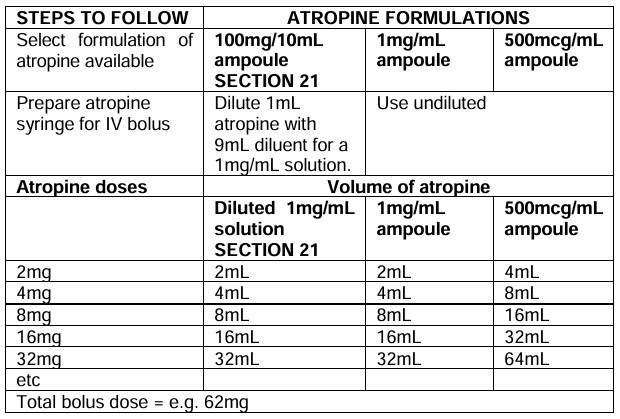
- Atropine bolus, IV, 2 mg.
- Reassess after 3–5 minutes for evidence of atropinisation as indicated by reduced bronchial secretions, dry skin, increasing heart rate and blood pressure, and dilating pupils (note: pupil dilatation may be delayed).
- Give repeated atropine boluses incrementally doubling the dose until adequate clinical response achieved, e.g. 2 mg, 4 mg, 8 mg, 16 mg etc.
- If no clinical response, give double the dose.
- If some response, give the same or reduced dose.
|
ATROPINE : SECTION 21 A high strength formulation (100mg in 10mL) of atropine may be available at select facilities. Confirm the strength available before preparing and administering to the patient. |
Click on the image to enlarge.
STEP 2:
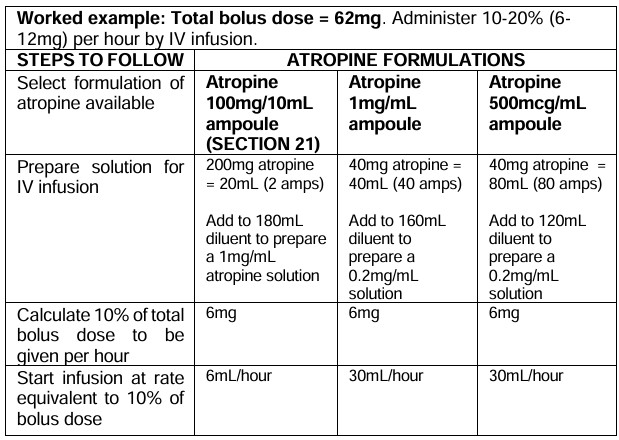
- Atropine IV infusion
- Calculate the total dose of atropine given as boluses. Give 10% of this dose per hour, titrating up to 20% per hour based on clinical response.
Click on the image to enlarge.
- Titrate according to clinical response, by frequent reassessment and adjustments:
- Bronchial secretions, bronchospasm or bradycardia recurs: increase dose.
- Good control of bronchial secretions and signs of atropine overdose (tachycardia, mydriasis, agitation, pyrexia, reduced bowel sounds and urinary retention): decrease dose.
- No recurrence of bronchial secretions and no signs of atropine overdose: reduce dose slowly.
STEP 3 (May be required in some patients)
- Atropine bolus, IV
LoE:IVb- Some organophosphates are lipophilic in nature and cholinergic symptoms may recur even once the atropine infusion is in place. In such cases, repeat bolus doses, starting at 2mg, can be given in addition to the atropine infusion. Bolus doses may be increased incrementally as in Step 1 above.
- Once the patient is restabilised, consider increasing the infusion rate, to 10% of the new total bolus doses i.e.
Infusion rate = 0.1 X (STEP 1 total bolus dose + STEP 3 total bolus dose). - Titrate the infusion rate up to 20% based on clinical response.
Note:
- Do not stop atropine infusion abruptly; instead, wean over at least 24 hours.
- Tachycardia and mydriasis are not contraindications for giving atropine in the acute resuscitation setting.
LoE:IIIalxix
For severe agitation:
- Diazepam, IV, 5–10 mg, immediately.
- Repeat after 30-60 minutes if needed.
LoE:IIIalxx
REFERRAL
Refer if ventilatory support is unavailable.
PARAQUAT POISONING
T60.3 + (X48.99/X68.99/Y18.99)
* Notifiable condition.
Poisoning from all pesticides (i.e. agricultural stock remedies) is a notifiable medical condition. Please visit https://nicd.ac.za/nmc-overview/notification-process for further information.
DESCRIPTION
Paraquat is the most toxic herbicide known, and toxicity causes multi-organ failure which is often fatal. Following oral ingestion, patients present with oral, oesophageal, and gastric erosions with severe gastroenteritis. Multi-organ failure develops within 1–3 days, particularly renal and respiratory failure. Patients surviving the initial phase usually develop pulmonary fibrosis.
GENERAL MEASURES
- Supportive and symptomatic management to maintain patent airway, adequate respiration, and circulation.
- Mechanical ventilation may be needed in some cases.
- Palliative care is the mainstay of treatment.
CAUTION
High inspiratory fraction of inspired oxygen (FiO2) may worsen pulmonary toxicity. Supplemental oxygen should only be provided if the patient is confirmed hypoxic.
MEDICINE TRETAMENT
- Activated charcoal.
Standard Treatment Guidelines and Essential Medicines List for South Africa, Adult Hospital Level, 2020-2024_Version 2.0_27 March 2025
Chapter 19 Poisoning_19.18 Pesticides and Rodenticides
Drugs mentioned
ICD-10 codes
- R00.1Bradycardia, unspecified
- R56.8Other and unspecified convulsions
- T44.4Poisoning, predominantly alpha-adrenoreceptor agonists, not elsewhere classified
- T60.0Toxic effect, organophosphate and carbamate insecticides
- T60.3Toxic effect, herbicides and fungicides
- X43.99Accidental poisoning by and exposure to other drugs acting on the autonomic nervous system, unspecified place, during unspecified activity
- X48.99Accidental poisoning by and exposure to pesticides, unspecified place, during unspecified activity
- X63.99Intentional self-poisoning by and exposure to other drugs acting on the autonomic nervous system, unspecified place, during unspecified activity
- X68.99Intentional self-poisoning by and exposure to pesticides, unspecified place, during unspecified activity
- Y13.99Poisoning by and exposure to other drugs acting on the autonomic nervous system, undetermined intent, unspecified place, during unspecified activity
- Y18.99Poisoning by and exposure to pesticides, undetermined intent, unspecified place, during unspecified activity