Pharmacological Management of RA
DMARDs Glucocorticoids Sequential DMARD Therapy for RA First-Line Therapy: MTX Monotherapy Second-Line Therapy: Combination csDMARD Therapy Third-Line Therapy: MTX plus b/tsDMARD Choice of b/tsDMARD Fourth-LineTherapy: Switching b/tsDMARDs De-escalation of Therapy Analgesics and Anti-Inflammatory Drugs DMARDs These agents are divided into three broad groups: conventional synthetic (csDMARDs), bio
Sequential DMARD Therapy for RA
First-Line Therapy: MTX Monotherapy
Second-Line Therapy: Combination csDMARD Therapy
Third-Line Therapy: MTX plus b/tsDMARD
Fourth-LineTherapy: Switching b/tsDMARDs
Analgesics and Anti-Inflammatory Drugs
DMARDs
These agents are divided into three broad groups: conventional synthetic (csDMARDs), biologic (bDMARDs) and targeted synthetic DMARDs (tsDMARDs).
csDMARDs to treat RA include methotrexate (MTX), leflunomide (LEF), sulfasalazine (SSZ) and antimalarials (AMAs) (Table 4).
bDMARDs may be either biologic original (boDMARDs) or biosimilar (bsDMARDs). Among the bDMARDs registered for use in RA in SA, four are tumour necrosis factor inhibitors (TNFis): receptor blockers (etanercept (original and biosimilar)) or monoclonal antibodies (infliximab (original and biosimilar)), adalimumab (original and biosimilar) and golimumab; and three non-TNFis: ritixumab (original and biosimilar), tocilizumab and abatacept.
tsDMARDs include the Janus kinase (JAK) inhibitors tofacitinib, baricitinib and upadacitinib.
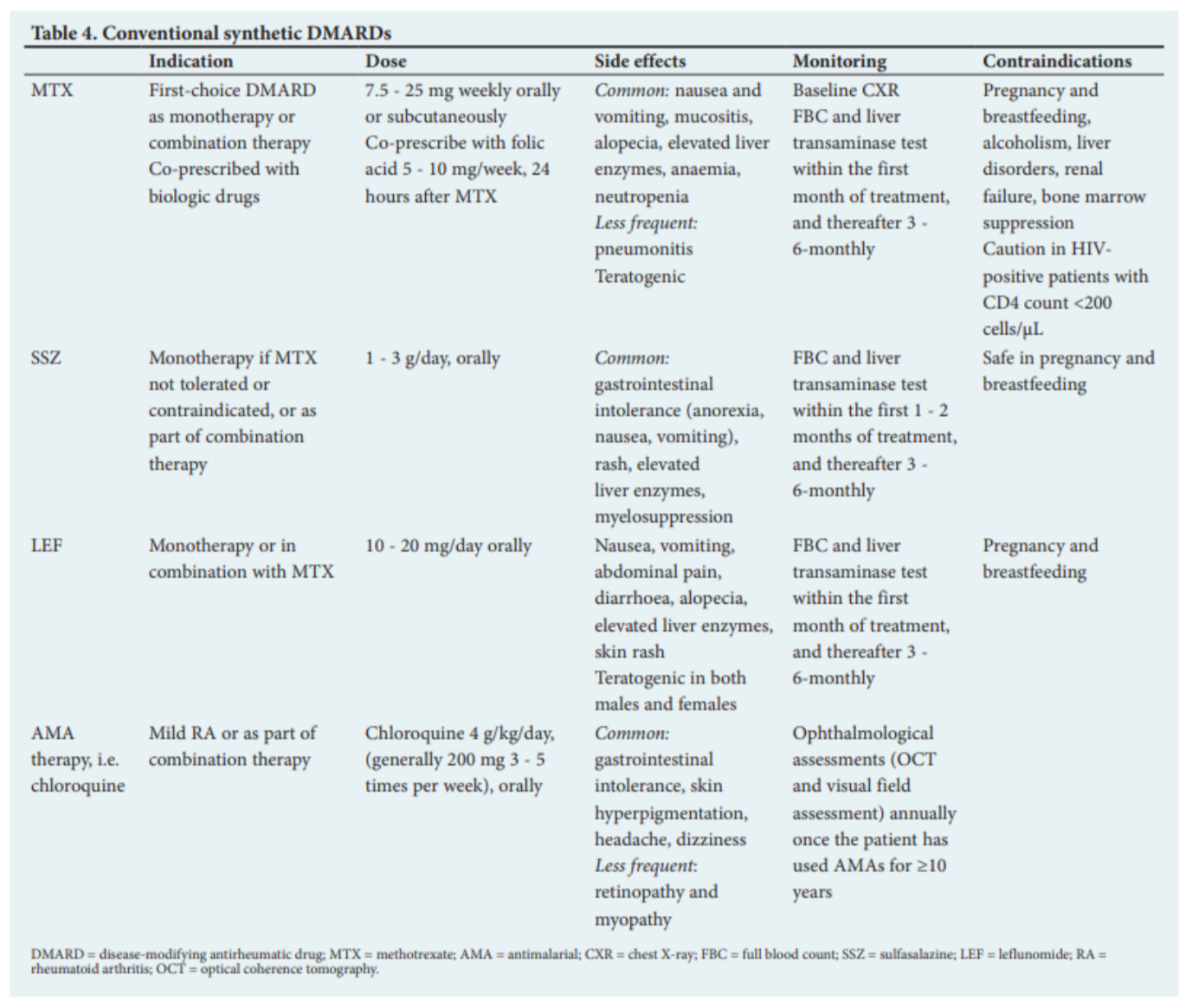
Click on the image to enlarge.
Glucocorticoids
Side-effects limit the use of glucocorticoids (GCs) to short term and low dose (≤7.5 mg/day) in combination with DMARDs. Longacting intramuscular methylprednisolone is an alternative to oral prednisone. GCs are not recommended as monotherapy for RA.
The risks associated with long-term GC use, especially at doses >5 mg/day, are considerable, including infection, vertebral and nonvertebral fracture, cardiovascular events, diabetes mellitus, obesity, cataracts, depressed mood, hypertension and dyspepsia.[40]
Short-term low-dose (<10 mg/day) GC ‘bridging therapy’ may be prescribed when initiating DMARD therapy for up to 3 months, after which the symptomatic effects seem to wane. Once DMARDs are fully effective, the GC should be tapered and stopped.[37,41]
Intra-articular GCs are useful for a mono- or oligoarticular flare of disease.
Extra-articular disease, including scleritis, vasculitis and serositis, may require moderate to high doses of GCs in combination with DMARDs or other immunosuppressants[42] (Table 5).
| Table 5. Suggestions for RA patients with comorbidities or extra-articular disease | ||
| Clinical problem | Potential issues with DMARDs/GCs | DMARD therapy of choice |
| Rheumatoid nodules | If progressive on MTX, change to non-MTX DMARD or reduce MTX dose |
AMA, discontinue smoking, rituximab |
| Interstitial lung disease | MTX may be used: beware of risk of acute pneumonitis | Rituximab, tocilizumab, abatacept or mycophenolate mofetil |
|
HIV positive, CD4 >200 cells/µL |
Nil |
All DMARDs safe |
| HIV positive, CD4 <200 cells/µL | Avoid MTX and bDMARDs because of risk of opportunistic infections | SSZ, AMA |
| Pregnancy | MTX/LEF contraindicated | SSZ, AMA, low-dose GC |
| Insufficient data on non-TNFi tsDMARD | TNFi: discontinue in 3rd trimester or delay neonatal vaccines (BCG, rotavirus) | |
| NAFLD |
Avoid MTX, LEF and TNFi if elevated liver enzymes/extensive fibrosis Consider low-dose MTX or TNFi for patients with normal liver enzymes and no evidence of advanced liver fibrosis who have moderate to high disease activity |
Rituximab, AMA, minimise GC if possible |
| Hepatitis B | Hepatitis B reactivation risk |
If HBsAg positive, co-prescribe antiviral with any b/ tsDMARD If prescribing rituximab and HBcAb positive (regardless of HBsAg result), co-prescribe antiviral |
| Hepatitis C | Deterioration of liver function if underlying liver disease |
Consider non-hepatotoxic DMARDs (SSZ or AMA) Rituximab may be bDMARD of choice |
| Active TB | Treat TB Monitor liver function if co-prescribing MTX with TB treatment |
Non-TNFi bDMARD |
| Latent TB or high risk for TB | Latent TB prophylaxis | Non-TNFi b/tsDMARD |
| Dyslipidaemia | Avoid tocilizumab, tsDMARDs | |
| Lymphoproliferative malignancy/other previous malignancy | Avoid b/tsDMARDs for 5 years | Rituximab |
| Heart failure | Avoid TNFi if severe heart failure | Non-TNFi b/tsDMARD |
| Serious infection in past 12 months or high risk of serious infection | Avoid GCs Avoid b/tsDMARDs |
csDMARDs, rituximab, abatacept |
| Demyelinating disorders | Avoid TNFi | Rituximab |
| Pyoderma gangrenosum | Calcineurin inhibitor | |
| RA = rheumatoid arthritis; DMARD = disease-modifying antirheumatic drug; GC = glucocorticoid; MTX = methotrexate; AMA = antimalarial; bDMARD = biologic DMARD; SSZ = sulfasalazine; LEF = leflunomide; TNFi = tumour necrosis factor inhibitor; tsDMARD = targeted synthetic DMARD; NAFLD = non-alcoholic fatty liver disease; HBsAg = hepatitis B surface antigen; HBcAb = hepatitis B core antibody; b/tsDMARD = biologic/targeted synthetic DMARD; TB = tuberculosis; csDMARD = conventional synthetic DMARD. | ||
Sequential DMARD therapy for RA
Initiation of DMARD therapy with escalation of therapy according to sequential steps is recommended if the LDA target is not reached (Table 6). If patients are taking a GC to remain at target, escalation of DMARD therapy is recommended over continuation of the GC.[37]
| Table 6. Stepwise algorithm for DMARD therapy in RA | |||
| Standard strategy | Alternative strategy | Inadequate response within 3 months | |
| First-line therapy | MTX monotherapy | Other csDMARDs if MTX not tolerated or contraindicated | Proceed to second-line therapy |
| Second-line therapy | Combination csDMARD | Non-MTX monotherapy | Proceed to third-line therapy |
| Third-line therapy | b/tsDMARD + MTX | If MTX not tolerated, consider tocilizumab or tsDMARD | Proceed to fourth-line therapy |
| Fourth-line therapy | Alternative b/tsDMARD | Alternative b/tsDMARD | |
| De-escalation | After sustained remission × 6 months, consider slow taper of b/tsDMARD, maintain csDMARD | Restart b/tsDMARD if flares | |
| DMARD = disease-modifying antirheumatic drug; RA = rheumatoid arthritis; MTX = methotrexate; csDMARD = conventional synthetic DMARD = b/tsDMARD: biologic/targeted synthetic DMARD; tsDMARD = targeted synthetic DMARD. | |||
First-line therapy: MTX monotherapy
MTX is the most widely prescribed csDMARD, has been used to treat RA for more than 50 years, and is the ‘anchor’ drug in RA. MTX is initiated at 7.5 - 15 mg weekly, orally or subcutaneously, with rapid dose escalation according to response and tolerability to a maximum of 25 mg weekly.[37] Co-prescription with folate (5 - 10 mg weekly) is recommended.[43] Patients with an inadequate clinical response to oral MTX may benefit from switching to subcutaneous MTX. A split dose of oral MTX over 24 hours, or subcutaneous MTX, may be prescribed for patients who do not tolerate oral weekly MTX.[44] If MTX is not tolerated or is contraindicated, SSZ or LEF can be considered.[37,44]
MTX has an excellent safety profile, and although mild elevation of liver enzymes is not infrequent, this is usually transient, and cirrhosis is rare.[45,46] A modest alcohol intake (1 unit per day) is acceptable for patients using MTX, provided that liver function remains normal.
A large proportion of patients (25 - 40%) improve significantly with MTX monotherapy, and in combination with GCs, almost half of patients can attain LDA or remission in early RA, a rate similar to that achieved with bDMARDs.[47] In treatment-naive patients, biologic/targeted synthetic DMARDs (b/tsDMARDs) are not recommended as first-line therapy, as no bDMARD + MTX trial has shown superiority over MTX + GC in MTX-naive patients.[41]
An AMA such as chloroquine may be used as monotherapy for mild RA.
Second-line therapy: Combination csDMARD therapy
Patients who fail MTX monotherapy should be treated with combination csDMARDs.[48] The most commonly prescribed combination treatment is ‘triple therapy’ MTX + SSZ + CQ. Alternatively, MTX + LEF may be effective. Another approach is to switch to an alternative csDMARD monotherapy.
Third-line therapy: MTX plus b/tsDMARD
South African Rheumatism and Arthritis Association (SARAA) eligibility criteria for b/tsDMARD therapies in RA are as follows:
- Moderate or high disease activity, i.e. CDAI >10 or SDAI >11
- A 3-month trial of at least two csDMARDs used serially or in combination (including MTX at a dose of at least 20 mg weekly unless contraindicated, or at least at the maximum tolerated dose)
- b/tsDMARDs may be considered earlier for severe refractory extra-articular disease (e.g. RA-interstitial lung disease).
All b/tsDMARDs have greater efficacy if co-prescribed with MTX or LEF to improve efficacy and reduce immunogenicity of bDMARDs.[47,49] If MTX and other csDMARDs are poorly tolerated or contraindicated, bDMARDs showing good efficacy as monotherapy (tocilizumab) or tsDMARDs are the most appropriate choices.[37]
The use of combination b/tsDMARDs is not recommended at present.
All b/tsDMARDs should be initiated by a rheumatologist. All patients with a rheumatic disease on b/tsDMARDs must be included, with patient consent, in the SARAA biologic registry (https://www. saraa.co.za).
Before commencing b/tsDMARD therapy, screening and treatment for latent TB, hepatitis B, hepatitis C and HIV, in addition to vaccination, should be done.
Choice of b/tsDMARD
Clinical trials and clinical experience have demonstrated the efficacy of all currently available therapies. All bDMARDs have similar response rates in RA: LDA is achieved by up to 40% of patients. Response rates decrease with increasing previous drug experience.[50]
The choice of which b/tsDMARD is offered depends on the safety profile, contraindications, comorbidities, patient preference, cost, and rheumatologist’s opinion. There are special circumstances where a particular agent may be preferred (Table 5). For example, rituximab should be considered as the initial bDMARD if there is a history of past lymphoma or other malignancy; any demyelinating disorder; or previous TB infection, latent TB, or a high risk of TB.[44]
Fourth-line therapy: Switching b/tsDMARDs
A b/tsDMARD that has not resulted in an adequate clinical response (LDA, i.e. CDAI ≤10, SDAI ≤11) after 3 months of treatment should be withdrawn, and an alternative b/tsDMARD should be prescribed. Any b/tsDMARD may be considered: evidence shows that administering a TNFi after another TNFi has failed can be as efficacious as using a drug with another mode of action.[50] The choice of which b/tsDMARD is offered therefore depends on the safety profile, contraindications, patient preference, cost, and rheumatologist’s opinion.
De-escalation of therapy
As noted above, GCs should be reduced and discontinued as soon as possible, ideally within 3 months, or once LDA is achieved.
For patients who have maintained persistent LDA/remission without a GC for at least 6 - 12 months, DMARD tapering may be cautiously considered. Discontinuation of all DMARDs may be associated with disease flares, so at least one tolerated csDMARD at the lowest dose should be continued.[51] No difference in outcomes has been shown in terms of whether the csDMARD or b/tsDMARD is tapered first, and based on cost, safety and availability, the b/ tsDMARD should be tapered first[52] Tapering (dose reduction and/ or interval increase), or even discontinuation of the b/tsDMARD, can be attempted but is frequently associated with disease flares. Reassuringly, most patients (>80%) will achieve target again once the bDMARD is restarted.[53]
Analgesics and Anti-Inflammatory Drugs
Analgesics should be prescribed and taken on an ‘as needed’ basis for pain control. Paracetamol is a very effective analgesic, and doses of up to 4 g daily can be prescribed. Opioid analgesics should be limited to short-term use because of toxicity.[54]
NSAIDs are effective in controlling pain and stiffness, but are purely symptomatic therapies in RA and offer no disease-modifying action. NSAIDs should be used at the lowest effective dose and for the shortest possible duration of time, and withdrawn once disease activity is controlled with DMARDs. The toxicity of these drugs should not be underestimated, and all NSAIDs should be used with caution. Many patients with RA have risk factors for NSAID-induced gastrointestinal tract events, including older age (>60 years), as well as co-prescription of GCs and aspirin. There should therefore be a low threshold for co-prescribing a proton pump inhibitor for gastroprotection, or for considering a cyclo-oxygenase-2 (COX2) selective agent.[55] In addition, all NSAIDs, both non-selective agents and selective COX-2 inhibitors, confer an increased risk of thrombotic events (stroke and acute coronary syndrome), and should be used with caution in patients with cardiovascular risk factors.[56] Other side-effects of NSAIDs, including hypertension, renal and liver dysfunction, should not be forgotten.
Summarised principles of rheumatoid arthritis therapy
- Early diagnosis
- Prompt initiation of disease-modifying antirheumatic drug therapy
- Frequent monitoring with a composite disease activity score and escalation of therapy until low disease activity or remission achieved
- Low dose GC (≤7.5mg daily) as “bridging therapy” for 1-3 months when initiating DMARDs, then GC should be reduced and discontinued.
- Screening and management of comorbidities is essential.
Tarr, G., Govind, N., Seboka, M., Gardiner, E., & Hodkinson, B. (2024). South African Rheumatism and Arthritis Association 2024 updated guidelines for the management of rheumatoid arthritis. South African Medical Journal, 114(9), e2598.