Platelet Product Transfusion
SANBS Clinical Guideline, 6th Edition, 2023
Platelet product administration
Indications for platelet transfusion
Neonatal and paediatric platelet transfusions
Platelets are responsible for the cessation of bleeding by the formation of platelet plugs at sites of vascular injury. Platelet transfusions can be indicated to prevent or stop active bleeding as a result of reduced platelet numbers or abnormalities of platelet function.
Platelet concentrates, like other blood components, carry risks and are costly to produce, and should therefore be used judiciously.
Platelet products
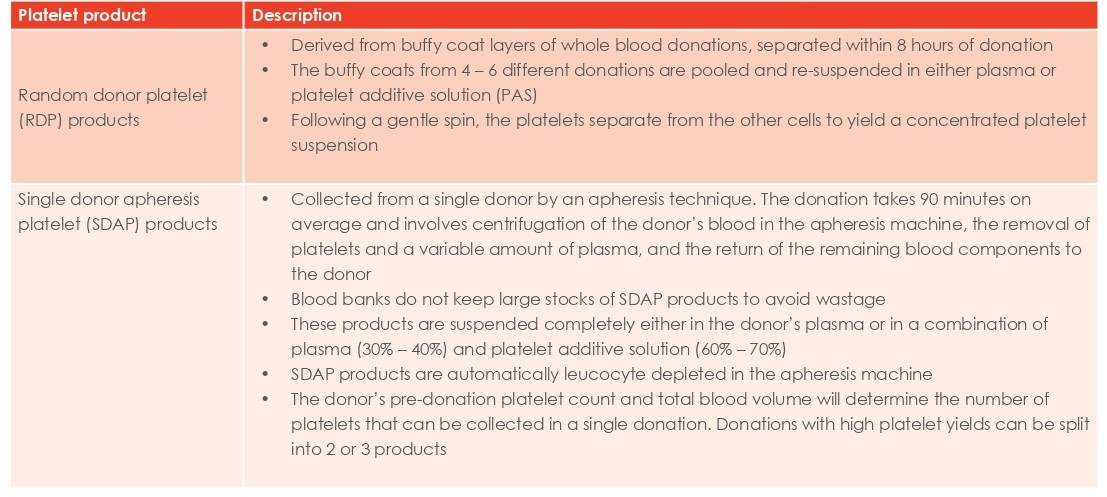
There are 2 types of platelet concentrates available.
Table 1
Click on table to enlarge
RDP and SDAP products have been shown to be therapeutically equivalent in terms of post-transfusion increments and haemostatic efficacy. The major differences between these products are the donor-exposure risk and cost.
The use of RDP concentrates exposes the patient to a higher number of donors, with associated risks of transfusiontransmitted infection and alloimmunisation. This is why patients with chronic platelet-transfusion needs (e.g. with haematological malignancies or undergoing stem-cell transplants) should receive SDAP products.
SDAP products are more costly to produce due to the high cost of the apheresis donation kits.
Studies show that using leucocyte-reduced (filtered) RDP products is equivalent to using SDAP products in terms of platelet alloimmunisation, so they should be considered in settings where SDAP products are scarce.
Leucocyte-depletion of random donor platelet products
The benefits of leucocyte-depletion of RDP products include a reduction in:
- Alloimmunisation (antibody formation to human leucocyte antigens and human platelet antigens) rates
- Transfusion-transmissible CMV infection
- Febrile non-haemolytic transfusion reactions (FNHTR)
There is an additional cost for this service that must be weighed up in resource-constrained settings.
Irradiation of platelet products
Platelets may be irradiated with no loss of function (see Leucocyte Depletion and Irradiation of Blood Components, for indications).
Dose and efficacy
RDP and SDAP products both contain a minimum of 2.4 x 10¹¹/l platelets and their volumes range between 200 ml and 300 ml. Comparative studies using higher platelet doses show a higher risk of patient adverse events, with no clinical benefit.
Infant SDAP products are produced by dividing Group O negative SDAP units into 4 doses. Each infant product has a volume of 40 ml – 60 ml and a platelet yield of 0.5 – 0.9 x 10¹¹/l.
Compatibility
A and B red cell antigens are expressed on platelets. ABO-compatible platelet products are the components of choice, although clinical demand and stock availability may not allow for this.
Some studies have indicated poorer platelet increments with ABO non-identical platelet products, but this has not been shown to be clinically significant in terms of haemostatic efficacy. In the event that ABO-incompatible products must be used, products with low antibody titres will be selected by the blood bank.
Since platelet concentrates may contain a small number of red cells, Rh-D negative platelets should be given to premenopausal Rh-D negative women. If this is not possible, administration of anti-D immunoglobulin should be considered once the platelet count is corrected.
Product storage
Platelet products are stored at room temperature (20 °C – 24 °C) in the blood bank for up to 5 days, under gentle agitation on a platelet shaker or “agitator”.
The shelf life of platelet products is extended to 7 days in certain countries that use pathogen-reduction treatment and/ or pre-issue bacterial screening protocols.
Platelet product administration
Platelet products should be transfused through a platelet administration set over a period of 15 – 30 minutes within 6 hours of issue from the blood bank. They should not be transfused through giving sets that have been used for red cell concentrates or whole blood.
Platelet products should be kept at room temperature, not refrigerated, and transfused to the patient as soon as possible.
Monitoring the response to platelet transfusions
If platelets are given therapeutically for active bleeding, the patient’s clinical response is the best indication of efficacy. Response to prophylactic platelet transfusions is best assessed by measuring the increase in the platelet count following the transfusion.
One platelet product (which is equivalent to 1 therapeutic dose) should increase the patient’s platelet count by 35 – 45 x 109/l within 10 – 60 minutes post transfusion. Failure of the platelet corrected-count increment (CCI) to reach a level of at least 5 x 10⁹/l within 1 hour after transfusion should raise suspicion of refractoriness.
Although the platelet dose is not recorded on platelet products in South Africa and can range from 2.4 – 5 x 10¹¹ per platelet unit, it can be calculated if the actual platelet-product dose is known:
 Click on image to enlarge
The following CCIs are regarded as unsatisfactory:
- 10 minutes to 1 hour after transfusion: <7.5 x 10⁹/l
- 1 – 17 hours after transfusion: <10% recovery of platelet count
- 18 – 24 hours after transfusion: <5 x 10⁹/l
Platelet transfusion refractoriness
Platelet transfusion refractoriness (PTR) is defined as the repeated failure to obtain satisfactory responses to platelet transfusions and can be attributed to immune or non-immune mechanisms.
Immune causes will result in both 1-hour and 24-hour CCI values being poor, whereas non-immune causes will show a normal 1-hour CCI but a poor 24-hour CCI. The aetiology of PTR is often multifactorial.
Non-immune causes account for about 80% of PTR episodes. These include:
- Fever
- Graft-versus-host disease
- Infection or sepsis
- Ongoing bleeding
- Drugs, e.g. antibiotics
- Veno-occlusive disease
- Splenomegaly
- Disseminated intravascular coagulation (DIC)
The major immune cause is the formation of antibodies against human leucocyte antigen (HLA). A less frequent cause is human platelet specific antigens (HPA) exposure through multiple platelet transfusions.
If PTR is confirmed in a patient, and non-immune causes have been excluded, HLA tissue typing of the patient is advised for the selection of HLA-matched SDAP products. In South Africa, this is performed in conjunction with the South African Bone Marrow Registry (SABMR), which supplies the blood services with a list of HLA-compatible donors to contact.
Even with HLA-matched products, 20% – 30% of these patients may have ongoing poor responses to the platelet transfusions, which could be related to unrecognised non-immune causes of platelet refractoriness, drugs or autoantibodies. It is also important to note that patients can lose antibodies over time (1 week to several months), so repeat assessment of antibody status is useful to avoid unnecessary use of HLA-matched SDAP products.
Platelet product risks
The risk of bacterial contamination is greater with platelet products because they are stored at room temperature. Bacterial screening is performed on a defined number of platelet products as per the quality-control specifications to monitor this.
The use of pathogen-reduction treatment of platelet products reduces the risk of bacterial contamination and other transfusion-transmissible infections, and this technology is being considered for use by the South African blood services. Adverse transfusion reactions can occur with platelet transfusions, like with any other blood component. The most common types are FNHTR and allergic reactions, the incidence of both being about 3%. Allergic transfusion reactions are reduced by using platelet additive solution in platelet products – because the proportion of plasma is far less, the patient exposure to plasma proteins is reduced.
Alloimmunisation is also a risk of repeated platelet product transfusions. This risk for patients with chronic platelet transfusion needs is reduced through the use of SDAP (leucocyte depleted) or filtered RDP products.
Indications for platelet transfusion
Platelet transfusions are indicated for the prevention (prophylactic transfusions) and treatment (therapeutic transfusions) of bleeding in patients with thrombocytopenia or platelet function defects. The cause of the thrombocytopenia should be established before a decision is made to transfuse.
Unless there is life-threatening bleeding or the patient requires an urgent procedure where alternative therapies to recover their platelet count are ineffective, platelet transfusions are contraindicated (or relatively contraindicated) in patients with:
- Thrombotic microangiopathies, e.g. thrombotic thrombocytopenia purpura (TTP)
- Immune thrombocytopenias, e.g. immune thrombocytopenia (ITP), heparin-induced thrombocytopenia (HIT), post-transfusion purpura (PTP)
The following recommendations for adult transfusions are based on guidelines produced by the BSH (British Society for Haematology) in 2017 and by the AABB (formerly the American Association of Blood Banks) in 2015.
Therapeutic platelet transfusions
Table 2

Click on table to enlarge
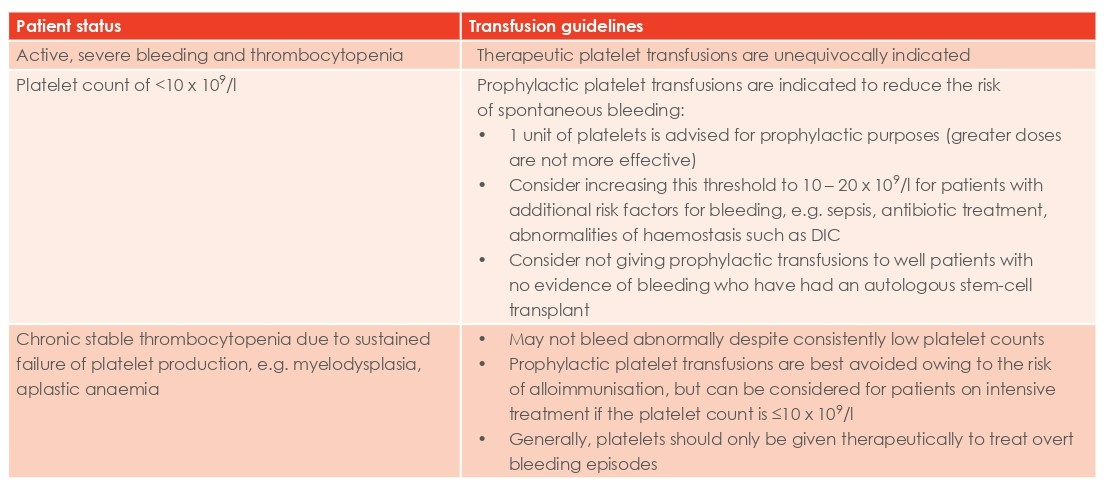
Patients with bone marrow failure or critical illness (in the absence of planned procedures)
Table 3
Click on table to enlarge
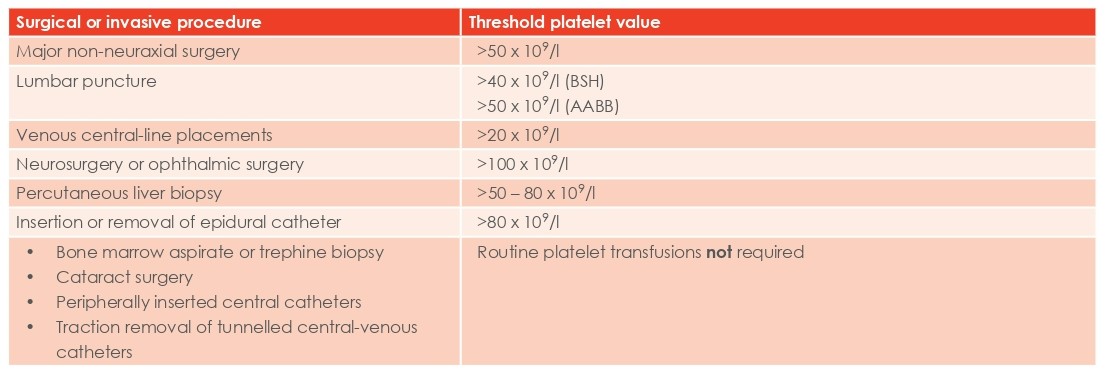
Prophylaxis for surgery and invasive procedures
The following are guidelines only since there is a lack of evidence to direct therapeutic decisions in this setting.
Table 4
Click on table to enlarge
Immune thrombocytopenias
Prophylactic platelet transfusions are not indicated for ITPs unless the patient is undergoing an urgent procedure and their platelet count cannot be corrected by other treatment options. Platelet transfusions should be reserved for life-threatening haemorrhage, together with other therapies, e.g. intravenous immunoglobulin and corticosteroids.
In post-transfusion purpura, intravenous immunoglobulin is the treatment of choice.
Tranexamic acid use
Tranexamic acid (TXA) has been recommended by the BSH as an alternative or addition to platelet transfusions in the following circumstances:
- For early administration to trauma patients who are bleeding or at risk of bleeding
- For surgical patients who are expected to have >500 ml blood loss, unless contraindications exist
- In patients with chronic thrombocytopenia caused by bone marrow failure
Neonatal and paediatric platelet transfusions
Dosage
The platelet dosage that is recommended is 10 ml/kg – 20 ml/kg, using a platelet administration set over a period of 30 – 60 minutes. Infant platelet concentrates are produced from Group O negative SDAP products.
Indications for transfusion
Owing to great variability in the literature regarding platelet value transfusion thresholds for babies and children, it is advised to seek paediatric consultant advice from your institution. Restrictive ordering practices are encouraged.
Platelet transfusions for ITP should be avoided unless there is life-threatening haemorrhage, as per adult guidelines.
Guidelines for neonatal platelet transfusion
Thrombocytopenia is a relatively common haemostatic complication in the neonatal ICU setting and is associated with an increased risk of severe intra- and peri-ventricular haemorrhage. Transfusion thresholds are difficult to establish as studies do not demonstrate severity of thrombocytopenia to be a major predictor of bleeding.
It is advised to consider prophylactic transfusions in all neonates at <30 x 109/l, but to consider <50 x 109/l if there is an increased bleeding risk:
- <1 000 g or <1 week old
- Clinically unstable
- Previous major bleeding
- Current minor bleeding
- Coagulopathy
- Planned surgery or exchange transfusions
Neonatal alloimmune thrombocytopenia
Neonatal alloimmune thrombocytopenia (NAIT) results most commonly from maternally derived anti-human platelet antigen 1a or 5b antibodies. If the diagnosis is suspected, maternal antibody testing can be arranged via the South African National Blood Service (SANBS) Tissue Immunology Laboratory in Johannesburg (011 761 9227/011 761 9228). Blood samples from both the mother and baby are needed.
If antibodies are detected in the maternal sample, the baby’s blood will be genotyped to establish if there is a correlation. HLA/HPA matched blood can be arranged via the SANBS Tissue Immunology Laboratory or with assistance from SABMR.
The use of maternal SDAP platelets is also an option, along with steroid administration for the baby.
Guidelines for paediatric platelet transfusion
Hypoproliferative thrombocytopenia as a result of chemotherapy or irradiation is a common reason for platelet transfusions in children. These children are at a higher risk of bleeding than adults are, due to the intensity of the chemotherapy and the functional differences in interactions between the vascular endothelium and platelets.
Therapeutic platelet transfusions are recommended for any child with active bleeding and thrombocytopenia.
There is little data to guide prophylactic platelet transfusions in children and extrapolation of the adult guidelines is often resorted to.
Further reading
- Estcourt LJ, Birchall J, Allard S, et al. Guidelines for the use of platelet transfusions. Br J Haematol. 2017;176(3):365-394. doi:10.1111/bjh.14423
- Kaufman RM, Djulbegovic B, Gernsheimer T, et al. Platelet transfusion: a clinical practice guideline from the AABB. Ann Intern Med. 2015;162(3):205-213. doi:10.7326/M14-1589
- Patel RM, Josephson C. Neonatal and pediatric platelet transfusions: current concepts and controversies. Curr Opin Hematol. 2019;26(6):466-472. doi:10.1097/MOH.0000000000000542
- Slichter SJ. Evidence-based platelet transfusion guidelines. Hematology Am Soc Hematol Educ Program. 2007:172-178. doi:10.1182/asheducation-2007.1.172
- Solves Alcaina P. Platelet transfusion: and update on challenges and outcomes. J Blood Med. 2020;11:19-26. doi:10.2147/JBM. S234374
Clinical Guidelines for the Use of Blood and Blood Products in South Africa, 6th Edition, 2023