Post Cardiac Arrest Care
Post Cardiac Arrest Care
Summary Algorithm
Background
Post-Cardiac Arrest Syndrome
ED Management of the Post-Cardiac Arrest Patient
Summary Algorithm
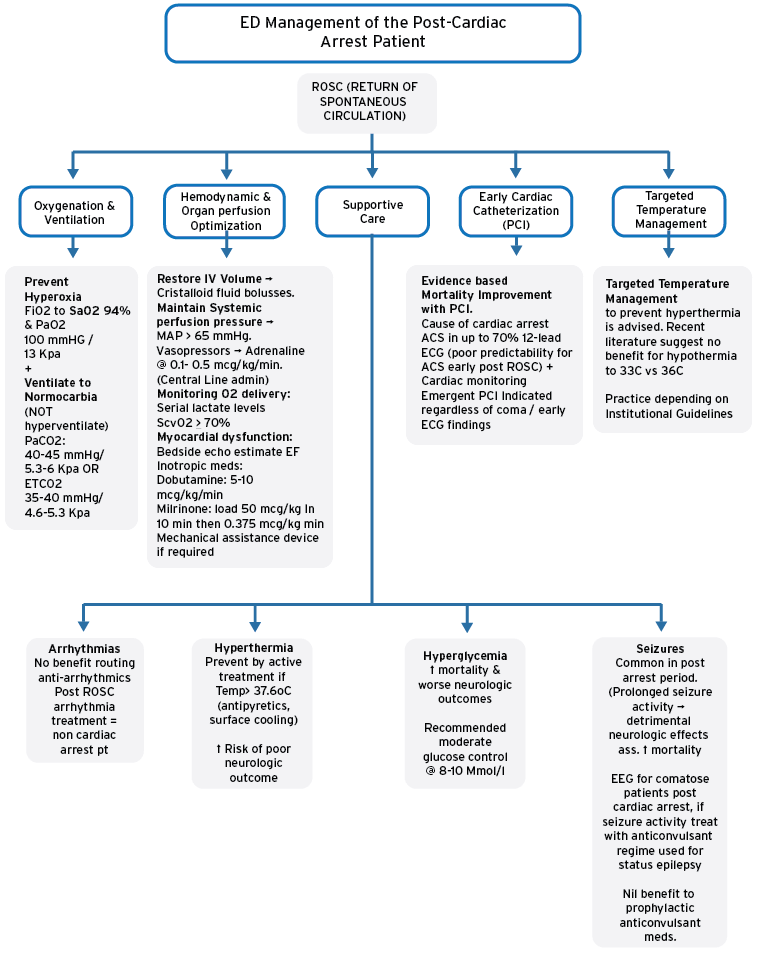
Background
- Most deaths following cardiac arrest occur in the first 24 hours
- Systematic post-cardiac arrest care can:
- Reduce early mortality caused by hemodynamic instability
- Reduce morbidity and mortality from multi-organ failure and brain injury
- Improve the likelihood of patient survival with good quality of life
- A comprehensive, structured system of care should be implemented to:
- Optimise haemodynamics and organ perfusion
- Optimise oxygenation and ventilation
- Initiate therapeutic hypothermia
- Emergent PCI when indicated
- Identify and treat precipitating causes
- Provide critical supportive care including targeted temperature management (TTM)
Post-Cardiac Arrest Syndrome
- “A complex array of pathophysiologic processes that occur after ROSC”
- Systemic ischemia-reperfusion response
- Mediated by:
- Increased cytokine production: activates neutrophils leading to a potent pro-inflammatory response
- Alterations in coagulation: an overall pro-coagulant state
- Oxygen free radical formation
- Adrenal dysfunction: a relative adrenal insufficiency
- Disruption of the blood brain barrier
- Extent of injury dependent upon duration of ischemia, co-morbidities, and cause of arrest
- Overall characterized by intravascular volume depletion, impaired vaso-regulation, pro-thrombotic state, and increased susceptibility to infection
- Mediated by:
- Brain injury
- Most deaths in patients with ROSC from out-of-hospital cardiac arrest are due to neurologic injury
- Reactive oxygen species
- Generated by mitochondria in ischemic neuronal tissues
- Trigger cascade of events including protein oxidation, lipid peroxidation, and DNA damage
- Hyperoxia can further increase the quantity of reactive species
- Activation of transcription factors – induces apoptosis, inflammation, and sustained oxidative stress
- Impaired auto-regulation
- Cerebral oedema: common in the early post-cardiac arrest period – association with increases in ICP controversial
- Myocardial dysfunction
- Common – may be seen in up to 70% of patients
- May contribute to increased morbidity and mortality
- Typically occurs within 8 hours following ROSC
- Manifested by increased cardiac filling pressures, decreased cardiac index, decreased systolic and diastolic function
- Aetiologies may include:
- Direct injury of myocardium from compressions or defibrillation
- Surge of catecholamines
- Depletion of ATP stores
- Generation of oxygen free radicals
- Alterations in sarcoplasmic calcium metabolism
- Up-regulation of heat shock proteins
- Cardiac index returns to baseline within 24-48 hours in most patients; may persist in a few patients for weeks
- Persistent Precipitating Cause
- Cardiac causes
- PE: 5-10% of cases
- Respiratory failure
- Drug overdose
- Electrolyte imbalances
- Sepsis
- Intracranial catastrophes
ED Management of the Post-Cardiac Arrest Patient
Oxygenation and Ventilation
- Pulmonary dysfunction common after cardiac arrest
- Hydrostatic pulmonary oedema – LV dysfunction
- Non-cardiogenic oedema – inflammatory, infective, physical injury
- Atelectasis
- Aspiration
- Patients develop regional V/Q mismatch; decreases arterial oxygen content
- Mechanical ventilation
- Adjust based on SpO2, ABG, minute ventilation, and pt synchrony
- Setting the mode
- Assist control
- No data to recommend a unique ventilator mode
- Setting the tidal volume
- Patients at high risk for ALI/ARDS: use a lung protective strategy
- Vt: 6 – 8 ml/kg
- Setting the FiO2 – “controlled re-oxygenation”
- Optimal level remains controversial
- Common practice to place all patients with ROSC on 100% FiO2
- Animal data suggests hyperoxia increases brain lipid peroxidation, metabolic dysfunction, neurological degeneration, and worsens short-term outcome
- Adjust FiO2 to the minimum concentration to achieve SpO2 ≥ 94%
- Maintain PaO2 ≈ 100 mm Hg; avoid hyperoxia
- Setting the respiratory rate
- Tendency to hyperventilate to correct the metabolic acidosis immediately after ROSC
- Hyperventilation can be detrimental
- Can lower PaCO2, cause cerebral vasoconstriction, and exacerbate cerebral ischemic injury
- Can also compromise systemic blood flow due to increases in intrathoracic pressure – decreases venous return and cardiac output
- Adjust respiratory rate to maintain normocapnia
- PaCO2 of 40-45 mm Hg OR
- PetCO2 of 35-40 mm Hg
Hemodynamic Optimisation
- Hemodynamic instability common after ROSC
- Essential components of hemodynamic optimisation include restoring intravascular volume, maintaining adequate perfusion pressure, monitoring oxygen delivery, and supporting myocardial dysfunction
- Restore intravascular volume
- Patients generally volume depleted due to increased vascular permeability
- Administer isotonic crystalloid fluid boluses; use cold IVFs (4oC) if therapeutic hypothermia is implemented
- Monitoring volume status
- CVP unreliable
- Use respirophasic changes of IVC on ultrasound, pulse pressure variation, systolic pressure variation
- Maintain adequate perfusion pressure
- Place an arterial line for continuous blood pressure monitoring
- MAP
- Better physiologic surrogate for organ perfusion pressure than SBP
- The optimum post-resuscitation blood pressure has not been defined can vary among individuals.
- AHA recommendation: MAP > 65 mm Hg
- Some patients may require a higher MAP (80-100 mm Hg) to maintain adequate CPP and oxygen delivery; small studies of MAP 80-100 mm Hg combined with therapeutic hypothermia show a trend towards improved survival rates
- Vasopressors
- Paucity of data about which drug to select first
- All can increase or decrease HR, increase arrhythmias, increase myocardial oxygen demand
- Administration through central line preferred
- No standard recommended infusion rates; typical starting doses:
- Noradrenaline: 0.1-0.5 mcg/kg/min
- Adrenaline: 0.1-0.5 mcg/kg/min
- Dopamine: 5-10 mcg/kg/min
- Phenylephrine: 0.5-2.0 mcg/kg/min
- Monitor oxygen delivery
- Hemodynamic optimization also dependent on assessing adequacy of oxygen delivery
- Current guidelines recommend:
- Serial lactate levels
- ScvO2 ≥ 70%
- Support myocardial dysfunction
- Common following ROSC; up to 70% of patients
- Typically occurs within 8 hours and resolves within 72 hours
- Perform bedside echo to determine global EF
- No proven harm to IVFs and vasoactive medications for patients with myocardial stunning
- Inotropic medications
- Dobutamine: 5-10 mcg/kg/min
- Milrinone: load 50 mcg/kg over 10 min then 0.375 mcg/kg min
- Mechanical assistance
- IABP
- LVAD
- Routine use not recommended since studies have not demonstrated consistent survival benefit
Early Cardiac Catheterisation
- ACS a common cause of cardiac arrest – up to 70%
- Obtain a 12-lead ECG as soon as possible; place on continuous cardiac monitor
- The early post-resuscitation ECG is less reliable for predicting acute coronary occlusion than it is in those who have not had a cardiac arrest.
- Pts with evidence of a STEMI should go for emergent PCI regardless of coma
- Strongly consider emergent PCI even in the absence of STEMI
- PCI should not be delayed because of the use of therapeutic hypothermia – PCI in the setting of hypothermia safe & associated with improved survival and outcome
Supportive Care
- Arrhythmias
- Prophylactic administration of antiarrhythmics not recommended
- Treatment of arrhythmias during post-cardiac arrest period does not differ from treatment in the non-cardiac arrest patient
- Hyperglycemia
- Common in post-cardiac arrest patients and is associated with increased mortality and worse neurologic outcomes
- Optimal glucose value/treatment strategy however remain controversial
- Only prospective, randomised trial of glucose control in patients with OOHCA showed no difference in 30-day mortality between those with strict control and those with moderate control; those with strict control had increase in neuron-specific enolase suggesting more severe brain injury.
- Current guidelines recommend a target glucose of 144-180 mg/dL for post-cardiac arrest patients
- Hyperthermia
- Increases the risk of poor neurologic outcome
- Aetiology may be related to activation of inflammatory cytokines
- Temperatures > 37.6o C should be treated aggressively with antipyretics or surface cooling techniques
- Targeted Temperature Management – section attached
- Seizures
- Seizures are common in post arrest period: 5-20%
- Prolonged seizure activity can have detrimental neurologic effects and is associated with increased mortality
- Current guidelines recommend
- EEG for comatose survivors of cardiac arrest
- Same anticonvulsant regiment used for status epilepticus for those who have seizure activity on EEG
- No benefit to the prophylactic administration of anticonvulsants
Targeted Temperature Management (TTM)
- Aims of TTM
- Cooling to 33˚C or 36˚C has been shown to be beneficial for patients with ROSC from cardiac arrest according to recent trials (2013)
- TTM in the Western Cape setting should be implemented to aggressively prevent hyperthermia / pyrexia in post arrest patients.
- Therapeutic hypothermia will only be implemented in selected patients in tertiary institutions by critical care specialists.
- Complications of Hypothermia
- Seizures (myoclonic and generalised tonic-clonic seizures.)
- Haemorrhage (IV sites, GIT, Oral, Nasal, Genital, Intracranial)
- Infection / Sepsis
- Arrhythmias (Atrial fibrillation/flutter, VT,VF, Bradyarrhythmias)
- Electrolyte & metabolic abnormalities (↓K+, ↓Mg, ↓PO4, ↓Glycaemia)
- Methods of cooling
- Cold IV fluids (4˚C)
- Ice packs – axillae & groins
- Commercial Temperature devices – Intravascular / Airflow mattress devices
- Monitoring
- Patients require monitoring in intensive care or equivalent area with continuous monitoring of Core Temp, ECG, BP, SaO2, and preferable EtCO2.
- Sedation
- Intravenous sedation is indicated to prevent patients from hyperthermia –institutional protocols to be followed.
- Analgesia first sedation with minimal or no benzodiazepines has been proven to decrease delirium in patients admitted to ICU.
Drafted Nov 2014, Review Nov 2016
Courtesy of: Michael Winters, MD, FAAEM FACEP. Associate Professor of Emergency Medicine and Medicine. Director, Critical Care Education. Co-Director, Combined EM/IM/Critical Care Program. University of Maryland School of Medicine, Baltimore, Maryland.
Useful References
Peberdy MA, Callaway CW, Neumar RW, et al. Post cardiac arrest care: 2010 American Heart Association guidelines for cardiopulmonary resuscitation and emergency cardiovascular care. Circulation 2010; 122:S768-786.
Kory P, Weiner J, Mathew JP, et al. A rapid, safe, and low-cost technique for the induction of mild therapeutic hypothermia in post-cardiac arrest patients. Resuscitation 2011; 82:15-20.
Nolan JP, Soar J. Post-resuscitation care: entering a new era. Curr Opin Crit Care 2010; 16:216-22.
Sunde K, Soreide E. Therapeutic hypothermia after cardiac arrest: where are we now? Curr Opin Crit Care 2011; 17:247-253.
Walters JH, Morley PT, Nolan JP. The role of hypothermia in post-cardiac arrest patients with return of spontaneous circulation: a systematic review. Resuscitation 2011; 82:508-16.
Zia A, Kern KB. Management of postcardiac arrest myocardial dysfunction. Curr Opin Crit Care 2011; 17:241-6.
Nielsen N, Wetterslev J, Cronberg T, et al. Targeted temperature management at 33˚C versus 36˚C after cardiac arrest. N Engl J Med 2013;369:2197-2206.