Post-Exposure Prophylaxis
Please click on the link below to access the most up-to-date version of this guideline. The content on this page is currently being updated to align with the latest publication. Always check the version number at the bottom of the screen to confirm which version you are using. Click here to access the Adult Hospital Level Chapter 10: HIV_and_AIDS_with_supporting_NEMLC_Report_Reviews_2025-9-Versio
Please click on the link below to access the most up-to-date version of this guideline. The content on this page is currently being updated to align with the latest publication. Always check the version number at the bottom of the screen to confirm which version you are using.
Post-exposure prophylaxis, occupational
Non occupational post exposure prophylaxis, sexual assault and inadvertent exposure
Non occupational post exposure prophylaxis, inadvertent non-occupational
National HIV Health Care Worker Hotline:
0800 212 506 or 021 406 6782
POST-EXPOSURE PROPHYLAXIS, OCCUPATIONAL
S61.0 + (W46.22 + Z20.6 + Z29.8)
DESCRIPTION
Antiretroviral therapy may prevent the risk of acquiring HIV following a significant occupational exposure.
It is essential to document occupational exposures adequately for possible subsequent compensation.
Other blood borne infections (hepatitis B and C) should also be tested for in the source patient and appropriate prophylaxis instituted in the case of hepatitis B.
Assessing the risk of occupational exposures
The risk of acquiring HIV following occupational exposure is determined by the nature of the exposure and the infectiousness of the source patient. High-risk exposures involve exposure to a larger quantity of viruses from the source patient, either due to exposure to larger quantity of blood or because the amount of virus in the blood is high.
Any one of the following is associated with an increased risk of HIV transmission:
- deep percutaneous sharps injuries
- percutaneous exposure involving a hollow needle that was used in a vein or artery
- visible blood on the sharp instrument involved in a percutaneous injury
- the source patient has terminal AIDS or is known to have a high viral load, i.e. >100 000 copies/mL
In instances when the risk of infection is extremely low or non-existent, post-exposure prophylaxis (PEP) is not indicated, as the risks of PEP will far outweigh the benefits. PEP is NOT indicated when:
- The material the healthcare worker was exposed to is not infectious for HIV in the occupational setting, e.g. vomitus, urine, faeces or saliva, unless these are visibly blood stained.
- The exposure was on intact skin.
- The source patient is HIV negative, unless there are clinical features to suggest seroconversion illness, in which case PEP should be commenced until further tests are done – consult with a virologist or infectious diseases specialist.
- The healthcare worker is HIV infected, as this person should be assessed for ART initiation.
PEP REGIMENS
PEP should be commenced as soon as possible after the injury. Do not delay initiating PEP while awaiting confirmatory test results on the source patient and health care worker. PEP should be considered up to 72 hours after exposure and, in exceptional circumstances involving high-risk exposures, PEP may be considered up to 7 days after exposure.
When PEP is indicated (administered preferably as a fixed-dose combination):
- Tenofovir disoproxil fumarate (TDF), oral, 300 mg daily for 4 weeks (provided baseline eGFR is >50 mL/minute. Do not delay initiation of PEP while awaiting baseline eGFR. Re-assess TDF eligibility once results become available).
AND
- Lamivudine, oral, 300 mg daily for 4 weeks
AND
- Dolutegravir, oral 50 mg once daily for 4 weeks.
LoE:IIIalii
If DTG is not tolerated:
- Tenofovir disoproxil fumarate (TDF), oral, 300 mg daily for 4 weeks (provided baseline eGFR is >50 mL/minute).
AND
- Emtricitabine, oral, 200 mg daily for 4 weeks
AND
LoE:IIIbliii
- Atazanavir/ritonavir 300/100 mg, 1 tablet, oral daily for 4 weeks
OR
- Lopinavir/ritonavir 200/50 mg, oral, 2 tablets 12 hourly for 4 weeks
If TDF is contraindicated or if source patient is known to be failing a TDF-based regimen, replace TDF and emtricitabine with:
- Zidovudine, oral, 300 mg 12 hourly for 4 weeks
AND
- Lamivudine, oral, 150 mg 12 hourly for 4 weeks
AND
- Continue third applicable drug (DTG or boosted PI – see above)
PEP is generally not well tolerated. Adverse effects occur in about half of cases and therapy is discontinued in about a third. Efavirenz is not recommended as it is very poorly tolerated in PEP.
Zidovudine often causes nausea and headache and so should only be given if TDF is contraindicated.
Lopinavir/ritonavir often causes diarrhoea. If lopinavir/ritonavir is not tolerated switch to atazanavir/ritonavir. Atazanavir/ritonavir often causes unconjugated jaundice, which is benign but may not be tolerated, in which case switch to lopinavir/ritonavir. If both these protease-inhibitors are not well tolerated, consult a specialist.
Recommendations for post exposure prophylaxis (PEP) after occupational exposure to infectious material (includes blood, CSF, semen, vaginal secretions and synovial/pleural/ pericardial/ peritoneal/amniotic fluid) from HIV seropositive patients are given in the table, below.
PEP for healthcare worker following occupational HIV exposure:
| Exposure | HIV Status of source patient | |
| Negative | Unknown or positive | |
| Intact Skin | no PEP | no PEP |
|
Mucosal Splash or Non-intact Skin or Percutaneous Injury |
no PEP |
PEP - TDF + 3TC + DTG OR - Other 3-drug regimen |
Table 10.11: PEP for healthcare worker following occupational HIV exposure
When the source patient is known to be failing ART, modify the PEP regimen:
- If the patient is on zidovudine, use TDF
- If the patient is on TDF, use zidovudine
PEP for healthcare workers following hepatitis B exposure:
Vaccination status and antibody response status of HCW
| Source patient | |||
| Vaccination status | HBsAg positive | HbsAg negative | HBsAg unknown |
| Unvaccinated or vaccination incomplete |
- HBIG, IM, 500 units* - Hep B vaccine (3 doses at monthly intervals) |
- Initiate Hep B vaccination (month 0, 1 and 6) | - HBIG, IM, 500 units* - Hep B vaccine (3 doses at monthly intervals) |
| Vaccinated AND known to have HBsAb >10 units/mL# |
No treatment | No treatment | No treatment |
| Vaccinated AND HBsAb <10 units/mL or level unknown |
- HBIG, IM, 500 units * - If HBIG <10 units/mL, repeat HBIG at 1 month - Repeat Hep B vaccine (3 doses at monthly intervals) |
No treatment | - HBIG, IM, 500 units* - If HBIG <10 units/mL, repeat HBIG at 1 month - Repeat Hep B vaccine (3 doses at monthly intervals) |
Table 10.12: PEP for healthcare workers following hepatitis B exposure
* HBIG and first dose of vaccine to be given simultaneously, but at different sites.
LoE:IVbliv
# If the delay in obtaining HBsAb results is more than 7 days initiate treatment as for vaccinated AND HBsAb < 10 units/mL.
After vaccination ensure the health care worker has a HBsAb > 10 units/mL 1 – 2 months after the last vaccine dose.
LoE:IVblv
Investigations and monitoring in occupational exposures:
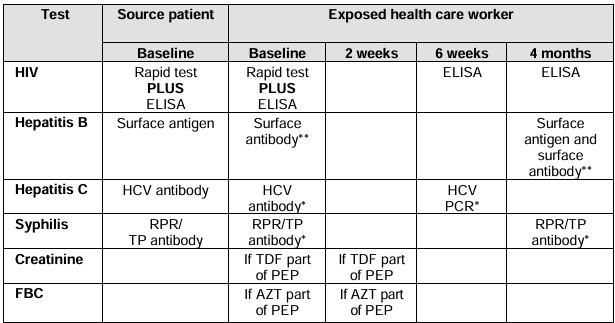
Click on the image to enlarge.
*Only if source patient was positive (in the case of syphilis, source patient must be RPR positive)
**Only if source patient was positive AND health care worker unvaccinated or HBsAb <10 units/mL
NON-OCCUPATIONAL POST EXPOSURE PROPHYLAXIS, SEXUAL ASSULT
Z29.8
PEP should be offered to rape survivors who present within 72 hours (management is the same as for occupational HIV exposure. See Post-exposure prophylaxis, occupational).
A patient presenting ≥72 hours since the alleged incident should not be given PEP, but should be counselled about the possible risk of transmission, with HIV testing provided at the time of presentation and 4 months later. Rape survivors who test HIV seropositive should be initiated on ART– see Antiretroviral therapy.
Other important aspects of care for the rape survivor should not be forgotten, i.e. contraception, treatment for sexually transmitted infections, counselling and forensic specimens.
Emergency contraception after pregnancy is excluded
Do a pregnancy test in all women and female adolescents. Children must be tested and given Emergency contraception from Breast Tanner Stage III. If unsure of staging, give emergency contraception when you detect any breast development (DO NOT REGARD MENARCHE AS AN INDICATION)
- Copper IUCD, e.g.:
- Cu T380A, inserted as soon as possible after unprotected intercourse and not later than 5 days.
LoE:IIIblvi
OR
- Levonorgestrel 1.5 mg, oral, as a single dose as soon as possible after unprotected intercourse, and not later than 5 days.
- If the woman vomits within 2 hours, repeat the dose.
- Advise women that their period should be on time; very rarely it is delayed but it should not be more than 7 days late. If this occurs, they should come back for a pregnancy test.
LoE:Ialvii
CAUTION
Emergency contraceptive tablets must be taken as soon as possible, preferably within 72 hours of unprotected intercourse, and not later than 5 days.
Enzyme inducers (including efavirenz and carbamazepine) cause a significant reduction in levonorgestrel concentrations.
Women on these medicines should preferably have copper IUCD inserted or alternatively double the dose of levonorgestrel.
Women > 80 kg or BMI ≥ 30 should also preferably have copper IUCD inserted or alternatively double the dose of levonorgestrel.
LoE:IIIblviii
An anti-emetic:
- Metoclopramide oral, 10 mg 8 hourly as needed.
LoE:IVblix
STI prophylaxis
- Ceftriaxone, IM, 250 mg as a single dose.
- For ceftriaxone IM injection: Dissolve ceftriaxone 250 mg in 0.9 mL lidocaine 1% without epinephrine (adrenaline).
AND
- Azithromycin, oral, 1 g, as a single dose.
AND
- Metronidazole, oral, 2 g immediately as a single dose.
LoE:IIIblx
HIV PrEP
If patient is at ongoing high risk of HIV acquisition, commence PrEP after PEP has been completed.
Perfom HIV test 4-weeks after initiating PrEP.
See PHC STGs and EML, Pre-exposure prophylaxis (PrEP).
NON OCCUPATIONAL POST EXPOSURE PROPHYLAXIS, INADVERTENT NON-OCCUPATIONAL
Z29.8
Inadvertent (non-occupational) exposure to infectious material from HIV sero-positive persons often requires clinical judgement and includes:
- human bites (requires hepatitis B, but not HIV prophylaxis)
- sharing of needles during recreational drug use
- consensual sexual exposure, burst condoms
- contact sports with blood exposure
LoE:IVblxi
For those who require PEP, management of inadvertent (non-occupational) HIV exposure is the same as for occupational HIV exposure. See Post-exposure prophylaxis, occupational.
Standard Treatment Guidelines and Essential Medicines List for South Africa, Adult Hospital Level, 2020-2024_Version 2.1_09 December 2024
Chapter 10 HIV and AIDS_10.5 Post-Exposure Prophylaxis