Post Exposure Prophylaxis, Occupational
Description General Measures Investigations Medicine Treatment Referral ICD-10 code: Z20.6 + Z20.5 + (Z57.8+X58.92+Z29.8) DESCRIPTION Post exposure prophylaxis may prevent the risk of acquiring HIV and hepatitis B following a significant occupational exposure to infectious material from a patient (includes blood, CSF, semen, vaginal secretions and synovial/pleural/pericardial/
ICD-10 code: Z20.6 + Z20.5 + (Z57.8+X58.92+Z29.8)
DESCRIPTION
Post exposure prophylaxis may prevent the risk of acquiring HIV and hepatitis B following a significant occupational exposure to infectious material from a patient (includes blood, CSF, semen, vaginal secretions and synovial/pleural/pericardial/peritoneal/amniotic fluid).
The risk of acquiring HIV following occupational exposure is estimated at 0.3%. There is a higher risk when:
- the injury is deep or
- involves a hollow needle or
- if the source patient is more infectious, e.g.: WHO stage 4 defining illness or known to have a high HIV viral load, i.e. >100 000 copies/mL, seroconversion illness.
GENERAL MEASURES
- Where the source patient is on ARVs or has been on ARVs, initiate prophylaxis and seek expert opinion. An extra blood sample (unclotted, EDTA) of the source patient should be stored in case of need for further resistance testing.
- Other blood borne infections that can be transmitted include hepatitis C and syphilis. Test all source patients (see monitoring table).
- Offer comprehensive and confidential pre-test HIV counselling.
- Advise HCW about the need to take precautions, e.g. condom use (for 4 months), to prevent HIV and HBV transmission to sexual partners.
- Document occupational exposures adequately for possible subsequent compensation.
INVESTIGATIONS
Table 21.13: Investigations and monitoring in occupational exposures
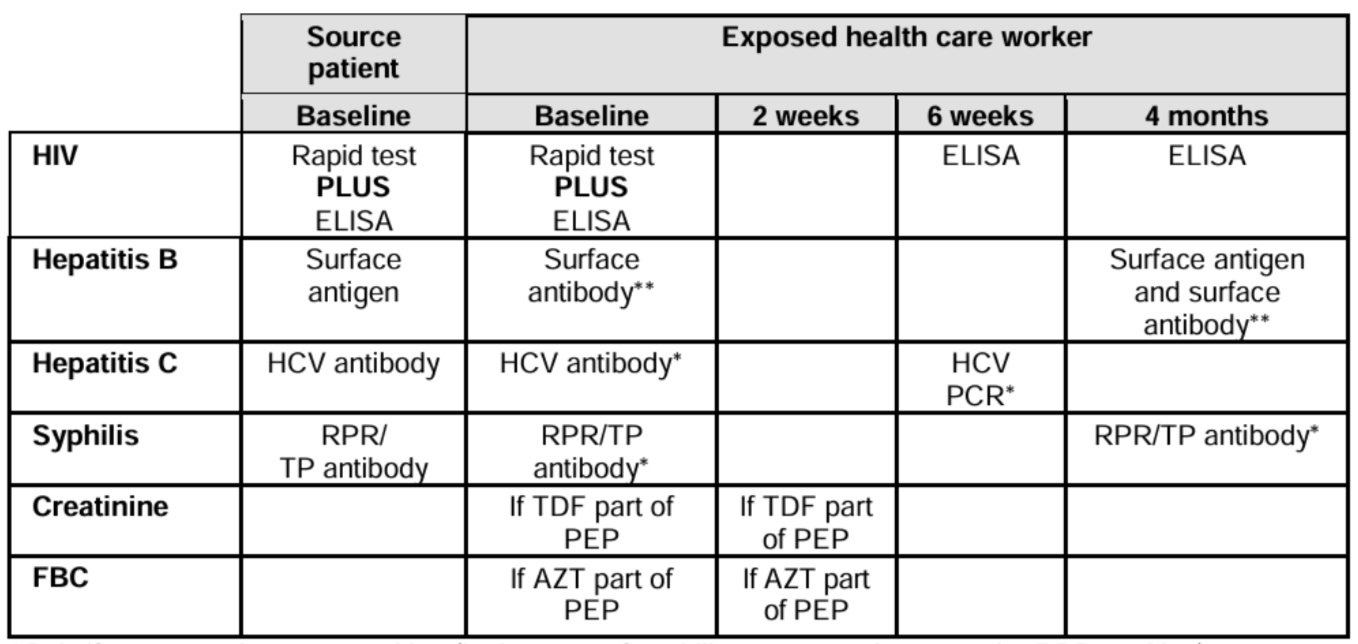
*Only if source patient was positive (in the case of syphilis, source patient must be RPR positive)
**Only if source patient was positive AND health care worker unvaccinated or HBsAb <10 units/mL
Click on the image to enlarge.
MEDICINE TREATMENT
1. Prevent HIV:
ICD-10 code: Z20.6 + (Z57.8+X58.92+Z29.8)
- Initiate HIV PEP immediately after the injury - within 72 hours. Do not wait for the confirmatory test results on the source patient and health care worker.
- If higher risk exposure (defined above) consider initiation of treatment beyond 72 hours, as the risks of prophylaxis in this setting may outweigh the benefits. Avoid initiating PEP beyond 7 days after exposure.
Note: HIV PEP is not indicated if:
- HCW exposed to body fluids which carry no risk of infection, e.g. vomitus, urine, faeces or saliva.
- HCW is HIV-infected. Stop PEP if HIV test of the health care worker is positive at the time of the injury.
- The source is HIV sero-negative unless there are features suggesting seroconversion illness.
- Continue prophylaxis until the results of additional tests are available.
- These cases should be discussed with virologists.
Table 21.14: PEP for healthcare worker following occupational HIV exposure.
| Exposure | HIV Status of source patient | |
| Negative | Unknown or Positive | |
| Intact skin | no PEP | no PEP |
| Mucosal splash or non-intact skin or percutaneous injury |
no PEP |
PEP: |
When PEP is indicated (administered preferably as a fixed-dose combination):
- Tenofovir (TDF), oral, 300 mg daily for 4 weeks (provided baseline eGFR is >50 mL/minute).
AND
- Lamivudine (3TC), oral, 300 mg daily for 4 weeks
AND
- Dolutegravir (DTG), oral 50 mg once daily for 4 weeks.
If DTG is not tolerated:
- Tenofovir (TDF), oral, 300 mg daily for 4 weeks (provided baseline eGFR is >50 mL/minute).
AND
- Emtricitabine (FTC), oral, 200 mg daily for 4 weeks.
AND
- Atazanavir/ritonavir 300/100 mg daily for 4 weeks.
OR
- Lopinavir/ritonavir (LPV/r) 200/50 mg, oral, 2 tablets 12 hourly for 4 weeks.
If tenofovir is contraindicated or if source patient is known to be on a failing tenofovir based regimen, replace tenofovir and emtricitabine with:
- Zidovudine (AZT), oral, 300 mg 12 hourly for 4 weeks.
AND
- Lamivudine (3TC), oral, 150 mg 12 hourly for 4 weeks.
Note: Adverse effects of PEP:
- PEP is generally not well tolerated. Adverse effects occur in about half of cases and therapy is discontinued in about a third. Efavirenz is not recommended as it is very poorly tolerated in PEP.
- TDF is contra-indicated in renal disease or with concomitant use of nephrotoxic medicines, e.g. aminoglycosides (check baseline creatinine clearance). Where TDF is contraindicated, switch to AZT. If AZT is not tolerated, consult or refer for further management.
- Zidovudine often causes nausea and headache and so should only be given if TDF is contraindicated.
- If dolutegravir is not tolerated, give ATV/r as the first choice protease inhibitor as LPV/r frequently causes gastrointestinal side effects. ATV/r may commonly cause jaundice (i.e. unconjugated hyperbilirubinaemia without hepatitis) which is harmless.
- If the source patient is known to be on a failing ART regimen, modification of the PEP regimen may be required. Consultation with a virologist or infectious diseases physician is recommended for advice on which antiretroviral medicines to use for PEP
- If the patient is on AZT or stavudine then TDF should be used.
- Patients on a failing second line ART regimen almost always have no resistance to protease inhibitors, so ATV/r or LPV/r should still be effective.
2. Prevent hepatitis B
Decide on what treatment to give the exposed person according to the vaccination status (and antibody response) of the exposed person, as well as the HBsAg results of the source patient, if known.
PEP following hepatitis B exposure:
ICD-10 code: Z20.5 + (Z57.8+X58.92+Z29.8)
Table 21.15: PEP for healthcare workers following hepatitis B exposure
| Vaccination status and antibody response status of HCW | Source patient status & treatment | ||
| HBsAg positive | HBsAg negative | HBsAg unknown | |
| Unvaccinated OR vaccination incomplete | - HBIG, IM, 500 units* - Hep B vaccine (3 doses at monthly intervals) |
- Initiate Hep B vaccination (month 0, 1 and 6) | - HBIG, IM, 500 units* - Hep B vaccine (3 doses at monthly intervals) |
| Vaccinated AND HBsAb ≥10 units/mL# | No treatment | No treatment | No treatment |
| Vaccinated AND HBsAb <10 units/mL | - HBIG, IM, 500 units* - Repeat Hep B vaccine (3 doses at monthly intervals) |
- Initiate Hep B vaccination (month 0, 1 and 6) | - HBIG, IM, 500 units* - Repeat Hep B vaccine (3 doses at monthly intervals) |
* HBIG and first dose of vaccine to be given simultaneously, but at different sites. # If the delay in obtaining HBsAb results is more than 7 days initiate treatment as for vaccinated AND HBsAb < 10 units/mL. After vaccination ensure the health care worker has a HBsAb ≥ 10 units/mL 1 – 2 months after the last vaccine dose.
Click on the image to enlarge.
REFERRAL
Note: Refer if there are inadequate resources with regard to:
- counselling
- laboratory for testing
- medico-legal examination
- medicine treatment
Click here for the NEMLC Recommendations for medicine amendments (2020-4 review cycle).
Standard Treatment Guidelines and Essential Medicines List for South Africa, Primary Healthcare, 2020-4_Version 1.1_October 2024
Chapter 21: Emergencies and Injuries