Post Resuscitation Care
Once children have been successfully resuscitated and emergency treatment provided, they remain at high risk for death or disability. In order to optimise outcomes, the following principles of care apply: Admit or refer to ward with appropriate monitoring facilities e.g. high care or intensive care unit as soon as possible. Identify and manage underlying pathology. Maintain normoxia (avoid both h
Once children have been successfully resuscitated and emergency treatment provided, they remain at high risk for death or disability.
In order to optimise outcomes, the following principles of care apply:
- Admit or refer to ward with appropriate monitoring facilities e.g. high care or intensive care unit as soon as possible.
- Identify and manage underlying pathology.
- Maintain normoxia (avoid both hyperoxia and hypoxia).
- Avoid hypo- and hypercapnia,
- Maintain systolic BP ≥5th percentile for age (See: Cardiovascular System, Hypertension); this may require intravascular fluids and/or inotropes.
- Avoid hyperthermia and treat fever aggressively.
- Provide adequate nutrition.
- Monitor and correct glucose and electrolyte abnormalities.
- Provide appropriate analgesia.
- Consider rehabilitation requirements.
TERMINATION OF RESUSCITATION
- The decision to stop CPR attempts depends on the specifics of the individual patient and should be based on clinical judgement.
- Consider stopping resuscitation attempts and pronouncing death if there is incurable underlying disease, or if asystole > 20 minutes.
Consider carrying on for longer especially with:
- hypothermia and drowning,
- poisoning or medicine overdose,
- neurotoxic envenomation (e.g. black and green mamba or Cape cobra snakebite) – see Snakebites.
This decision should take into consideration the potential risk that CPR poses to the rescuer, e.g. infectious diseases.
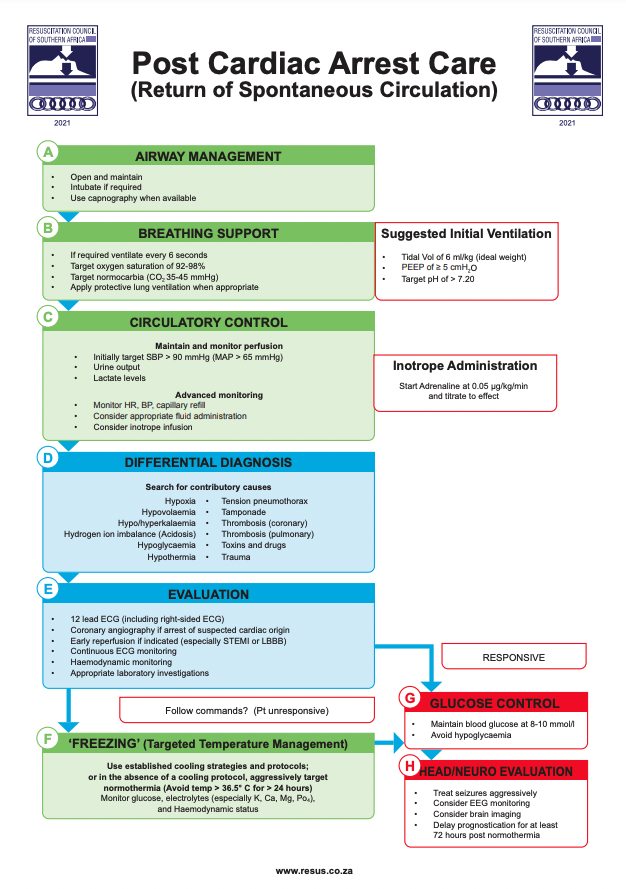
Click on the image to enlarge
Standard Treatment Guidelines And Essential Medicines List For South Africa, Hospital Level, Paediatrics, 2023 Edition
Chapter 1: Emergencies and Trauma, 1.1 Paediatric Emergencies, 1.1.5 Post Resuscitation Care