Practice Recommendations for Sorpion Envenomation (in the Absence of Antivenom)
Scope and Purpose Clinical Question: Concise statement describing the clinical dilemma Structured PICO Evidence Synthesis Approach Summary of Evidence and Contextual Considerations - Risk Stratification and Severity Grading - Role of the Poisons Information Helpline in Species Identification - Limitations of Existing Severity Scoring Systems - Differences in Clinical Presentation: Adults vs Child
Scope and Purpose
Clinical Question: Concise statement describing the clinical dilemma
Structured PICO
Evidence Synthesis Approach
Summary of Evidence and Contextual Considerations
- Risk Stratification and Severity Grading
- Role of the Poisons Information Helpline in Species Identification
- Limitations of Existing Severity Scoring Systems
- Differences in Clinical Presentation: Adults vs Children
- Contextual Relevance
Clinical Presentation and Management by Severity Grade
- Grade 1: Localised Envenomation
- Grades 2–4: Systemic Envenomation
- Management Principles for Grades 2–4
Scorpion Envenomation: Graded Management Summary Table
Disposition and Referral
- Grade 0–1 (Localised Envenomation Only)
- Grade ≥2 (Systemic Envenomation)
Contextual considerations
Summary of Recommendations
Endorsement and Approval
References
Date of Report: 09 June 2025
Prepared By: Christopher Straeuli, Patricia Leighton, Heike Geduld, Heinri Zaayman, Sa’ad Lahri, Clint Hendrikse
Request Origin: PTC
Scope and Purpose
These clinical practice recommendations provide focused guidance on the management of scorpion envenomation in the Western Cape, specifically in the context of the current unavailability of scorpion antivenom. This document is not intended as a comprehensive guideline on scorpionism, but rather addresses a critical evidence gap by offering practical, evidence-informed recommendations for frontline clinicians. The guidance reflects local epidemiology and resource constraints and was developed through a rapid evidence review and expert consensus process. Supportive care remains the cornerstone of management in the absence of antivenom. Clinicians are advised to refer to the AfriTox1 database or contact the Poisons Information Helpline (0861 555 777) for case-specific toxicology advice.
|
Summary of key recommendations
|
1. Clinical Question: Concise Statement describing the Clinical Dilemma
Scorpion envenomation is an uncommon but potentially life-threatening condition in South Africa. Over a 10-year period, the Tygerberg Poisons Information Centre recorded 740 cases, with nearly 20% classified as serious envenomations.2 Of these, 90% received antivenom. Most incidents occurred in the Western Cape and predominantly affected adults, although severe outcomes are more likely in children.2
It is important to note that this dataset likely reflects a referral bias: most reports are made by clinicians seeking guidance in moderate to severe cases, while mild stings or those managed outside the formal health system are less likely to be captured. As a result, the true incidence of serious scorpion envenomation may be lower than these figures suggest.
In Southern Africa, serious systemic toxicity is primarily caused by two Parabuthus species: P. granulatus and P. transvaalicus.3 These stings can result in fatal outcomes, particularly in younger patients.4 While national and international guidelines recommend antivenom for Grade 3–4 systemic envenomation, a recent national shortage—linked to production interruptions at the South African Vaccine Producers (SAVP)—has rendered antivenom inaccessible.
In this context, supportive care remains the cornerstone of management. Although the current antivenom shortage has prompted renewed focus on non-pharmacological interventions, it is important to emphasise that supportive care is essential regardless of antivenom availability. Antivenom has a delayed onset of action and may not prevent early complications, such as respiratory failure - particularly in paediatric patients. These practice recommendations aim to provide structured, evidence-informed guidance on supportive care that remains relevant both in the current context and when antivenom access is restored.
2. Structured PICO
| Component | Description |
| Population | People who sustained a scorpion sting, including all adults and children who access health care (via EMS or facility-based care) |
| Intervention | Standard care, which includes supportive management but WITHOUT scorpion antivenom |
| Comparator | Standard care, which includes supportive management AND scorpion antivenom |
| Outcomes(s) | Primary – mortality; Secondary outcomes – hospital length of stay, need for ventilatory support, ICU/HCU admission and length of stay |
3. Evidence Synthesis Approach
These recommendations were developed using a tiered evidence synthesis process:
- Rapid literature review: A focused search was conducted to identify relevant studies and existing guidance. Findings were pragmatically appraised for relevance and quality.
- Expert consensus: In the absence of sufficient high-certainty evidence, a structured consensus process was undertaken with a multidisciplinary group of clinicians and toxicology experts.
- Contextual adaptation: Recommendations were informed by expert clinical judgement and tailored to reflect local epidemiology, resource availability, and system-level constraints.
Consensus meeting date: 08/05/2025
Participants (Name/Role):
- Heike Geduld – Emergency Medicine, ECSS (Provincial Emergency Medicine)
- Carine Marks – Pharmacist and director of Tygerberg Poisons Information Centre
- Clint Hendrikse – Emergency Medicine, UCT, Head of Division
- Sa’ad Lahri – Emergency Medicine, SU, Head of Division
- Waseela Khan – Emergency Medicine, UCT
- Heinri Zaayman – Emergency Medicine, SU
- Pat Leighton - Emergency Medicine, UCT
- Thasveer Gansen – Emergency Medicine, SU
- Mignon Du Toit – Emergency Medicine, SU
- Chris Straeuli – Emergency Medicine, UCT
Reviewed by:
- Bradley Browne – Paediatrician, Director: Poisons Information Centre, Red Cross Hospital
- Kate Balme – Poisons Information Centre. Red Cross Hospital
4. Summary of Evidence and Contextual Considerations
These practice recommendations are based on a rapid review of the available literature, structured consensus among emergency medicine and toxicology experts, and contextual adaptation to the South African health system. Key issues considered are outlined below.
4.1 Risk Stratification and Severity Grading
- Early recognition of systemic envenomation is critical to reducing morbidity and mortality.
- The routine use of a severity grading system is recommended to aid risk stratification, identify patients requiring close observation or escalation of care, and facilitate communication between healthcare providers and poison centres.
- The adopted grading system is based on a contextual adaptation of the UpToDate5 classification and is preferred over the Poisoning Severity Score6 (PSS), which may under classify systemic toxicity in scorpion stings.
Severity Grades (Adapted)
- Grade 0: No signs or symptoms of envenomation
- Grade 1: Localised pain and/or paraesthesia at the sting site
- Grade 2: Pain or paraesthesia extending beyond the sting site
- Grade 3: Any of the above, plus cranial nerve dysfunction or somatic/autonomic neuromuscular signs
- Grade 4: All features of Grade 3 combined
- Use of the grading system enables early triage, helps prioritise transfer to higher levels of care (e.g. TBH, GSH, RXH), and promotes consistent documentation across sites.
4.2 Role of the Poisons Information Helpline in Species Identification
- If a photo of the scorpion is available, clinicians are strongly encouraged to consult the Poisons Information Helpline (0861 555 777) for expert review.
- Accurate identification is essential for risk assessment, particularly in distinguishing medically important species such as Parabuthus. While species-level identification may be challenging, simple morphological cues can assist: scorpions with thick tails and small pincers are more likely to be Parabuthus, whereas thin-tailed scorpions with large pincers are typically of lower medical significance.
- If the scorpion species is confirmed to be of low medical importance—i.e. unlikely to cause systemic envenomation—then the patient may be safely discharged with analgesia and appropriate follow-up advice.
4.3 Limitations of Existing Severity Scoring Systems
- The Poisoning Severity Score (PSS) may not adequately capture systemic toxicity from scorpion envenomation. In particular, patients with paraesthesia or systemic symptoms may still be classified as Grade 1 using PSS6 .
- The adapted UpToDate5 grading system allows for earlier detection of Grade 2 or higher severity and is more appropriate in the South African context, where delayed recognition and transport are major contributors to adverse outcomes.
4.4 Differences in Clinical Presentation: Adults vs Children
- Although most scorpion stings occur in adults (71% in local data), children are disproportionately affected by severe outcomes and mortality. 4
- Children under 13 years may present with distinct features, even in early systemic envenomation. These include:
- Excessive salivation
- Marked anxiety or hyperactivity
- Dyspnoea and early respiratory distress
- Autonomic dysfunction (e.g. tachycardia, hypertension)
- Unique behavioural features seen in paediatric systemic envenomation include:
- Agitation, restlessness, uncontrolled thrashing and flailing
- Crying, screaming, jerking movements
- Inability to remain still or be restrained
- Facial grimacing, lip-smacking, chewing-like motions
- These signs are highly abnormal and are often misinterpreted but should be viewed as clear indicators of Grade 3 or higher envenomation, requiring urgent escalation.
4.5 Contextual Relevance
- Local mortality is often related not to the direct effects of venom alone, but to delays in transport, missed early signs, and inadequate early resuscitation.
- As such, a structured and proactive approach to risk assessment—especially in children—is essential to reducing preventable deaths.
- The use of the adapted severity grading system facilitates:
- Triage and disposition planning
- Clear communication between referring and receiving facilities
- Decision-making regarding transfer to tertiary care centres
5. Clinical Presentation and Management by Severity Grade
Management of scorpion envenomation should be guided by clinical severity, informed by the adapted grading system. The approach is stratified below by grade, with specific attention to differences in adult and paediatric presentations.
5.1 Grade 1: Localised Envenomation
Clinical Features
- Pain localised to the sting site
- No remote symptoms or systemic signs
Management
- Analgesia:
- Administer oral paracetamol
- If applied early, local cooling with ice packs may help reduce pain and slow venom absorption. This is most effective when administered before the onset of severe hyperalgesia
- If pain is not controlled with oral analgesia, consider local anaesthetic infiltration (e.g. lignocaine without adrenaline, 3–5 mg/kg).
- Consider regional anaesthesia with longer-acting agents if expertise is available and pain is severe
- Supportive care:
- Irrigate wound if needed
- Provide tetanus prophylaxis as indicated
- NSAIDs may be used for analgesia if clinically appropriate and no contraindications exist (e.g., suspected renal impairment, active bleeding).
- Observation:
- Observe for 12–24 hours
- Discharge if no systemic symptoms develop
- If expert identification confirms a scorpion species of low medical significance, early discharge may be considered
5.2 Grades 2–4: Systemic Envenomation
Clinical Features
Symptoms may develop within 1–4 hours post-sting (up to 8 hours)
- Grade 2:
- Remote pain and/or paraesthesia
- Anxiety, hyperaesthesia
- Muscle cramps
- Grade 3:
- Cranial nerve dysfunction (dysphagia, drooling, dysarthria)
- Respiratory distress or failure
- Autonomic instability (tachycardia, hypertension, fever, sweating)
- Neuromuscular dysfunction (ataxic gait, weakness, myoclonic jerks, other involuntary movements)
- Grade 4:
- Combined features of Grade 3
Paediatric-Specific Presentation (Grade 3 and higher)
- Unexplained crying, restlessness, or agitation
- Abnormal movements: jerking, writhing, posturing
- Facial grimacing, lip-smacking, chewing-like motions
- Severe hypersalivation
- Early respiratory failure
- These features may mimic seizures or toxidromes and should trigger urgent escalation
5.3 Management Principles for Grades 2–4
Pain Management
- Continue Grade 1 analgesia strategies
- Add fentanyl (intranasal or IV) if available and clinically indicated
- Morphine is not preferred due to increased histamine release
Airway Management
- Respiratory depression is the leading cause of mortality, especially in children
- Clinicians must anticipate airway deterioration and act early
- Prepare for intubation in all Grade 3 or 4 cases, particularly in agitated children
Intubation Strategy
- Premedication: Consider short-acting benzodiazepine (e.g., midazolam) to permit preoxygenation in extremely restless patients
- Induction:
- Preferred: Etomidate (0.2-0.3 mg/kg)
- Alternative: Ketamine (2 mg/kg)
- Alternative: Propofol (if operator expertise is available)
- Muscle Relaxant:
- Preferred: Rocuronium (0.9–1.2 mg/kg)
- Alternative: Suxamethonium (less effective theoretically due to neuromuscular pathophysiology)
- Ketamine is a reasonable and safe first-line induction agent in children, particularly where clinicians are familiar with its use. Although ketamine can increase secretions, this is generally manageable and should not preclude its use. In the presence of bulbar dysfunction4 , however, excessive salivation may complicate airway management. Clinicians should be aware of this possibility and prepare accordingly.
Ventilation Strategy
- Volume-controlled mode with lung-protective strategy (tidal volume 6–8 mL/kg)
- Initial PEEP: 5–6 cm H₂O
- Titrate FiO₂ and PEEP based on oxygenation and evidence of pulmonary oedema
- Consult a specialist if the clinician is not experienced with ventilated patients
Circulatory Support
- Monitor for autonomic instability (tachycardia, hypertension)
- Treat with sedation and analgesia
- If persistent, consider labetalol infusion—but only under senior guidance
Neuromuscular Symptoms / Muscle Cramps
- Consider a slow IV infusion of 10% calcium gluconate (10 mL over 5–10 minutes)
- Adults: 10 mL over 5–10 minutes
Children: 0.5 mL/kg (maximum 10 mL) over 5–10 minutes - Duration of effect: ~20–30 minutes
- Maximum of one repeat dose
- Adults: 10 mL over 5–10 minutes
Bronchospasm
Administer inhaled β2-agonist therapy (e.g., salbutamol) if bronchospasm is present
Sedation Prior to and After Intubation
- Before intubation:
- Children: Midazolam may be required to facilitate intubation
- Adults: If agitation persists despite analgesia, titrated midazolam is recommended
- After intubation:
- Midazolam and morphine infusion
- Alternatively, propofol/morphine combination if available
Scorpion Envenomation: Graded Management Summary Table
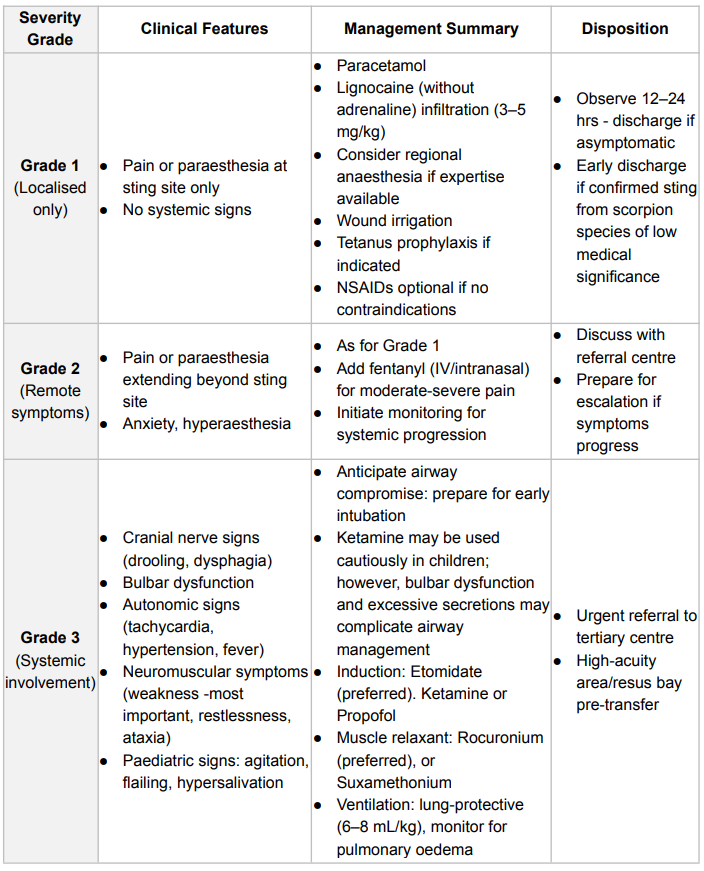
Click on the image to enlarge.
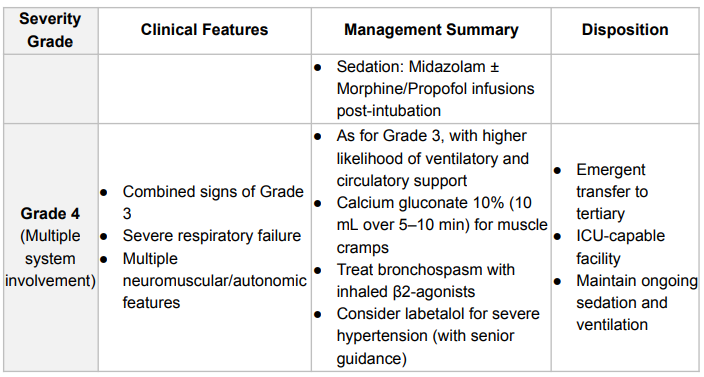
Click on the image to enlarge.
Unlike in cytotoxic snakebites, NSAIDs are not contraindicated in scorpion envenomation. They may be used for pain control provided there are no individual contraindications (e.g., renal impairment, active bleeding). Concerns raised in snakebite literature regarding NSAID-associated complications are not directly applicable to neurotoxic scorpion stings.
6. Disposition and Referral
Clinical disposition should be guided by the severity grading, available resources, and proximity to a higher-level facility. All patients with systemic signs of envenomation (Grade 2 and above) require early discussion with a referral centre.
6.1 Grade 0–1 (Localised Envenomation Only) Disposition:
- Observe at the base facility for 12–24 hours post-sting.
- If no systemic symptoms develop, discharge with analgesia and clear return instructions.
- If the scorpion has been positively identified by an expert as being of low medical significance, the patient may be discharged earlier, provided pain is controlled.
Safety Netting:
- Advise the caregiver/patient to return immediately if symptoms progress (e.g., agitation, difficulty breathing, excessive salivation, or weakness).
6.2 Grade ≥2 (Systemic Envenomation)
Disposition:
- All patients with Grade 2 or higher severity must be discussed with a referral centre (e.g., Tygerberg Hospital, Groote Schuur Hospital, Red Cross War Memorial Children’s Hospital).
- Transfer to a tertiary facility should be arranged for patients with:
- Bulbar or respiratory symptoms
- Autonomic instability
- Severe agitation or behavioural disturbance (particularly in children)
- Anticipated need for ventilatory or intensive care support
Stabilisation Prior to Transfer:
- Move the patient to a high acuity/resuscitation area.
- Secure airway, breathing, and circulation (ABCs).
- If transfer is delayed and intubation is required, ensure continuous sedation and ventilation support on route.
-
Contact the Poisons Information Helpline at 0861 555 777 for further guidance and support with ongoing management or triage decisions.
Referral Communication:
- Use the adapted severity grading system in all referrals to facilitate consistent and rapid clinical handover.
7. Contextual Considerations
These recommendations were developed in response to a critical gap in guidance during a period of national antivenom shortage. They reflect the realities of the South African health system and aim to support safe, feasible, and equitable care for patients with scorpion envenomation.
| Factor | Consideration |
| Risk–Benefit | The absence of antivenom increases the risk of adverse outcomes in severe cases. These recommendations aim to mitigate harm by standardising supportive care and early escalation. |
| Feasibility | All recommendations are designed to be implementable within the existing provincial emergency care system, using available medications, equipment, and personnel. |
| Cost and Resources | No additional direct costs are anticipated. Dissemination will be supported via EMGuidance and existing platforms without requiring new infrastructure. |
| Acceptability | A multidisciplinary group of emergency medicine and toxicology experts contributed to these recommendations, ensuring broad clinical relevance and alignment with frontline practice. |
| Equity | By standardising clinical care, these guidelines aim to improve outcomes in rural and under-resourced settings, where delayed transport and limited specialist access increase risk. |
| Practice Variation | In the absence of high-certainty evidence, some variation in practice is expected. These recommendations aim to reduce unwarranted variation by providing structured clinical pathways. |
| Urgency | The nationwide shortage of scorpion antivenom creates an urgent need for interim guidance. These recommendations provide timely support to clinicians during this high-risk period. |
| Guideline Alignment | These recommendations are aligned with national Standard Treatment Guidelines (STGs)7 , AfriTox1 , and UpToDate5. They provide contextualised advice in the absence of locally specific Western Cape guidance. |
8. Summary of Recommendations
These clinical practice recommendations provide structured, context-specific guidance for the management of scorpion envenomation in the absence of antivenom. They are intended to support safe, standardised care, improve early recognition, and guide appropriate escalation.
8.1 Species identification should be attempted via the Poisons Information Helpline (0861 555 777). Early expert confirmation of scorpions species of low medical significance allows for safe discharge with symptomatic care.
8.2 Use a standardised severity grading system (adapted from UpToDate5 ) to guide triage, treatment, and inter-facility communication. This system is preferred over the Poisoning Severity Score in this context.
8.3 Grade 1 (localised envenomation) can be managed with analgesia, wound care, and observation. NSAIDs may be used for pain control if no contraindications are present. Discharge may be considered after 12–24 hours if no systemic symptoms develop.
8.4 Grade 2–4 (systemic envenomation) requires escalation of care. Early recognition and referral are critical. Anticipate the need for airway protection, particularly in paediatric patients.
8.5 In children, restlessness, agitation, and abnormal movements (e.g., flailing, grimacing, lip-smacking) may indicate severe systemic involvement. These are not behavioural signs, but markers of Grade ≥3 envenomation.
8.6 Intubation should be considered early in patients with bulbar symptoms, respiratory distress, or severe agitation. Etomidate and rocuronium are the preferred agents. Avoid ketamine.
8.7 Ventilation should follow lung-protective strategies. Monitor closely for pulmonary oedema. Sedation post-intubation should include midazolam ± morphine or propofol.
8.8 All cases of Grade ≥2 must be discussed with a referral centre. Use the severity grading system to structure referrals and ensure consistent communication.
These recommendations are conditional, based on expert consensus and low-certainty evidence. They are intended as interim guidance during the current antivenom shortage.
9. Endorsement and Approval
These recommendations were developed by a multidisciplinary panel of clinicians and toxicology experts through a structured consensus process. They are formally endorsed by the academic heads of Emergency Medicine at Stellenbosch University and the University of Cape Town.
| Name | Position | Affiliation | Date |
| A/Prof Sa’ad Lahri | Head of Division: Emergency Medicine | Stellenbosch University | 09 June 2025 |
| A/Prof Clint Hendrikse | Head of Division: Emergency Medicine | University of Cape Town | 09 June 2025 |
For queries related to these recommendations, contact:
Poisons Information Helpline – 0861 555 777
AfriTox Database – www.afritox.co.za
10. References
- Poisons Information Centre RCCH. AfriTox [Internet]. [cited 2025 Jun 2]. Available from: https://www.afritox.co.za/
- Marks CJ, Muller GJ, Sachno D, Reuter H, Wium CA, Du Plessis CE, et al. The epidemiology and severity of scorpion envenoming in South Africa as managed by the Tygerberg Poisons Information Centre over a 10 year period. Afr J Emerg Med Rev Afr Med Urgence. 2019 Mar;9(1):21–4.
- Müller GJ, Modler H, Wium CA, Veale DJH. Scorpion sting in southern Africa: diagnosis and management. Contin Med Educ [Internet]. 2012 [cited 2025 Jun 2];30(10). Available from: https://www.ajol.info/index.php/cme/article/view/83136
- Müller GJ. Scorpionism in South Africa. A report of 42 serious scorpion envenomations. South Afr Med J Suid-Afr Tydskr Vir Geneeskd. 1993 Jun;83(6):405–11.
- LoVecchio F. Scorpion envenomation causing neuromuscular toxicity (United States, Mexico, Central America, and Southern Africa) [Internet]. [cited 2025 Jun 2]. Available from: https://sniv3r2.github.io/d/topic.htm?path=scorpion-envenomation-causing-neuromuscular-toxi city-united-states-mexico-central-america-and-southern-africa
- Persson HE, Sjöberg GK, Haines JA, Pronczuk de Garbino J. Poisoning severity score. Grading of acute poisoning. J Toxicol Clin Toxicol. 1998;36(3):205–13.
- NHI – EDP – STGs and EML – National Department of Health [Internet]. [cited 2025 Jun 2]. Available from: https://www.health.gov.za/nhi-edp-stgs-eml/
Emergency Medicine Cape Town, Clinical Practice Recommendations (EM-CPR)_Scorpion Stings Practice Recommendations_Practice Recommendations for Scorpion Envenomation (in the Absence of Antivenom)_Version Control: 1.2_Review Date: 12 June 2025