Pre-Exposure Prophylaxis (PREP)
Please click on the link below to access the most up-to-date version of this guideline. The content on this page is currently being updated to align with the latest publication. Always check the version number at the bottom of the screen to confirm which version you are using. Click here to access the Primary Health Care - PHC Chapter 11: Human Immunodeficiency Virus and Acquired Immune Deficienc
Please click on the link below to access the most up-to-date version of this guideline. The content on this page is currently being updated to align with the latest publication. Always check the version number at the bottom of the screen to confirm which version you are using.
Click here to access the Primary Health Care - PHC Chapter 11: Human Immunodeficiency Virus and Acquired Immune Deficiency Syndrome (HIV and AIDS) - 26 February 2026
Description
Contraindications to PrEP
Oral PrEP Regimen
PrEP Safety
Stopping PrEP
Referral
Z20.6 + Z29.2
Consult the most recent National Department of Health Guideline for PrEP eligibility criteria.
DESCRIPTION
Pre-exposure prophylaxis (PrEP) is the use of antiretroviral medicines by HIV-negative individuals before potential exposure to HIV to prevent them from acquiring HIV infection.
PrEP only protects against HIV infection; it does not offer protection against other STIs or pregnancy.
PrEP should be used as part of a package that also includes condoms; lubricants for anal sex; STI management; screening and management of intimate partner violence; sexual and reproductive health services; medical male circumcision; and HIV services, including counseling and testing, HIV management, ART, and PEP.
All individuals requesting PrEP should be assessed and initiated if elgible.
Individuals initiated on PrEP must be:
- HIV-negative.
- At substantial risk of HIV infection.
- Willing and able to adhere to PrEP.
- Prepared to come for repeat HIV testing every 3 months.
- No contra-indications to tenofovir or emtricitabine.
- No suspicion of acute HIV-infection (see below: clinical features).
Clinical features of acute HIV infection
| Symptoms | Signs |
| Malaise, anorexia, myalgia, headache, sore throat, sore glands, rash | Fever, sweating, viral meningitis, generalised lymphadenopathy, hepatosplenomegaly, pharyngitis, truncal rash, orogenital herpetiform ulceration, oral/oesophageal candidiasis, cervical adenopathy |
CONTRAINDICATIONS TO PrEP
- Pre-existing HIV infection.
- Estimated creatinine clearance or eGFR < 60 mL/min.
- Use of nephrotoxic medicines e.g. aminoglycosides.
- Young women/men < 35 kg or < 15 years of age who are not Tanner stage 3 (sexual maturity) or greater.
- Unwilling or unable to adhere to daily PrEP.
ORAL PrEP REGIMEN
A fixed dose combination formulation of:
- Tenofovir disoproxil fumarate (TDF), oral, 300 mg daily.
AND
- Emtricitabine, oral, 200 mg daily.
LoE:Ia55
Note:
To reach adequate protective levels in tissues, 7 days of daily dosing are required. Individuals should be counselled that additional barrier protection should be used until therapeutic levels achieved.
LoE:IIIb56
Screening investigations before starting PrEP
| Investigation | Purpose | Action |
| HIV test (using algorithm in the HTS guidelines*) | Assessment of HIV status | If HIV-negative, consider PrEP If HIV-positive: Link to treatment and care services. |
| Estimated creatinine clearance/ eGFR | To identify pre-existing renal disease. | Do not initiate PrEP if creatinine clearance/eGFR < 60 mL/min. Repeat creatinine clearance after two weeks. If renal function returns to normal and other PrEP criteria are met, PrEP may be initiated. Refer for further investigation if renal function remains abnormal. |
| Hepatitis B surface antigen (HBsAg) | To diagnose chronic hepatitis B infection. To identify those eligible for vaccination against hepatitis B. |
Assess eligibility for vaccination if available (see table below).. If HBsAg-positive, do ALT prior to PrEP initiation.
|
| ALT if HBsAg-positive | If ALT persistently elevated or other abnormal liver function tests, refer for assessment. | |
| Urine pregnancy test | To identify if pregnant. | Provide counselling covering risk of HIV infection during pregnancy and benefits of taking PrEP. |
| RPR | To diagnose syphilis infection for treatment. | Manage according to STI guidelines. |
| Syndromic STI screening | To diagnose and treat STI. | Manage according to STI guidelines. |
Table 1: Screening investigations before starting PrEP
*HIV Testing Services guidelines
Note:
- If symptoms or signs of acute HIV infection are present, PrEP should be postponed until symptoms subside and a repeat rapid HIV test after 4 weeks remains negative.
- TDF + FTC is active against hepatitis B (HBV) infection. HBV infection is not a contra-indication to PrEP, but will require LFT monitoring. Discontinuation of TDF + FTC in patients with HBV requires referral to a specialist because of a risk of a hepatitis flare.
Hepatitis B immune status and PrEP eligibility
| Hepatitis B surface antigen (HBsAg) | Hepatitis B surface antibody (HBsAb) | Action |
| Negative (-) | Negative (-) | Start PrEP. Vaccinate concurrently if available |
| Negative (-) | Positive (+) | Start PrEP. No vaccine needed |
| Positive (+) | N/A | Refer for evaluation, if ALT > 2 times upper limit of normal. |
Table 2: PrEP eligibility determined by hepatitis B immune status
Note:
PrEP users with chronic hepatitis B infection who develop abnormal liver function tests should be referred for assessment.
PrEP follow up and monitoring
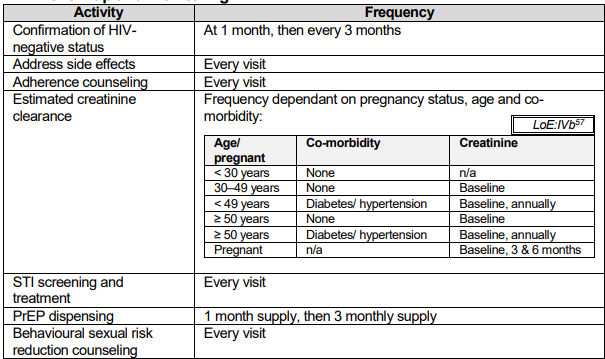
Table 3: Monitoring of person(s) on PrEP
Click on image to enlarge
PrEP SAFETY
Relevant medicine interaction information
| Medicine | Interaction information |
Advise |
| Standard TB medicines | No interaction | No need for dose adjustments |
| Hormonal contraception | No interaction | Hormonal contraception does not affect PrEP effectiveness, nor does PrEP affect hormonal contraceptive effectiveness |
| Nephrotoxic medicines | Increase risk of renal side effects | Avoid PrEP. Advise other prevention methods |
Table 4: Oral PrEP drug interactions
Side effects of TDF + FTC combination
| Major | Renal toxicity, decreased bone mineral density, extremely small risk of lactic acidosis and hepatic steatosis or steatohepatitis |
| Minor | Gastrointestinal symptoms (diarrhoea, nausea, vomiting and flatulence), unintentional weight loss |
Table 5: Side effects of oral PrEP
Note:
- Minor side effects are relatively common (approximately 1 in 10 individuals in the first 1-2 months).
- Mild and self-limiting; do not require discontinuation.
- Renal toxicity and decreased bone mineral density usually reversible upon stopping PrEP.
STOPPING PrEP
PrEP should be stopped if:
- Tests HIV-positive
- Renal disease develops
- Non-adherent to PrEP
- Does not need or want PrEP
- No longer meets eligibility criteria
- There are safety concerns where the risks of PrEP use outweigh potential benefit
Continue PrEP for 7 days after the last potential HIV exposure.
LoE:IVb58
Note:
Patients with chronic HBV may experience a hepatitis flare on discontinuation of PrEP.
REFERRAL
- HBsAg-positive, with abnormal ALT.
- Discontinuation of TDF + FTC in patients with HBV.
PrEP Initiation Algorithm
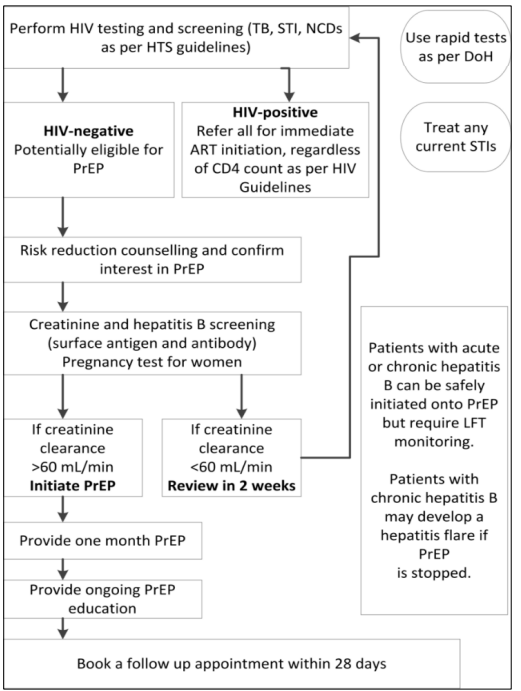
Figure 1: PrEP initiation algorithm
Click on image to enlarge
NOTE:
In patients with Chronic Kidney Disease (CKD) with eGFR < 60mL/min, PrEP is contrainUpdate in progressdicated.
Standard Treatment Guidelines and Essential Medicines List for South Africa, Primary Healthcare, 2020-2024_Version 2.1_09 December 2024
Chapter 11: HIV & AIDS: HIV prevention_11.11 Pre-exposure Prophylaxis (PrEP)