Pre-Transfusion
SANBS Guideline - Updated February 2020
Ordering of blood and blood products
Specimen collection
Patient identification
Requesting blood or blood products
Pre-transfusion testing
Benefits and risks of pre-transfusion testing options
Special requests, services and products
Blood on returnable basis (BRB)
Ordering of blood and blood products
Always remember the three most important rules:
- Identify the patient according to hospital protocol.
- Document all events prior, during and after transfusions.
- Communicate (doctor, patient, nursing staff and blood service provider).
Specimen collection
The doctor who orders blood is responsible for ensuring that the correct procedure is followed when taking
the sample for pretransfusion testing:
- Use only SANBS EDTA tubes.
- Do not use expired tubes.
- Identify the patient according to hospital protocol (see patient identification below).
- Complete the label on the specimen tube at the patient’s bedside from the information on the patient’s wristband.
- Ensure that the label with patient’s details is securely affixed to the specimen tube.
- The tube must be 3⁄4 full of the blood specimen. Please contact the blood bank to enquire about minimal sample volume required for paediatric patients.
- Record the date and time the specimen was taken on the specimen label.
- Sign both the specimen and the “Request for Blood or Blood Components” form.
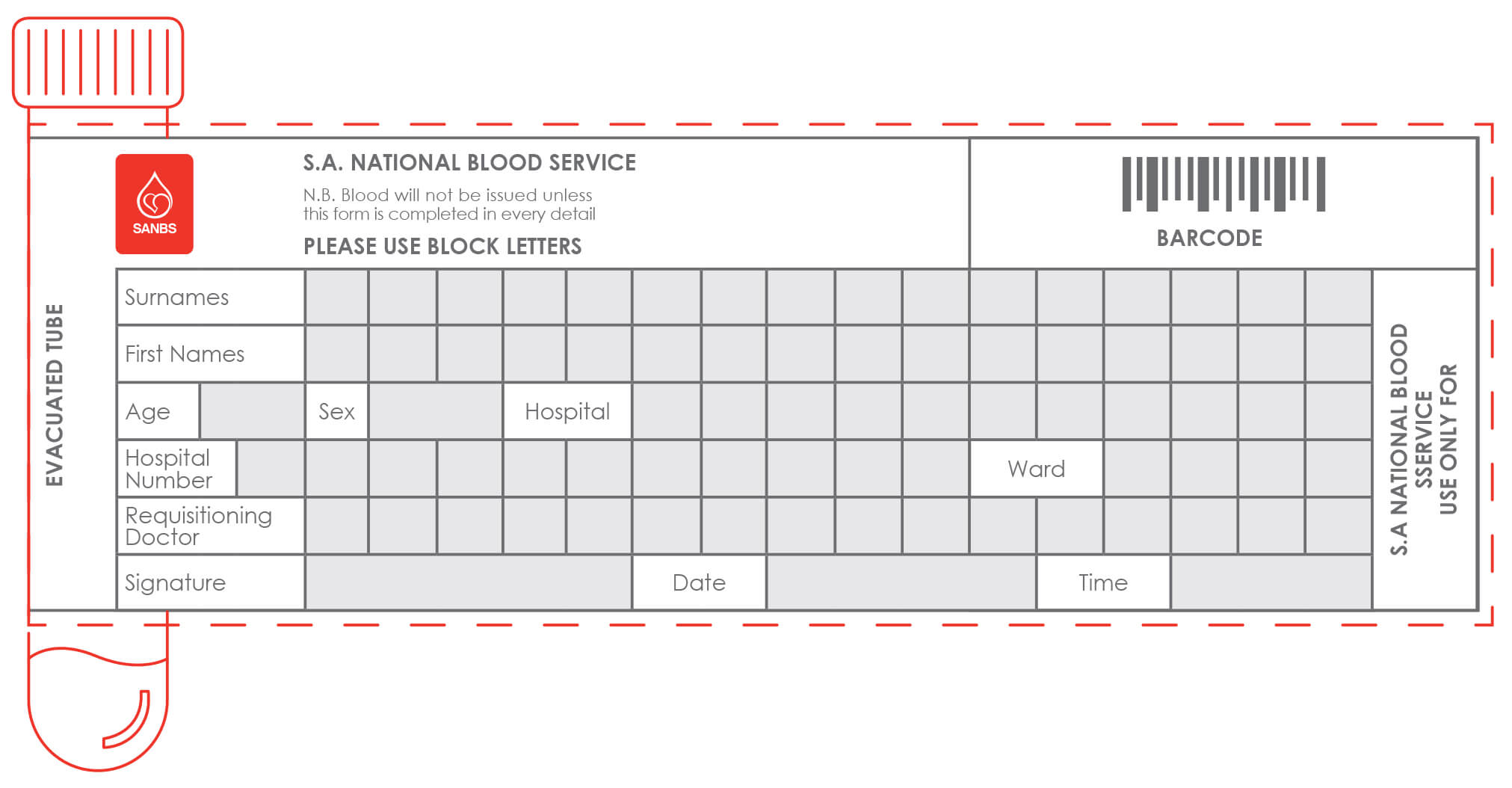
Click on the image to enlarge
Patient identification
- Each patient must wear an identification wristband with a unique hospital number.
- Check that the doctor has obtained and documented informed consent.
- Ask your patient: “What is your name, surname and date of birth?”
- Check doctor’s notes to confirm if a blood transfusion has been prescribed.
- Check that all the patient’s details, including hospital number, are identical on the doctors notes, the nursing notes and any other hospital records.
- Verify that all the patient’s details are identical on their wristband and the hospital records and that the patient has verbally confirmed their name, surname and date of birth.
Requesting blood or blood products
- If any special services (see below) are required, the doctor must discuss his / her request with the blood bank prior to submitting the order, as some products are not stored at the blood bank and may need to be transported from the processing centre to the blood bank in time.
- Incomplete or illegible request forms will not be accepted by the blood bank.
- The request form must contain the following information:
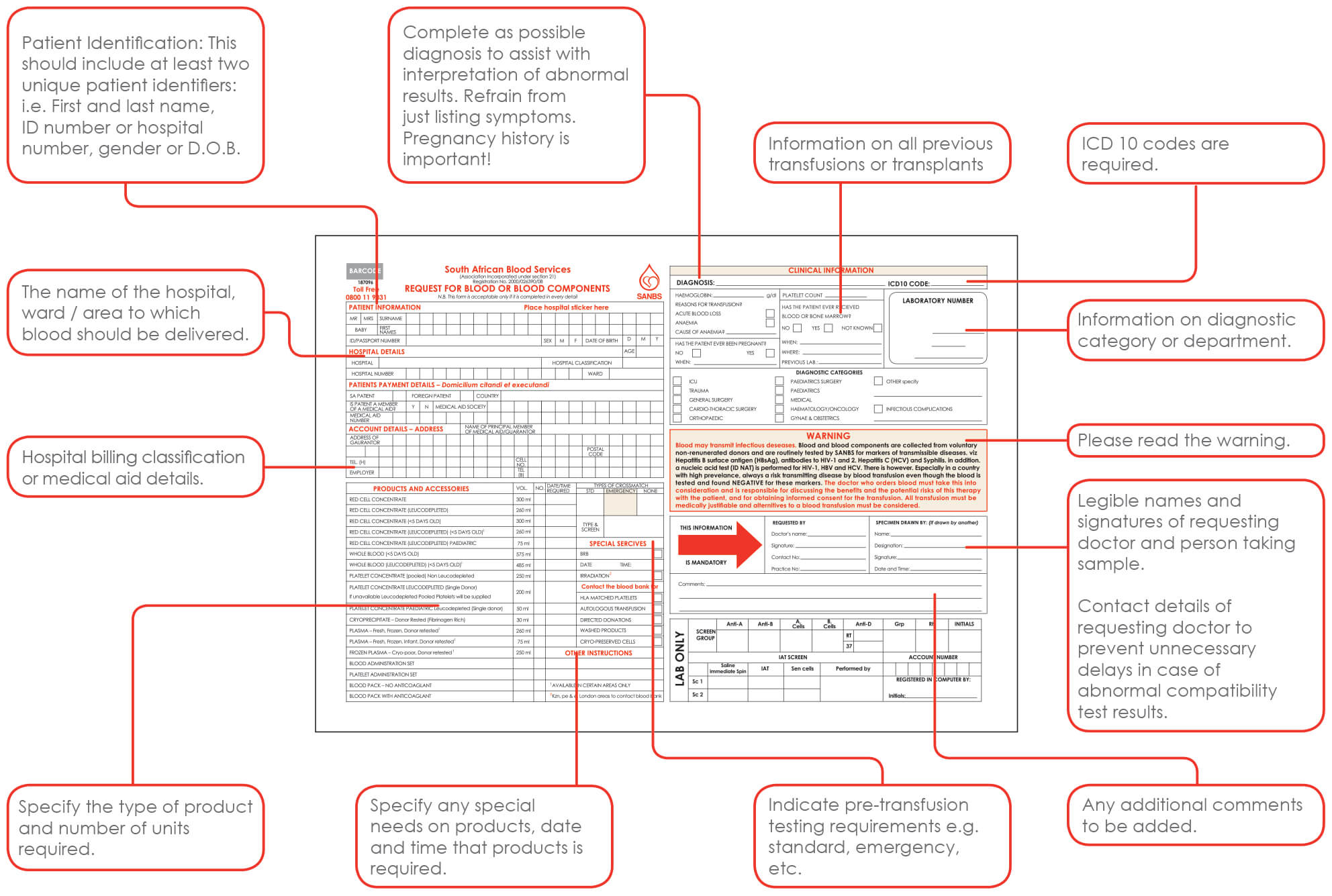
Click on the image to enlarge
All details of the request must be noted in the patient’s file to aid in preventing misdirected transfusions.
Pre-transfusion testing
SANBS laboratories perform two-phase compatibility testing as follows:
Phase 1:
- Using patient’s sample, determine the ABO and Rhesus grouping.
- Using the patient’s sample, do irregular antibodies screening.
Phase 2:
- Using the patient’s sample, reconfirm the patient’s ABO and Rh group.
- Reconfirm the ABO and Rh grouping of the donated unit.
- Using red cells from the donated unit and serum from the patient’s sample, perform a compatibility test between the donor and patient.
|
The use of uncross-matched blood exposes patients to a higher risk of transfusion reactions, as undetected antibodies may cause severe haemolytic reactions
|
Benefits and risks of pre-transfusion testing options
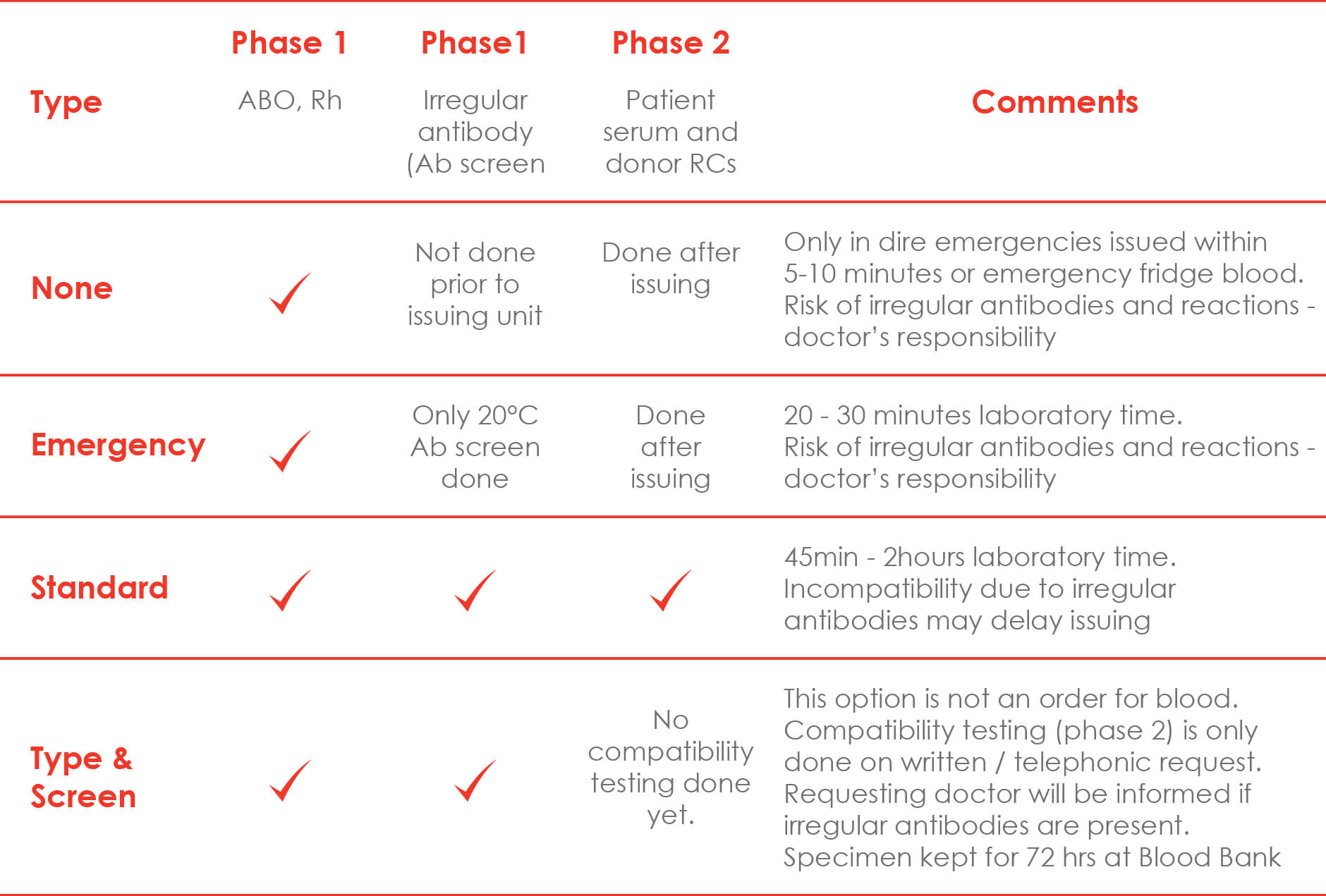
Click on image to enlarge
Times displayed in the above table indicate laboratory-testing time only and do not allow for delays in
transportation of samples and products to and from the blood bank.
Special requests, services and products
Special services / products available include:
- Irradiated products
- Washed products
- Filtered products
- HLA-matched platelet products
- Autologous and directed programmes
- Cryo-preserved cells
- Blood on returnable basis
For any special requests (e.g. washed, irradiated or filtered products), please notify the blood bank in advance. Please ensure that the specific requirements on storage / shelf-life / administration / documentation are adhered to when making use of the above services or products. Further detail is available from the blood bank or from Clinical Guidelines for the use of Blood Products in South Africa, 4th Edition.
Blood on returnable basis (BRB)
Where available, the BRB system assists in blood conservation programmes. Blood is issued in a BRB hamper with two separately sealable compartments. Units are packed with eutectics (ice packs) and temperature-monitoring devices. Unused units may be returned to the blood bank for credit and re-issued to another patient if:
- The compartment’s seal is unbroken
- The cold chain has been maintained (temperature loggers)
- The BRB hamper is returned to the blood bank within 12 hours or 24 hours depending on the validation period of that hamper
All units that were transfused must be meticulously recorded in the patient’s file.