Preserving Renal Function and Managing Complications of Renal Failure
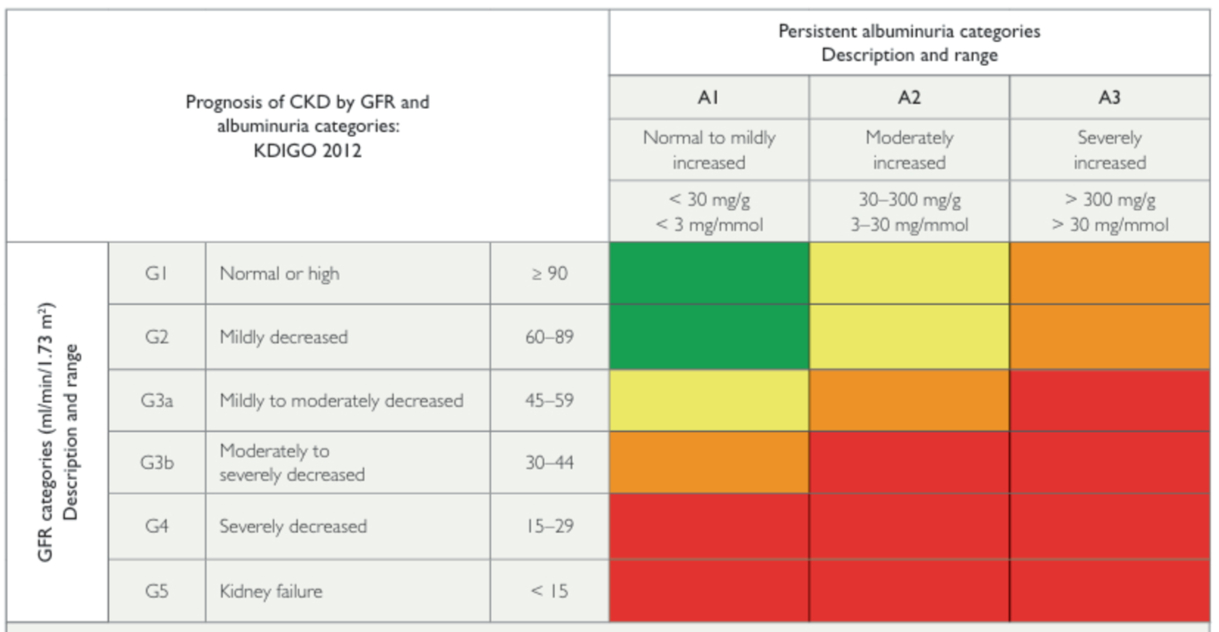
Screening for CKD must be conducted in high risk individuals at each interaction with the healthcare system. High risk individuals in South Africa include those with: Diabetes Hypertension Urological disorders Family history of renal disease Drug addicts (“tik”, cocaine) HIV-positive individuals. The guidelines that follow are specifically aimed at CKD stages 4 and 5 (Figure 1). Table 2 describes
Screening for CKD must be conducted in high risk individuals at each interaction with the healthcare system. High risk individuals in South Africa include those with:
- Diabetes
- Hypertension
- Urological disorders
- Family history of renal disease
- Drug addicts (“tik”, cocaine)
- HIV-positive individuals.
The guidelines that follow are specifically aimed at CKD stages 4 and 5 (Figure 1). Table 2 describes management strategies to preserve residual renal function and manage complications of CKD.
Click on the image to enlarge.
Figure 1. Classification of chronic kidney disease by GFR and degree of albuminuria. Patients at low or moderate risk for disease progression (green/yellow) should be followed up at least yearly, those at high risk (orange) twice-yearly, and those at very high risk (red) should be seen three or more times per year, as required. eproduced with permission from KDIGO [40,41]. bbreviations: CKD, chronic kidney disease; GFR, glomerular filtration rate; KDIGO, Kidney isease: Immproving Global Outcomes.
Table 2. Strategies to preserve residual renal function and manage complications of stages 4 and 5 CK [22].
| Aim/target of treatment | Non-pharmacological | Pharmacological | |
| General measure: Lifestyle |
Aim: to balance preservation of residual renal function while maintaining QOL | - Avoid and manage obesity - Avoid smoking - Salt restriction - Implementation of healthy lifestyles - Early identification and treatment of urinary tract infections - Education of patients on potentially nephrotoxic agents |
- Avoid over-the-counter medications/ illicit substance use/traditional medications - Avoid nonsteroidal anti-inflammatory drugs. - Ensure HIV is virally suppressed with ART (avoid TDF) - Avoid/temporarily discontinue ACEIs/ ARBs if dehydrated |
| BP (recommend review of the hypertension guideline) [42] | Aim: to optimise QOL, preserve physical and cognitive function and minimise the risk of orthostatic hypotension [22] BP target ± 160/90 mmHg |
- Salt restriction - Fluid restriction - Complementary therapies (e.g. relaxation techniques and music) |
Furosemide titrated to effect (titrate to 250 mg bd) Avoid K+ sparing agents if potassium is >5.6 mmol/L, i.e. (ACEi/ARB/ spironolactone) unless regular 3-monthly blood tests can be done |
| Fluid | Aim: avoid excessive intake and promote euvolemia | - Consider role of diet: fluids and sodium intake - Avoid table salt and cooking with salt - Avoid salt-containing spices and seasoning - Consider alternative flavouring agents - unsalted herbs, garlic, ginger, chillies - Avoid processed and canned foods |
Diuretics (if not anuric): - Loop diuretics are most effective: furosemide titrated up to 250 mg daily - If shor t of breath, seeTable 1 |
| Acidosis | Prevent symptoms associated with acidosis: SOB, nausea, mineral bone disease (MBD), appetite | Severe acidosis: - Treat acidosis to maintain bicarbonate >23 mmol/L and within upper limit of normal range [43,44] (level of evidence 2B) - Star ting dose: Citrosoda 4 g, sodium bicarbonate (1.5–2 g) or baking soda ½ teaspoon dissolved in 125 mL water = 26.8 mEq bicarbonate |
|
| Hyperkalaemia | Aim: to avoid fatal arrhythmia | - Avoid foods high in potassium (banana, avocado, potatoes, tomatoes) | - Avoid ACEi/ARB/spironolactone - Consider sorbitol/lactulose - Add/increase diuretics |
| Anaemia management See KDIGO guideline [34] | Aim: to preserve QOL and avoid symptomatic anaemia | - Surveillance of Hb and iron levels - Exclude other causes of anaemia |
- The overall aim is to treat symptomatic anaemia - Oral supplementation (e.g. iron sulphate 150 mg po daily (can be constipating)) - Iron supplementation: examples include Venofer /Rautevene/Zypiron/Cosmofer. IV iron can be given as a max dose of 200 mg IV stat or total dose infusions of 1000–2000 mg - Targets for CKD patients include transferrin saturation 20–30%, and ferritin >300 ng/mL - Erythropoietin (EPO) supplementation: only if the patient is symptomatic with anaemia and only if available to the patient - Transfusions of packed red cells may be necessary if the patient is symptomatic, particularly if EPO is not available |
| Calcium and phosphate metabolism: See KDIGO guideline [45] | Aim: should not be to focus on normalising biochemistry but rather on emphasising adequate nutrition | Emphasize adequate nutrition (avoid malnutrition) Avoid high phosphate containing food (dairy, nuts, legumes, etc.) - Liberalize the diet |
- Continue vitamin D supplementation, and phosphate binder if patient is tolerating (and if predicted survival is long) - Vitamin D 50 000 U weekly - Calcium carbonate/acetate up to 1500 mg total calcium per day take with meals (e.g. Titralac/chewable B-Cal/ Glycal II tds with food) |
| Diabetes See South African diabetes guidelines [46] | Aim: simplify medication regimens. As CKD progresses, the need for medications decreases. Less stringent HbA1C targets (8%) |
- Limited fruit and fruit juices - Healthy diabetic diet |
- Stop metformin in advanced CKD - Titrate down insulin – as CKD progresses, the need for insulin decreases and requires patient education and monitoring of blood sugar levels |
| Lipid | No evidence that statins provide benefit in context of significant frailty or decreased life expectancy [47,48] | Emphasize adequate nutrition | Stop statin |
| Managing medication | Not causing harm and simplifying medication regiments | - STOP ANY NON-ESSENTIAL MEDICATION (e.g. simvastatin) - Stop medications contraindicated in renal failure, e.g. metformin and digoxin - Adjust drug dose for renal function |
Abbreviations: HIV, human immunodeficiency virus; ART, antiretroviral therapy; TDF, tenofovir; QOL, quality of life; NSAID, non-steroidal anti-inflammatory drug; ACEi, angiotensin converting enzyme inhibitor; ARB, angiotensin receptor blocker; bd, twice daily; Hb, haemoglobin; BP, blood pressure.
Wearne, N., Krause, R., Davidson, B., and Brennan, F., 2020. Renal palliative and supportive care in South Africa – A consensus statement. African Journal of Nephrology, 23(1), pp.86-107.