Preventing the Spread of Infection
Supporting the Antimicrobial Resistance Strategy Framework and the Guidelines on Implementation of the Antimicrobial Strategy in South Africa: One Health Approach and Governance, 2018
Contact precautions
Droplet precautions
Transmission-based precautions are always IN ADDITION to standard precautions and are designed to interrupt transmission of highly transmissible or epidemiologically important pathogens based on the route of transmission.
Common practise to all three types of precautions include gloves, disposable gowns/ aprons and isolation of the patient, if indicated (see tablebelow ). In addition, the isolation cubicles, should ideally have their own dedicated equipment for patient use.
| Transmission-based precautions |
| Contact Gloves and placement |
| Droplet Facemask to protect mucous membrances |
| Airborne N95 respirator and negative pressure ventilation and placement |
Identifying when to use transmission-based precautions is the role of the IPC staff in consultation with the doctor, microbiologist and nurse in charge of the unit. A tool to support this task is the “alert organism list” which helps identify patients with resistant organisms in the hospital. An example of such a report is provided in Annexure C. “Alert” organisms are those that either necessitate an infection control intervention as they are important from a public health perspective (outbreak prevention or control) or may serve as an indicator of inadequate infection control practices or processes.
The action to be taken will depend on each hospital’s practices and should be undertaken in consultation with facility level microbiologists or infectious disease/ infection control experts and infection control guidelines. The nurse in charge of the ward and the doctor responsible for the patient concerned should be informed and be involved where necessary in any action is to be taken. Their role will be to implement and enforce appropriate IPC measures.
Contact precautions
Conditions and/or organisms (either colonising or pathogenic) which require contact precautions include the following:
- Antimicrobial-resistant bacteria transmitted by contact such as but not limited to methicillin-resistance Staphylococcus aureus (MRSA), Acinetobacter, Vancomycin-resistant enterococci, multiand extensively drug-resistant Gramnegative bacteria (GNB), Candida spp etc.
- Conditions: skin infections, diarrhoeal diseases.
- In addition, procedures such as wound dressing or where contact with faeces, urine, secretions or excretions is anticipated necessitate contact precautions.
Patients who need contact precautions should ideally be placed in a single room (if possible, with en suite ablution facilities or a commode) and the door closed. However, if such facilities are not available the patient should be nursed in the ward separated from the rest of the patients by at least 2 metres or cohorted (i.e. patients managed in adjacent beds).
There should be dedicated equipment used for the patient, ideally disposable, such as stethoscopes, blood pressure cuffs and thermometers. Should disposable equipment not be available then decontamination procedures in accordance with standard operating practices should be applied to the equipment used for infectious patients including those in isolation. The room should be cleaned thoroughly and disinfected between each patient use and after discharge (terminal cleaning). Any shared equipment is to be cleaned with hospital disinfectant (e.g. disposable detergent disinfectant-impregnated wipes) after each use. All linen, including bed curtains, should be removed after discharge.
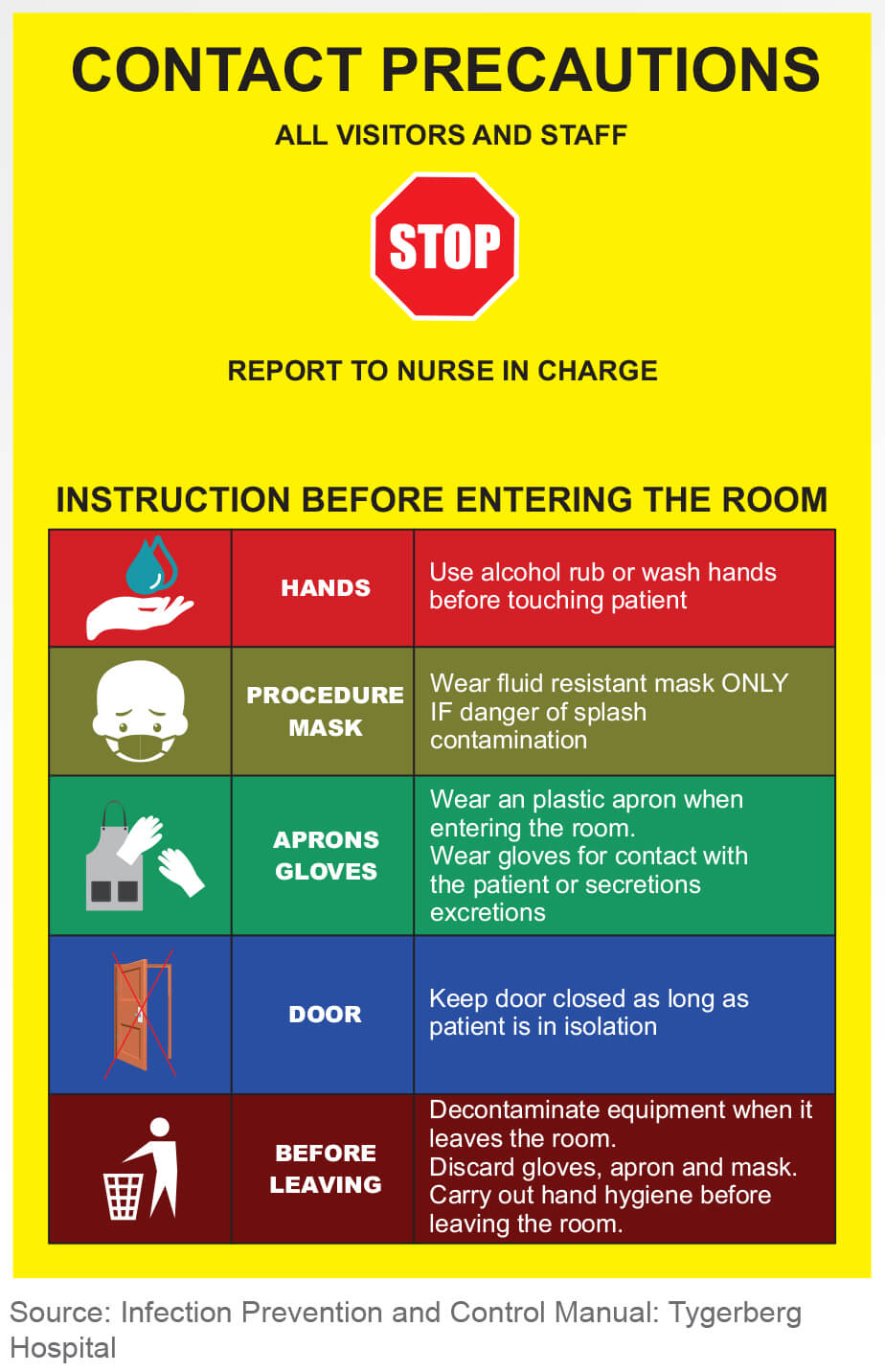
A “Contact Precautions” sign (see Contacts Precautions signage) should be affixed to the door to remind staff of the precautions they need to apply which include the following:
- Hand hygiene before and after entering the room.
- Put on gloves before entering the room.
- Put on a disposable gown/apron prior to entering the patient’s room when direct contact with the patient or the patient’s environment is anticipated.
- Keep door closed at all times.
- Remove and discard gloves and gown and clean hands before leaving the patient’s room or, in a semi-private room or multi-bed bay situation, before leaving the patient’s immediate vicinity.
Contact precautions signage
Click on image to enlarge
Contact precautions may be discontinued following consultation between the clinical and IPC teams but usually lasts until the patient is discharged.
Droplet precautions
Transmission occurs when droplets containing microorganisms generated from an infected person are propelled a short distance (about 1 metre) away, and come in contact with another person’s conjunctivae or mucous membranes (eyes, nose or mouth). Droplets do not remain suspended in the air but travel for short distances before they fall due to gravity, landing on surfaces surrounding the patient, thus contaminating the environment. Microbes transmitted by the droplet route include influenza and other respiratory viruses, and Neisseria meningitidis, the cause of meningococcal meningitis. Some viruses and bacteria survive outside the body in the presence of mucous, serum and organic matter.
Risk-prone procedures for droplet transmission in hospitals include:
- Coughing up or inducing sputum production for laboratory tests;
- Endotracheal suctioning (open and closed) of ventilated patients;
- Chest physiotherapy;
- Taking Chest X-Rays from patients who are coughing, especially with poor cough etiquette;
- Bronchoscopy;
- Re-use of ventilator circuits and respiratory equipment;
- Washing and cleaning respirator ventilation equipment in clinical areas without adequate knowledge or protection.
Patients on droplet precautions usually require a private room with the door closed at all times. Patients are encouraged to remain in their room except for essential purposes. However, if private rooms are not available the patient should either be nursed in the ward close to a window and separated from the rest of the patients by at least 2 metres or they should be cohorted.
A “Droplet Precautions” sign (see Droplet precautions signage) should be affixed to the door or at the bedside. HCWs should wear a face mask that covers the mouth and nose, such as a regular surgical mask, and eye protection (safety goggles, face shield) if high risk procedures that generate large numbers of droplets are being undertaken.
Droplet precautions may be discontinued when symptoms resolve or when criteria for discontinuing precautions have been met.
Droplet precautions signage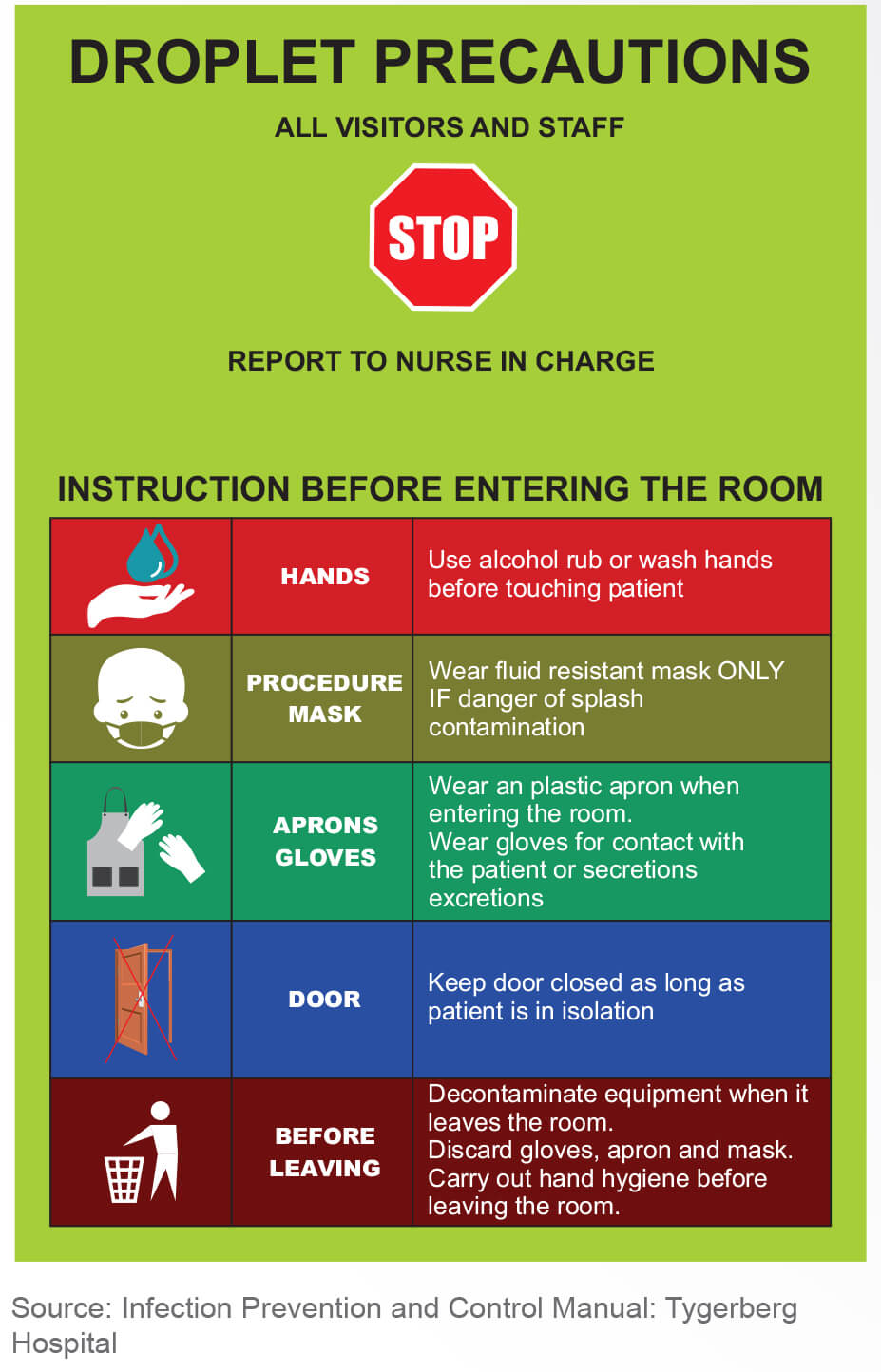
Click on image to enlarge
Airborne precautions
Airborne precautions are required for patients infected with tuberculosis, measles, and chickenpox. Airborne droplet nuclei (particles sized 5 microns or smaller) carry the microbe and may be released into the air to be carried via air currents. These droplet nuclei can remain suspended in the air for prolonged periods of time.
Negative pressure air handling (ventilation) is required for isolating patients diagnosed or suspected of being infected with the above organisms and should provide no less than 6 air changes per hour (ACH). Ideally a private negative pressure isolation room (NPIR) should be available within all facilities. In the absence of negative pressure ventilation, open window ventilation with fans may be used to reduce the microbial burden in the environment and should achieve around 6-12 ACH. All HCWs entering the room of a patient with suspected or confirmed tuberculosis, should wear a fit-tested N95 respirator or equivalent.
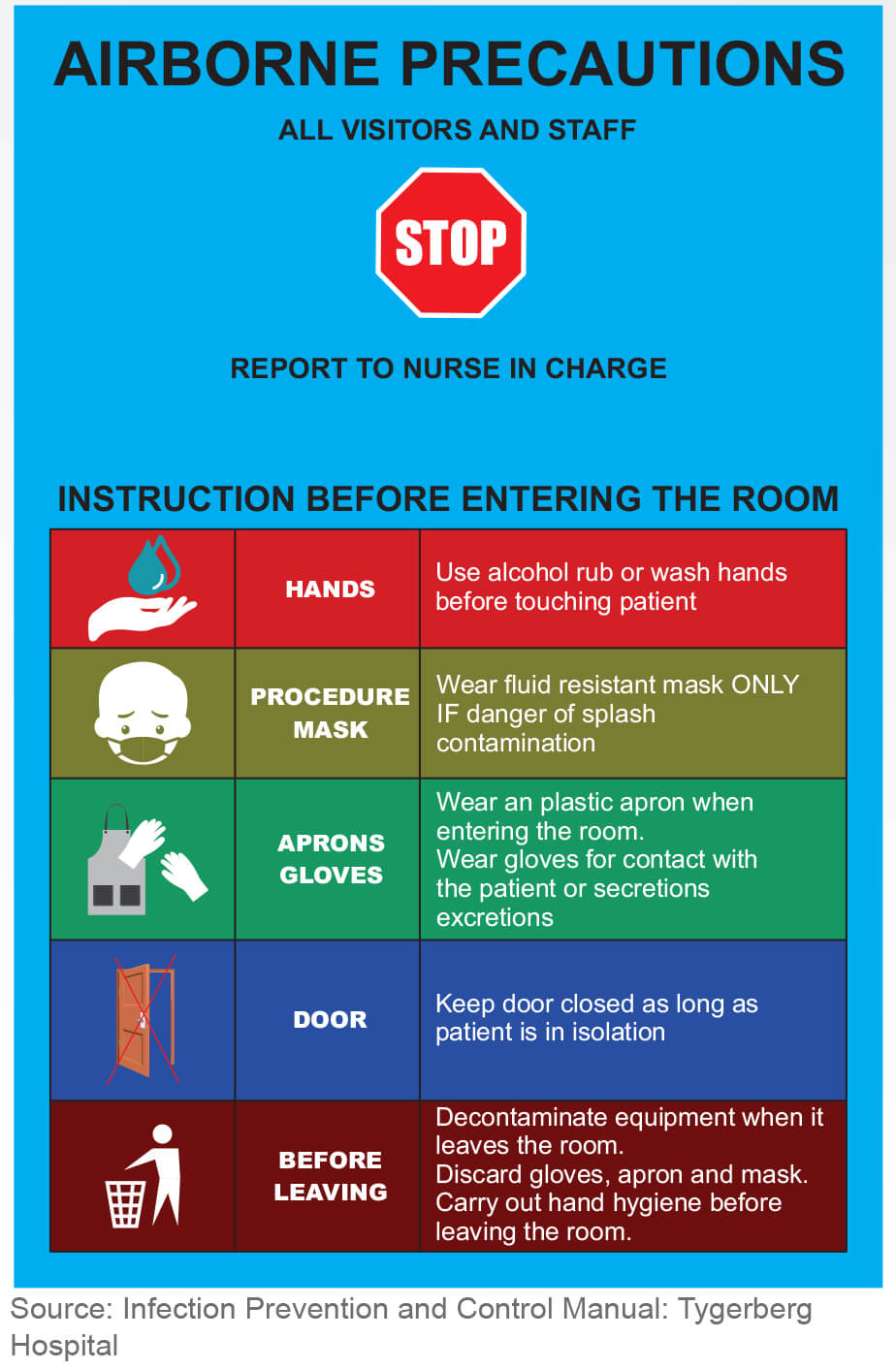
An “Airborne Precautions” sign (see Airborne precautions signage) should be affixed to the door. Airborne precautions may be discontinued following consultation between the clinical and IPC team or when the patient is discharged.
Airborne precautions signage
Click on image to enlarge