Prevention of influenza
Prevention of influenza Influenza vaccination is the most effective method for prevention and control of influenza infection available currently. In general, influenza vaccines are most effective among children ≥ 2 years and healthy adults. A meta-analysis including data from years when there was a mismatch between vaccine and circulating strains estimated a pooled vaccine efficacy (VE) of 59% (9
Prevention of influenza
Influenza vaccination is the most effective method for prevention and control of influenza infection available currently. In general, influenza vaccines are most effective among children ≥ 2 years and healthy adults. A meta-analysis including data from years when there was a mismatch between vaccine and circulating strains estimated a pooled vaccine efficacy (VE) of 59% (95% CI: 51-67) in healthy adults.[43] Previous studies from South Africa have reported influenza VE estimates from 2005 to 2015 which ranged between 46% and 87% when there was a good match and ranged between -14% and 38% when the circulating A(H3N2) strain showed marked genetic drift.[44, 45]
A randomised controlled trial conducted in South Africa has shown that when pregnant women received the influenza vaccine, their risk of developing influenza was halved, as was the risk to their infants in the first 24 weeks of life.[46] The vaccine has been shown not only to be efficacious for prevention of influenza in both mothers and their infants but also safe.[47-49] Trivalent influenza vaccine has been shown to provide protection in HIV-infected adults without severe immunosuppression.[50] Data are unclear as to the effectiveness in HIV-infected children aged <5 years. [51] In certain groups, including the elderly, immunocompromised individuals and infants, influenza vaccine is less effective; however, it may reduce the incidence of severe disease, e.g. bronchopneumonia, hospital admission and mortality.
1. Influenza vaccination
Because of the changing nature of influenza viruses, WHO monitors the epidemiology of influenza viruses throughout the world. Each year recommendations about strains to be included in the vaccine for the upcoming influenza season are made. Separate recommendations are made for the Southern and Northern Hemisphere vaccines each year.[52] In the presence of the pandemic of SARS-CoV-2, we strongly recommend influenza vaccination this year. It is highly likely that co-circulation of viruses will occur. Above average coverage of influenza vaccination may assist with reducing the number of people requiring hospitalisation. Groups at increased risk for severe influenza illness and COVID-19, listed in section 2.2 , should be prioritised for influenza vaccination.
1.1 Recommended influenza vaccine formulation for 2021
The following strains have been recommended for the trivalent and quadrivalent inactivated influenza vaccine (IIV) 2021 Southern Hemisphere influenza season[53]:
Egg-based tri/quadri-valent vaccines
- an A/Victoria/2570/2019 (H1N1)pdm09-like virus;
- an A/Hong Kong/2671/2019 (H3N2)-like virus;
- a B/Washington/02/2019-like (B/Victoria lineage) virus; and
- a B/Phuket/3073/2013-like (B/Yamagata lineage) virus*.
*Quadrivalent vaccine is available in private sector and limited number of doses in public sector.
These recommendations include a change to the A(H3N2) and A(H1N1) component of egg-based vaccines strains compared with the 2020 Southern hemisphere trivalent and quadrivalent IIV. For A(H1N1)pdm09 vaccine virus component, A/Brisbane/02/2018-like virus was replaced with A/Victoria/2570/2019-like virus and for the A(H3N2) vaccine virus component, A/South Australia/34/2019-like virus was replaced with an A/Hong Kong/2671/2019-like virus. The trivalent IIV is only available in the public sector (at designated clinics and hospitals), the quadrivalent IIV is available mostly in the private sector with limited doses in public sector, generally from March or April. Either trivalent- or quadrivalent IIV may be used during 2021 depending on cost and availability at the time.
1.2 Quadrivalent influenza vaccine
Quadrivalent IIV in South Africa was first introduced in private sector in 2020 and from 2021 it will be available in public and private sector. Quadrivalent IIV differs from trivalent IIV in that it provides active immunisation against four influenza virus strains (two A subtypes and two B lineages) compared to trivalent IIV which contains two A subtypes (influenza A(H1N1) and influenza A(H3N2) and a single B lineage (either B Victoria or Yamagata lineage). As influenza B is relatively more common in children than older age groups, the main clinical advantage of quadrivalent vaccines is in childhood.[47, 48] Some studies have suggested that the group who will most benefit from the additional influenza B lineage contained in QIV are individuals without pre-vaccination immunity to the lineage not contained in the TIV.[49] Children are more likely than adults to lack this pre-vaccination immunity because they will likely have had fewer preceding influenza infections. There is likely also some benefit from using quadrivalent IIV in healthcare workers and at risk adults, including pregnant women.
1.3 Preventing seasonal influenza during a Coronavirus disease 2019 (COVID-19) pandemic
Non - pharmaceutical interventions to prevent transmission of both influenza and COVID-19 should be promoted and influenza vaccination especially among groups at high risk of severe influenza illness and COVID-19 should be promoted.
1.4 Influenza vaccination and COVID-19
Influenza vaccination has no known efficacy against SARS-CoV-2. However, the signs and symptoms of influenza are similar to those of COVID-19. If available, influenza vaccination is recommended to decrease the chances of getting influenza during the winter, when influenza and SARS-CoV-2 may both circulate. It is particularly important to protect healthcare workers and ensure they are able to work and to reduce additional burden on the health system.
1.5 Groups recommended for influenza vaccination
Because of limited resources and the fact that not all individuals who fall among the groups at risk for severe influenza disease respond well to influenza vaccination, the National Department of Health is prioritizing certain groups of individuals. The recommendation for groups to be prioritised will be reviewed annually based on available data and resources. Prioritisation strategy for 2021 has taken into consideration the COVID-19 epidemic. The following are among the groups that are prioritised for the targeted public in order of priority funded influenza vaccination campaign in 2021, these priority groups apply to both public funded vaccine and privately accessed vaccine:
- Healthcare workers (highly recommended)
- Individuals aged ≥ 65 years
- Individuals with cardiovascular disease (including chronic heart disease, hypertension, stroke and diabetes), chronic lung disease (including asthma and chronic obstructive pulmonary disease) and individuals living with HIV or AIDS
- Pregnant women at all stages of pregnancy, including the postpartum period
Other groups that would benefit from influenza vaccination should adequate vaccines supplies be available once the above groups have been vaccinated:
- Individuals (adults or children ≥ 6 months) who are at high risk for influenza and its complications because of underlying medical conditions and who are receiving regular medical care for conditions such as including tuberculosis, chronic renal diseases and metabolic disorders such as inherited metabolic disorders and mitochondrial disorders, and individuals who are immunosuppressed.
- Residents of old-age homes, chronic care and rehabilitation institutions.
- Persons aged 6 months - ≤18 years on long-term aspirin therapy and who therefore might be at risk for experiencing Reye syndrome after influenza virus infection.
- Individuals who are morbidly obese (body mass index ≥40 kg/m2).
- Adults and children who are family contacts of individuals at high risk of severe influenza.
- Any persons wishing to minimise the risk of influenza acquisition, especially in workplace settings where large-scale absenteeism could cause significant economic losses.
Health workers should also advise/inform patients where influenza vaccines are provided free of charge or provided as part of their annual medical aid benefits.
1.6 Contraindications to influenza vaccination
The IIV is an inactivated vaccine, and has a well-established safety record. It is safe for use in pregnancy and in children ≥6 months of age. Contraindications to the administration of IIV include:
- A history of severe (anaphylactic) hypersensitivity to any component of the vaccine, including protein, or after a previous dose of any influenza vaccine. Anaphylaxis is rare and a careful history will distinguish between anaphylaxis and other allergic reactions. Mild egg protein allergy is not a contraindication to influenza vaccine
- Infants <6 months of age
Precautions
- Persons with moderate illness with or without fever should preferably be immunised after symptoms have resolved
1.7 Influenza vaccine dosage and administration
Influenza vaccine should be given sufficiently early to provide protection for the coming winter. A protective antibody response takes about 2 weeks to develop. The best time to vaccinate is before the influenza season starts, but getting it later will still protect during the rest of the season.
The IIV should be administered intramuscularly (IM) as follows:
- Adults and children 6 years and above: Injection into the upper arm (deltoid)
- Children aged 1 year to <6 years: Injection into the LEFT upper arm
- Infants aged 6 – 11 months: Injection into the LEFT antero-lateral thigh
Table 2: Recommended dosage of influenza vaccine
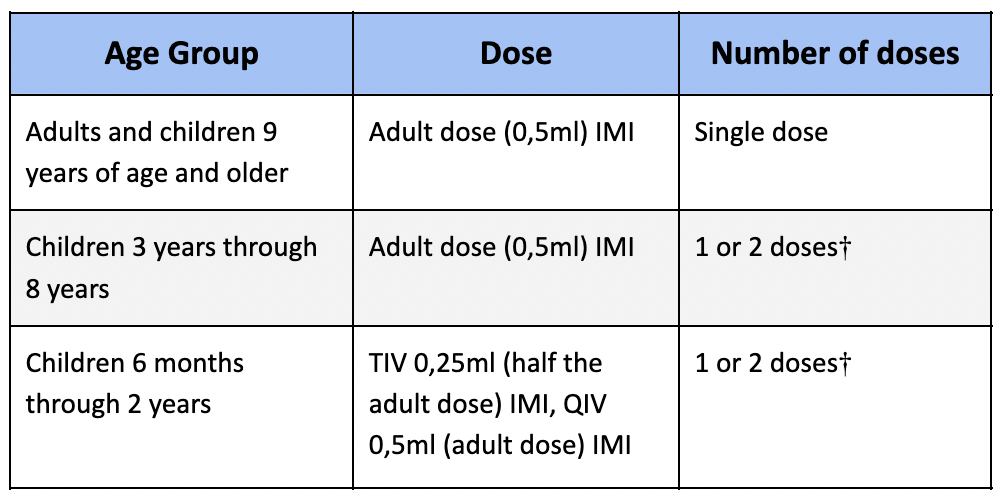 *Note: influenza vaccine is not recommended for infants <6 months of age. †2 doses should be administered
≥ 1 month apart during 1st year of vaccination, thereafter one dose. If QIV was administered as the first dose and is not available for the second dose then TIV can be given.
Click on the table to enlarge
1.8 Influenza vaccination and SARS-CoV-2 vaccine
Currently there are no immunogenicity or safety data for co-administration of SARS-CoV-2 and influenza vaccines. Co administration of influenza and SARS-CoV-2 vaccines on the same day is not recommended. Influenza and SARS-CoV-2 vaccines can be given ≥ 14 days apart. The two vaccines should be given on opposite arms when given between 14 and 28 days of each other, this is to assist with monitoring of local reactions. There is no particular requirement regarding the order of receiving the influenza vaccine and SARS-CoV-2 vaccine. However, if both vaccines are available at the same time and an individual is eligible for both, SARS-CoV-2 vaccine should be prioritised. People in higher priority COVID-19 groups [54]should receive SARS-CoV-2 vaccine as soon as possible. Whereas people in lower COVID-19 priority groups should receive their influenza vaccine first, while waiting for the SARS-CoV-2 vaccine to be available to them.
2. Chemoprophylaxis of influenza
Annual influenza vaccination is the best way to prevent influenza, because vaccination can be given well before influenza virus exposures occur, and can provide safe and effective immunity throughout the influenza season. Antiviral chemoprophylaxis is currently NOT recommended. However, WHO guidelines state that individuals at high risk of severe disease who have been exposed to a patient with influenza may benefit from presumptive treatment with a full twice-daily 5-day course of antivirals, even if they do not show signs and symptoms of infection. Alternatively, such patients can be monitored closely for early signs of possible influenza infection, and given antiviral treatment if they occur. [55]
3. To prevent transmission of influenza to others, patients should:
- Stay at home until symptoms have resolved (at least 24 hours after fever has defervesced)
- Avoid close contact with others especially those at high risk for severe influenza (see section 2.1 for individuals at risk of severe influenza)
- Avoid close contact such as kissing or sharing drinks
- Cover coughs and sneezes (cover mouth and nose with tissue or cough or sneeze into an elbow
- Wash hands with soap and water or disinfect with an alcohol-based hand rub regularly
- Limit the number of visitors
- Wipe down surfaces that are frequently touched or shared (doorknobs, remote controls) with a standard household disinfectant
Influenza: NICD recommendations for the diagnosis, management, prevention and public health response, National institute of communicable diseases, 2021