Primary Postpartum Haemorrhage
The guidelines recommend management of common obstetric conditions at primary and referral level, based on local experience and evidence-based practice. They are not intended as strict protocols nor as standard operating procedures, but rather as a guide to safe effective management of common obstetric problems. The guidelines should be most useful to interns, medical officers and registrars.
Causes of postpartum haemorrhage
Management of PPH after vaginal delivery
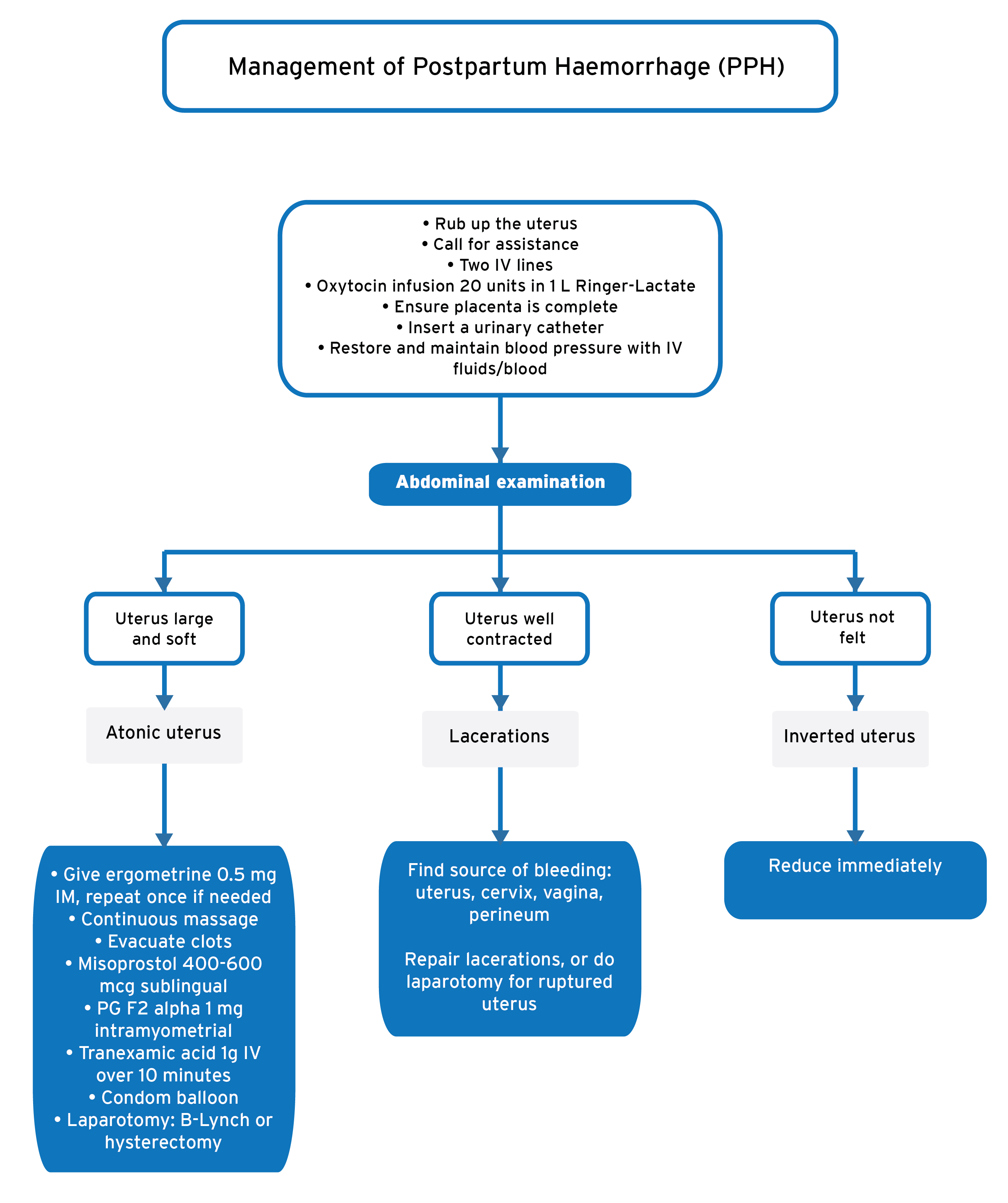
Management of postpartum haemorrhage algorithm
Primary postpartum haemorrhage (PPH) is defined as blood loss >500 mL in the first 24 hours after vaginal delivery, or 1000 mL after a caesarean section. A more useful definition may be a clinically excessive blood loss after delivery. Atonic uterus is by far the most common cause of PPH after vaginal delivery.
Causes of postpartum haemorrhage
- Atonic uterus:
- Primary uterine atony (idiopathic)
- Retained placenta or products of conception
- Multiple pregnancy
- Multifibroid uterus
- Prolonged labour & labour augmentation
- Prolonged second stage of labour
- Abruptio placentae
- Placenta praevia (lower segment atonic)
- Trauma:
- Ruptured uterus
- Cervical laceration
- Vaginal & perineal lacerations
- Uterine trauma at caesarean section
- Coagulation failure (usually in synergy with the above causes)
- Abruptio placentae
- Severe pre-eclampsia
- Severe systemic or uterine sepsis
- Massive haemorrhage
- Maternal clotting disorders, e.g. von Willebrand’s disease
- Long-standing intrauterine fetal death
- Amniotic fluid embolism
- Incompatible blood transfusion
- Inverted uterus
Prevention of atonic uterus
Identify women with risk factors, such as multiple pregnancy, antepartum haemorrhage, polyhydramnios, prolonged labour, history of previous postpartum haemorrhage, vaginal birth after caesarean section, & parity ≥5 after delivery. For these women, give oxytocin 20 units in 1L Ringer-Lactate at 125 mL/hour after delivery of the placenta in addition to routine third stage management that includes oxytocin 10 units IM.
Management of PPH after vaginal delivery
- Call for help & rub up the uterus to expel clots & induce contraction
- Start a rapid infusion with 1 L Ringer-Lactate solution in one arm
- In the other arm start oxytocin 20 units in 1 L Ringer-Lactate at 250 mL/hour
- Ensure that the whole placenta has been delivered
- Insert an indwelling urinary catheter
- Look for the cause of bleeding by examining the woman’s abdomen:
- A large soft uterus is atonic: add ergometrine 0.5 mg IM (if not contraindicated by cardiac disease and hypertension) & massage the uterus continuously; if clots are retained in the uterus, remove them manually
- The woman may help by continuing massage of her own uterus
- A well contracted uterus with bright red fresh bleeding indicates that haemorrhage is caused by lacerations, including possibly uterine rupture. The lacerations need to be repaired following examination of the entire birth canal, in the lithotomy position, in theatre under anaesthesia if necessary
- If the uterus cannot be felt through the abdomen, uterine inversion may be the cause of haemorrhage, & can be confirmed by performing a vaginal examination. This needs immediate reduction
- If haemorrhage from an atonic uterus cannot be controlled:
- Continuously massage the uterus
- Continue with oxytocin infusion, & consider a repeat dose of ergometrine
- Order at least two units of packed cells urgently
- If misoprostol is to be used, give 400-600 mcg sublingually or rectally as a single doseInject prostaglandin F2-alpha 1 mg into the myometrium: dilute 5 mg in 20 mL water & inject 2-4 mL (0.5-1 mg) through the skin into the uterine fundal myometrium; contraindications include asthma & cardiovascular disease
- Give tranexamic acid 1 g IV over 10 minutes (also useful with lacerations)
- Insert a condom balloon or Bakri balloon into the uterus and inflate by gravity or manually to 400 mL with saline, then pack the vagina to prevent balloon expulsion, & observe for uterine relaxation or further bleeding. Record the volume of fluid in the balloon. If effective, the balloon may be half-deflated after 12 hours & removed after 24 hours.
- With further bleeding, arrange for urgent examination in theatre with manual exploration of the uterus for rupture and retained products, & possible laparotomy with B-Lynch brace suture, systematic devascularization (uterine & ovarian arteries), hysterectomy or internal iliac artery ligation
- If unable to do hysterectomy & with persistent bleeding from the uterus, tie a Foley catheter around the lower segment while awaiting help. This can also be done at caesarean section where bleeding is uncontrollable
- As a last resort, apply firm and sustained pressure to the aorta above the level of the umbilicus and call for senior help while replacing blood loss
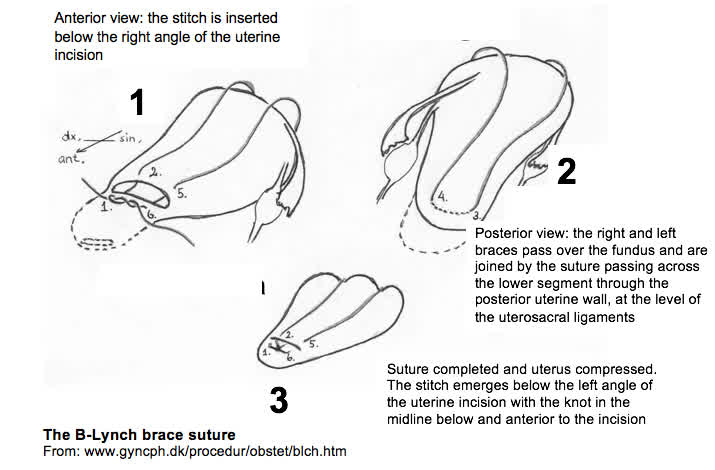
Inserting a B-Lynch brace suture
- This may be done for PPH after normal delivery or after caesarean section
- Put the woman in a modified Lloyd Davies position (thighs spread but not flexed much), to allow surgery while observing for vaginal bleeding
- Do a laparotomy and exteriorize the uterus
- Open the lower segment (if not already open) with a transverse incision
- Explore the inside of the uterus for bleeding points, and place figure-of-8 sutures over any single large bleeding points
- Compress the uterus with the hands. If this stops the bleeding, a B-Lynch brace suture is likely to be successful
- Use a single 1 metre length of thick absorbable suture material (chromic 1 or 2), with a large needle
- Ensure that the assistant compresses the uterus well while the suture is tightened & tied
Hayman sutures or multiple square sutures, where the uterus does not need to be opened, may be attempted as alternatives to a B-Lynch suture.
Management of Postpartum Haemorrhage