Principles for Rational Antibiotic Prescribing
This guideline aims to assist healthcare workers with antibiotic prescribing for common clinical syndromes in adult patients in South Africa, utilizing Local and International guidelines, key publications, and expert opinion.
Decide if an antibiotic is indicated
Choose an appropriate empiric antibiotic
Ensure correct dose and route of administration
Start the appropriate antibiotic rapidly in severe infections
Practice early and effective source control
Evaluate antibiotic appropriateness every day
Decide if an antibiotic is indicated: does the patient have a bacterial infection?
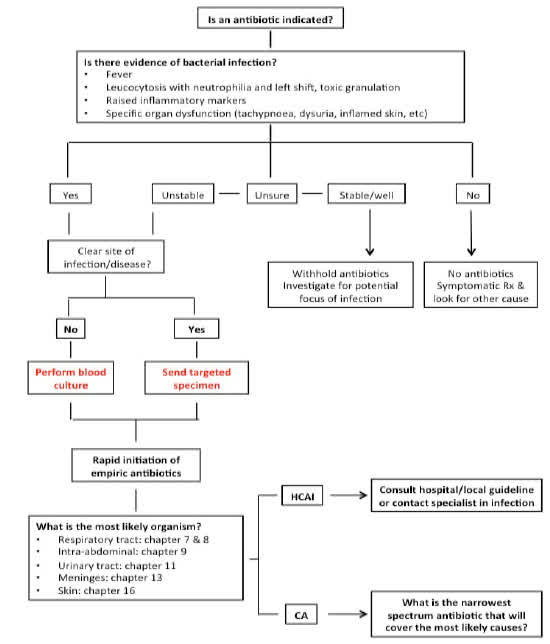
Targeted refers to specimen from site of infection e.g. urine for cystitis
Perform cultures before administering antibiotics in hospitalised patients or in outpatients with recurrent infections
This allows de-escalation to a narrow spectrum antibiotic once the antibiogram is available and is a cornerstone of antibiotic stewardship
Choose an appropriate empiric antibiotic:
a. Target the most likely pathogen(s) for the site of infection
This can be predicted by understanding the broad groups of pathogens that most commonly cause infections at various sites:
- Skin and soft tissue: Gram-positive cocci
- Urinary tract: Gram-negative bacilli
- Intra-abdominal: Gram-negative, Gram-positive and anaerobic organisms
- See chapters on specific infections for more details
An appropriate empiric antibiotic can then be selected by matching the narrowest spectrum antibiotic with the likely pathogens. Spectrums of activity of commonly used antibiotics are shown below
| Gram positive cocci | ||||||
| Clusters | Pairs/chains | |||||
| MSSA | MRSA | S. pneumoniae Most other streptococci |
E. faecalis | E. faecium | VRE | |
| Amoxicillin/ ampicillin | - | - | + | + | - | - |
| Cloxacillin | + | - | +/- | - | - | - |
| Clindamycin | + | +/- | + | - | - | - |
| Ceftriaxone | + | - | + | - | - | - |
| Co-‐amoxiclav | + | - | + | / | - | - |
| Vancomycin | / | + | / | / | + | - |
| Ertapenem | / | - | / | - | - | - |
| Moxifloxacin | / | +/- | + | / | +/- | - |
| Linezolid | / | / | / | / | / | + |
| Daptomycin | / | / | / | / | / | / |
| Gram negative | |||||||
| Bacilli | Cocci | ||||||
| E. coli Klebsiella spp. |
Enterobacter spp. | ESBL | CRE | Salmonella spp. | Pseudomonas spp. | Neisseria meningitidis | |
| Amoxicillin/ ampicillin | - | - | - | - | / | - | +/- |
| Penicillin | - | - | - | - | / | - | +/- |
| Cotrimoxazole* | +/- | +/- | +/- | - | +/- | - | - |
| Ceftriaxone | + | - | - | - | + | - | + |
| Co-amoxiclav | + | - | - | - | / | - | / |
| Ciprofloxacin | + | + | +/- | +/- | + | + | / |
| Aminoglycosides | + | + | +/- | +/- | - | + | - |
| Cefepime | / | + | - | - | / | + | / |
| Piptazobactam | / | +/- | - | - | / | + | / |
| Ertapenem | / | + | + | - | / | - | / |
| Imipenem | / | / | / | +/- | / | + | / |
| Meropenem | / | / | / | +/- | / | + | / |
*Associated with much higher rates of toxicity than other antibiotics. Avoid using if a suitable alternative with a similarly narrow spectrum of activity is available
+ usually susceptible: recommended first line therapy while awaiting antibiogram
‐ frequent resistance or poor clinical efficacy: do not use
+/- variable susceptibility: only use with antibiogram result
/ usually susceptible but not first choice: do not use unless there is a compelling reason (e.g. allergy, toxicity or resistance to first line drug or better outcomes for a particular site of infection)
b. Assess likelihood of antibiotic resistance
Risk factors include known colonisation with a resistant pathogen, HCAI, recent antibiotic exposure. Local resistance patterns inform prescribing.
c. Review potential contraindications
Allergy:
Clinicians should differentiate an immediate type 1 IgE mediated hypersensitivity reaction from other less dangerous types of hypersensitivity. Classical signs of type 1 hypersensitivity are anaphylaxis, angioedema, urticarial rash, and bronchospasm. If a type I hypersensitivity reaction to penicillin has occurred, then all β-‐lactam antibiotics should be avoided, unless there is no alternative drug available when penicillin desensitisation can be attempted as an inpatient.
Patients with other types of hypersensitivity reactions, usually a maculopapular rash to amoxicillin, should avoid all penicillins but may tolerate other β-‐lactam antibiotics like cephalosporins. The 1st generation cephalosporins should be avoided as they have a higher risk of cross- reactivity with penicillin, but this risk is much lower for second- or third- generation cephalosporins reported to be only 0.1%.
If the previous reaction to penicillin was a maculopapular rash, it is relatively safe to use 2nd/3rd generation cephalosporins and use would depend on the patient’s social circumstances and access to follow-up. However, in patients with a remote history of a rash on penicillin it is often difficult to differentiate a maculopapular rash from an urticarial rash – all β-lactam antibiotics should be avoided if urticaria occurred on penicillins as this is a type 1 reaction. In this setting, skin testing before using a cephalosporin is recommended, as a positive reaction to penicillin indicates type 1 hypersensitivity.
Toxicity:
Antibiotics can cause direct dose‐dependent toxicity and should be avoided in patients at high risk of developing organ damage with a specific agent. For example, do not use aminoglycosides in patients with renal impairment or hearing loss.
d. Choose drug with adequate target tissue penetration
| CSF | Lung | Soft tissue | Urinary tract | |
| Ampicillin | Good (in high doses) | Good | Good | Good |
| Cloxacillin | Inadequate data | Fair | Good | No data |
| Clindamycin | Poor | No data | Good | No data |
| Co-amoxiclav | Poor | Good | Good | Fair |
| Ceftriaxone | Good (in high doses) | Good | Good | Good |
| Aminoglycosides | Poor | Poor | Fair | Good (if normal GFR) |
| Ciprofloxacin | Good (in high doses) | Good | Good | Good |
| Co-‐trimoxazole | Good | Good | Good | Good |
| Ertapenem | Poor | Good | Good | Good |
| Meropenem | Good (in high doses) | Good | Good | Good |
| Imipenem | Good* | Good | Good | Good |
| Vancomycin | Poor | Fair | Poor | Good |
| Linezolid | Good | Good | Good | Good |
| Daptomycin | Poor | Poor | Good | Good |
*Associated with higher risk of seizures
e. Aim for a single drug with the desired spectrum of activity
Monotherapy is preferred unless combination therapy is required for synergy (e.g. endocarditis) or extended spectrum beyond what can be obtained with a single drug (e.g. atypical pathogens in severe CAP).
Ensure correct dose and route of administration
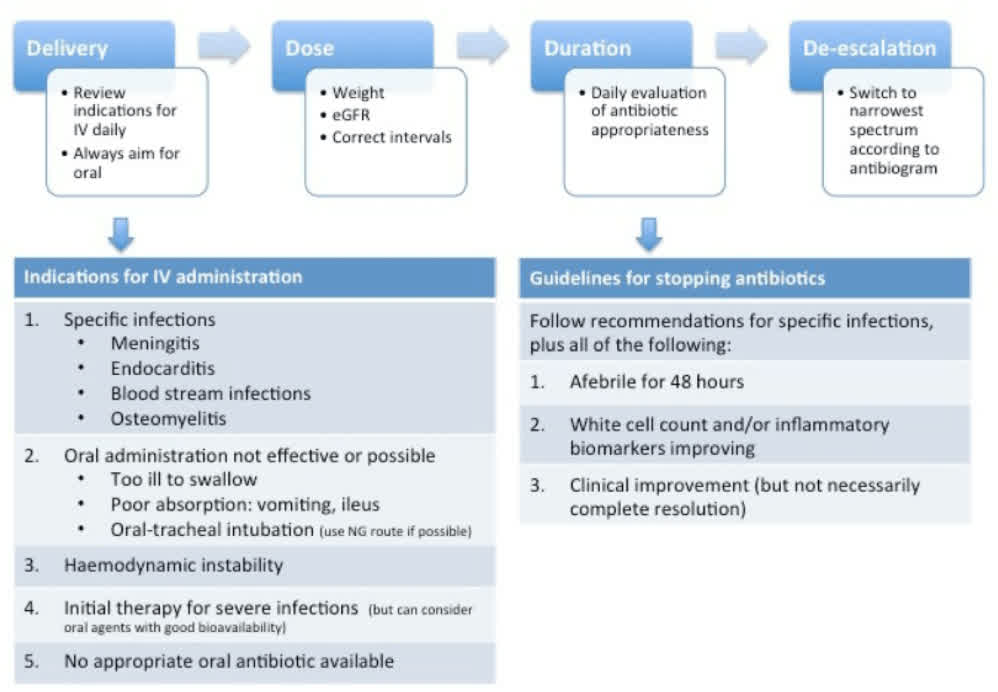
The oral/enteral route is preferred whenever possible for patients with mild to moderate infections. Intravenous antibiotics should be reserved for severe infection or for certain sites such as the CSF, bacteraemia, endocarditis, bone and joint infections.
| Oral absorption (%) | Comments | |
| Penicillin VK | Moderate | Take without food |
| Amoxicillin | Good | |
| Flucloxacillin | Good | Take on empty stomach |
| Clindamycin | Good | |
| Co-amoxiclav | Good | |
| Ciprofloxacin | Good | Do not give via NGT or with antacids |
| Doxycycline | Excellent | Take with food, do not co-‐administer with antacids |
| Azithromycin | Good | Take without food |
| Metronidazole | Excellent | |
| Co-trimoxazole | Good | |
| Linezolid | Excellent |
Start the appropriate antibiotic rapidly in severe infections
Mortality increases by 8% for every hour antibiotic administration is delayed in septic shock1
Practice early and effective source control
Search for and remove any persistent foci of infection
Evaluate antibiotic appropriateness every day