Proteinuria: Approach in Children
Approach to proteinuria in children
Lead Author: Dr Christel du Buisson
Acknowledgements: Dr Peter Nourse, Dr Priya Gajjar, Prof Mignon McCullouch
Summary Algorithm
Introduction
Clinical presentation
Examination and assessment
Differential diagnosis for positive and negative readings for urine dipstix
How to diagnose persistent asymptomatic proteinuria
Management
Referral criteria
Summary Algorithm
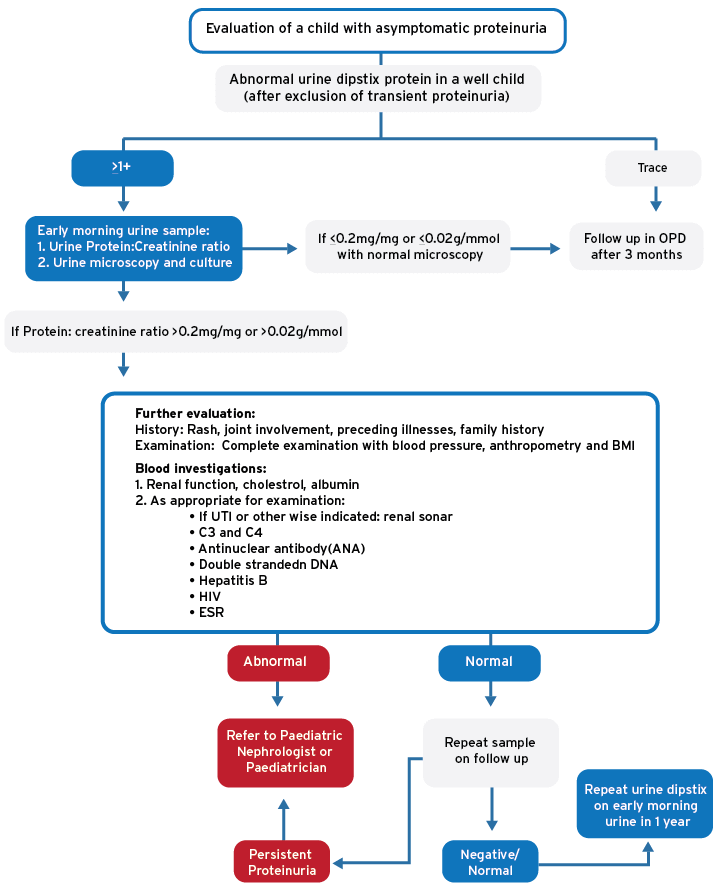
Click on image to enlarge
Introduction
Proteinuria is defined as a loss of urinary protein of more than 100mg/m2 or 150mg per day. If it is difficult to obtain a 24 hour urine, early morning spot urine samples can be send for a protein:creatinine ratio.
Presence of persistent proteinuria in children is an indication of renal disease, but the presence of proteinuria on a random urine sample does not indicate disease, as it could be transient or postural.
Unfortunately, urine dipstix only detect macro-molecules, such as albumin and not low molecular weight proteins such as beta-2-microglobulin. This should be kept in mind when assessing children with suspected renal disease.
Proteinuria is due to one of 3 mechanisms:
- Glomerular loss - large molecules such as albumin
- Tubular loss - low molecular weight molecules
- Overflow - due to overproduction of low molecular weight protein which is mostly seen in adults with Multiple Myeloma and will not be discussed further
Clinical presentation
- Asymptomatic proteinuria: usually an incidental finding and/or coincide with other systemic diseases
- Symptomatic proteinuria: Either have features of nephrotic syndrome, nephritic-nephrotic syndrome, hypertension or other forms of glomerular disease (see guidance for these specific presentations)
- Fanconi’s syndrome: Children will present with failure to thrive, acidosis, multiple electrolyte disturbances with clinical features of acidosis, hypokalaemia, hypocalcaemia & rickets. Proteinuria would be present on dipstix as well as alkaline urine, with glycosuria
- Systemic disease: Diabetic patients can develop tubular proteinuria, which is low molecules proteins, which would not be detected by dipstix or trace on dipstix. Urine should be send to the laboratory for evaluation for Beta-2-microblobulin & other low molecular weight proteins
Examination & Assessment
Is the patient symptomatic with features of:
- Nephrotic syndrome – see specific protocol
- Nephritic/Nephrotic syndrome – discuss with paediatric team and/or paediatric nephrology
Exclude transient proteinuria:
- Transient Proteinuria: Seen in children with Febrile illness, hypovolaemia, sepsis, seizures, intense exercise. Thus a history of when the urine sample was taken is important. Proteinuria will resolve as the primary disease resolves. Send a spot urine specimen for formal protein:creatinine ratio to quantify the proteinuria. Will resolve as the patient improves. If not, follow guidance of persistent proteinuria.
- Postural or orthostatic proteinuria should be excluded. An early morning specimen can be taken at home & brought in.
When symptomatic & transient proteinuria has been excluded, the patient has persistent asymptomatic proteinuria follow as per below.
Note: Dipstix when used as surveillance for proteinuria – remember the results can give false results
Differential diagnosis for positive and negative readings for urine dipstix
Positives:
- Concentrated urine
- Alkaline urine
- Gross Haematuria
- Dipstix left in the urine to long/delayed reading(always remember to read the interpretation instructions of your dipstix)
- Contaminated with secretions from Urinary tract or vagina
- Contaminated with antiseptics, chlorhexidine
Negatives:
- Dilute urine
- Acidic urine
How to diagnose persistent asymptomatic proteinuria:
Do Urine dipstix:
- If positive & asymptomatic, follow up at paediatric OPD and repeat
- Ask parents to bring a early morning urine sample with for follow up visit (sterile sample not necessary)
At follow up:
- Do dipstix on sample brought by parents. If still positive for proteinuria, do a urine protein: creatinine ratio. Patient will need to be followed up at paediatric OPD.
Interpretation of early morning spot urine protein: creatinine ratio:
- Children<2 years of age:
- Normal: <0.5mg/mg or <0.05g/mmol
- Proteinuria: >0.5mg/mg or >0.05g/mmol
- Children older than 2 years:
- Normal: <0.2mg/mg or <0.02g/mmol
- Proteinuria: 0.2-2mg/mg or 0.02-0.2g/mmol
- Nephrotic range proteinuria: >2mg/mg or >0.2g/mmol
Management
Patients with asymptomatic persistent proteinuria. Need to be referred to Paediatric OPD for follow up.
Referral criteria
- All patients with persistent proteinuria on follow up must be referred to a paediatrician in your hospital or referral hospital (or to a paediatric nephrologist if available in your hospital).
- All patients with proteinuria with features of any existing disease or disease features found on investigations must be referred to a paediatrician or paediatric nephrologist (if available in you hospital or referral hospital)
References
- Up to date: Proteinuria in children
- Jerry Bergstein. A practical approach to proteinuria. Pediatric Nephrology(1999)13:697-700
- John R Brandr. Orthostatic proteinuria and the spectrum of diurnal variablility of urine protein excretion in healthy children. Pediatric Nephrology(2010)25:1131-1137
- Ching-Yuang Lin. The prevelance of heavy proteinuria and the progression risk factors in children undergoing urinary screening. Pediatric Nephrology(2000)14:953-959