Protocol for Induction of Labour
Protocol for Induction of Labour
Procedure for IOL for Gestation of 26 weeks and more
If the cervix if favourable (Bishop score 8 or more)
If cervix unfavorable (Bishop score <8)
Intra-cervical Balloon for Cervical Ripening
IOL-related Complication: Hyper Stimulation
IOL in Specific Scenarios : HIV Positive Women
IOL in Specific Scenarios: Previous Caesarean Section
Procedure for IOL for Gestation 13 - 26 weeks with an Intra-Uterine Death
Misprostol Oral Solution Information
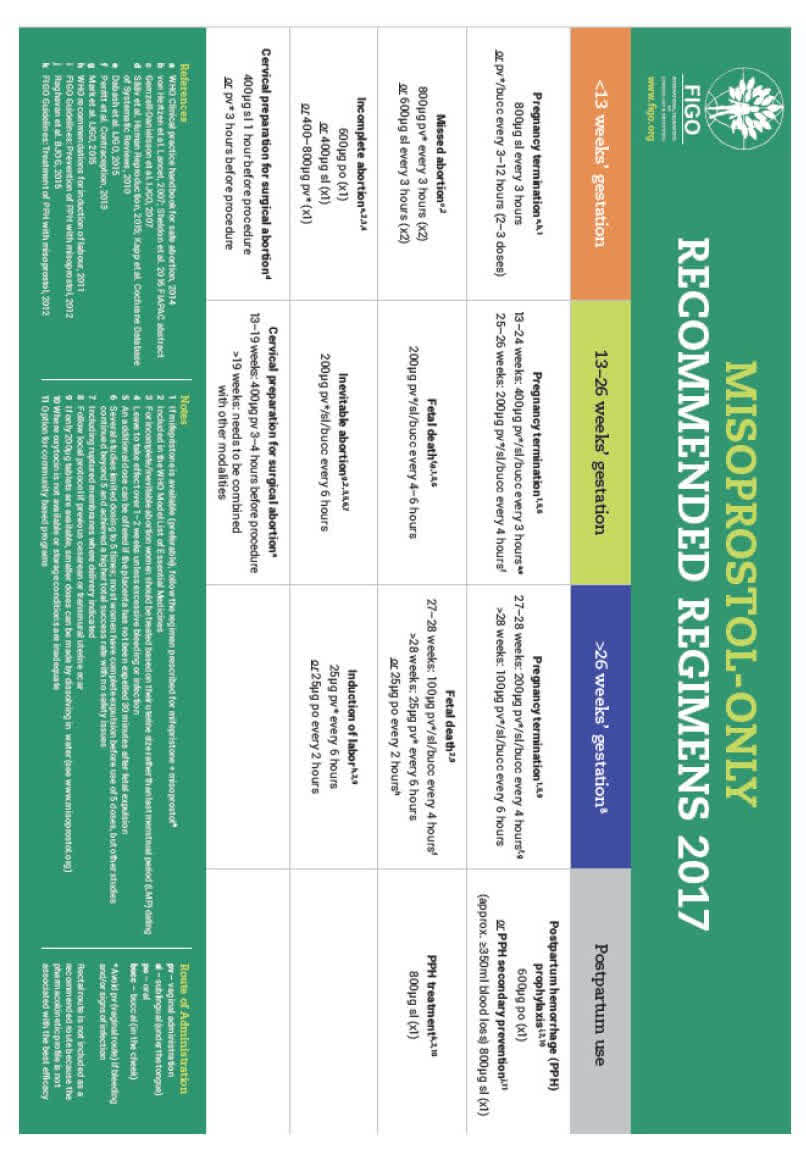
Misprostol only Recommended Regimens 2017 Chart
Standard Operating procedure for Elective IOL booked at High Risk Clinic
- Complete the IOL Safety Check List before starting any induction
- All patients that require an elective IOL must first be discussed with a consultant who must sign the form or give telephonic consent for the induction
- The indication for all IOL should be a well-defined and compelling enough for caesarean section (CS) if the IOL fails
- IOL for maternal request or maternal convenience is not an accepted indication
|
Absolute contra-indications for labour induction |
|
|
Any gynaecological, obstetrical or medical condition that precludes safe vaginal delivery
|
|
|
Malpresented (e.g. transverse lie, footling breach)
|
Cord presentation
|
|
Contracted or Abnormal Pelvis
|
Active genital herpes
|
|
Major placenta praevia
|
Previous CS x 2 in third trimester
|
| Large fetus (>4.5kg in non-diabetic mothers, >4.0kg in diabetic mothers) Based on best clinical judgement, not necessarily ultrasound | |
| Previous major uterine surgery incl. classical caesarean section |
|
Abbreviations
| EDV | Abscent end diastolic flow | AROM | Artificial rupture of membranes |
| ASHT | Acute Severe Hypertension | ||
| BMI | Body mass index | CS | Caesarean section |
| CPR | Cerebroplacental ratio | CTG | Cardio-tocograph |
| EASI | Extra-amniotic saline infusion | EFW | Estimated fetal weight |
| IUFD | Intra-uterine fetal death | IUGR | Intra-uterine growth restriction |
| IOL | Induction of labour | PGWC | Provincial Government Western Cape |
| PG | Prostaglandin | PO | Orally |
| TOLAC | Trial of labour after Caesarean section | UAD | Umbilical artery Doppler |
|
Modified Bishop Score |
||||
| Cervical Feature |
Score | |||
| 0 | 1 | 2 | 3 | |
| Dilation | < 1cm | 1-2 cm | 3-4 cm | >4cm |
| Length | >4 cm | 3-4 cm | 1-2 cm | <1cm |
| Station | - 3 | -2 | -1/0 | +1/+2 |
| Consistency | Firm | Medium | Soft | |
| Position | Posterior | Mid | Anterior | |
| The following modifiers can be used for the "Modified Bishop Score" |
Add 1 point to score for:
|
Subtract 1 point from score for:
|
||
1. Procedure for IOL for Gestation of 26 weeks and more:
Do a full maternal and fetal assessment with emphasis on:
- Abdominal examination (lie, presentation, estimated fetal weight, head above brim)
- Cervical assessment (Bishop score)
- 10 minute CTG to ensure fetal well being
- Complete an Induction Safety Checklist
1.1. If the Cervix is Favourable (Bishop Score of 8 or more):
Do artificial rupture of membranes/amniotomy (AROM)
- This should only be done if there are no contra-indications; AND a normal CTG
- This is a sterile procedure (clean hands, sterile gloves, clean the perineum with tap water)
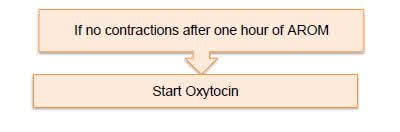
- Rupture of membranes should be followed by oxytocin administration one-hour later, if not adequate contractions by then (three contractions of at least 40s per 10 min)
- HIV positive (If viral load unknown or any detectable viral load)
- Breech
- IUFD (except if acute abruption suspected)
- Unengaged presenting part (except in controlled AROM with severe polyhydramnios)
- Preterm fetus (Gestational age <35w0d)
Oxytocin for IOL - general remarks
- Only administer in emergency centre with continuous CTG
- Not to be used within 6 hours of any prostaglandin administration
- Suitable after AROM or expulsion of the cervical balloon catheter, irrespective of Bishop score
- Suitable in trial of labour after previous C/S (TOLAC) (for induction only, not to be used for augmentation)
- Avoid oxytocin if membranes intact and Bishop score is unfavourable (i.e. < 8), except when HIV positive with failed or contraindicated misoprostol/mechanical methods
Preparing the Oxytocin infusion:
- Put 12 Units Oxytocin in 200ml Normal Saline as a side infusion
- Rinse administration set before connecting with IV line
- Write drug content on vaculiter in large black permanent marker (Koki pen)
|
Use the standard protocol sheet for Oxytocin infusion |
|
1. Start at low dose (1-2mU/min) (at 2 dpm if using 60 dropper set or 2ml/h if IVAC)
2. After every 30 min: assess CTG & contractions. Only increase dose when CTG is normal and when less than 3 strong (>40s) contractions in 10 minutes palpated 3. Increase with 2ml/h increments at 30 minute intervals until 3 to 4 strong contractions / 10 min. Up to a maximum of 20ml/h (20mU/min) 4. Review oxytocin when not in labour after 6 hours on maximum dose 5. Discuss further management with the consultant |
Stop or decrease the infusion when there are any of the following:
- 5 or more contractions / 10 minutes (tachysystole)
- Uterus not relaxing between contractions
- If CTG is suspicious or pathological
You can restart at a lower dose once the incident has settled
In grand multiparas and TOLAC wean infusion (stepwise) after 2 hours of sustained 3 or 4 strong contractions/10 min If contractions fade away after lowering the dose, increase it again to the previous level
2. If the Cervix is Unfavourable (Bishop Score < 8)
- Reconsider the indication and gestation
- Ensure that a full maternal and fetal evaluation is done
Use mechanical means (bulb catheter) or medical means (prostaglandins) or both for cervical ripening:
2.1. Misprostol for IOL
Misoprostol (oral dose of 20μg 2-hourly x 24 hours) if no contra-indications*
*Contra-indications for misoprostol (Consider Dinoprostone gel instead)
- Previous uterine surgery (C/S, open uterine surgery/ when the uterine cavity was entered]
- Grande multiparity (Parity 5 or more)
- IUGR with AEDV or REDV or severe redistribution
- Severe pre-eclampsia (misoprostol not first choice, but can be can be considered if no there are no good alternatives, no ASHT, no imminent eclampsia, documented normal fetal growth/placental function, documented normal CTG and no previous abruption placentae)
|
Do not interrupt or delay the process once it has started (e.g. due to labour ward over capacity).
If Bishop Score is still < 8 after 24 hours of Misoprostol,
discuss with consultant again:
|
Consider Intra-cervical balloon or Extra-Amniotic Saline Infusion (EASI) |
Consider 2nd course of Misoprostol Rest the patient for 24 hours (if maternal and fetal conditions are stable) Repeat 24 hours of misoprostol |
Consider C/S for failed IOL (see later) |
2.2. Intra-Cervical Balloon for Cervical Ripening
Intra-cervical balloon does not cause uterine contractions and does not need CTG monitoring. It can safely be done as an outpatient procedure.
This mechanical induction method is NOT the recommended method for:
- Patient with overt lower genital tract infection
- Immune-compromised patients / HIV stage 3 or 4 disease
- Patients with ruptured membranes
NOTE!
If this method is used in these circumstances (e.g. if other methods have failed and none of the alternative methods are suitable), then antibiotic cover is indicated.
|
Technique for Intra-cervical Balloon
|
Extra-amniotic Saline Infusion (EASI) Technique
|
Oxytocin is needed in the majority of patients with intra-cervical catheter to initiate contractions.
The timing of oxytocin administration is either:
- As soon as catheter is expelled OR
- As soon as catheter is placed (urgent induction)
- For urgent inductions, misoprostol can be started at the same time as the insertion of the bulb
2.3. Dinoprostone Gel
Prostaglandin E2 is very expensive and NOT much more effective than misoprostol or the intracervical balloon catheter in the presence of an unfavourable cervix. It should therefore only be considered if these much cheaper alternatives are contraindicated or technically not possible.
- When used with a previous uterine scar, administer two doses only (6 hours apart) (note that the manufacturer regards a uterine scar as a contra-indication for dinoprostone).
Specific indications for Dinoprostone:
- When AROM or intracervical balloon catheter is not feasible in patients with:
- Grande multiparity (Parity 5 or more)
- IUGR with AEDV or REDV
- Severe placental insufficiency (strongly suspected or proven)
- Previous uterine surgery (consultant decision needed - unregistered use)
- The cervix is completely closed
Available preparations:
Prandin E2 Gel 1mg/3g: 1mg IN THE POSTERIOR FORNIX every 6hrs (not exceeding 3mg in total).
Technique for Prostaglandin gel insertion:
- Assemble the syringe as shown in packaging.
- For Prandin E2
- Insert into the posterior vaginal fornix; speculum not needed. Patient to remain supine for 30 minutes after insertion.
- Do a CTG for 60 minutes after each dose
- For Prandin E2
3. IOL-related Complication: Hyperstimulation
|
Be prepared for hypercontractility when using Oxytocin (4-12 % of cases) or any prostaglandins (up to 2% of cases)
|
|
|
Hyper-contractility
|
|
| If hyper-stimulation syndrome develops: | |
|
|
*If hyperstimulation responds to tocolysis, wait 1 hour and start oxytocin again at lower dose (2 steps lower than before). If misoprostol was used consider alternative IOL method (AROM/balloon catheter) or wait at least 6 hours and start misoprostol again.
4. IOL in Specific Scenarios : HIV Positive Women
IOL Recommendations:
- Follow the same guidelines as for misoprostol, balloon catheter and oxytocin (and Dinoprostone) but add prophylactic antibiotic cover for intracervical catheter placement (ampicillin and metronidazole).
- If labour was not established after cervical ripening (mechanical/pharmacological) and Oxytocin infusion, do a C/S for failed IOL (if maternal condition allows for anaesthetic).
- Do not rupture membranes unless delivery is imminent (within 4 hours).
- If maternal condition is not favourable for anaesthetic (advanced HIV disease), discuss with the consultant in labour ward for possible sterile AROM and expedient delivery of the baby
5. IOL in Specific Scenarios: Previous Caesarean Section
The best method, efficacy, and safety of cervical ripening and/or labour induction in this population have not been established. At least 50 percent of inductions in women with a prior C/S are successful, with the highest chance of success in women with a prior vaginal delivery and favourable cervix. Induced labour appears to be associated with a higher rate of uterine rupture than spontaneous labour with the relative risk of rupture reported as 4.9 for induction of labor without prostaglandins and 15.6 for induction with prostaglandins.
Recommendations:
- In-depth counselling about the risks and benefits of IOL versus repeat C/S, as well as the risks associated with waiting for spontaneous labour.
- Evaluate for strip (or sweep) of membranes after 38 weeks of gestation to hasten the onset of spontaneous labour.
- For a favourable cervix: choose AROM and administration of oxytocin, if not contraindicated. Do not exceed a maximum dose of 20 mU/min. Intrauterine pressure catheter monitoring for the prediction of uterine rupture can be useful for judicious titration of oxytocin.
- For an unfavourable cervix discuss the risks and benefits of mechanical and pharmacologic options of cervical ripening. Mechanical cervical ripening (bulb) followed by AROM and oxytocin administration appears to limit the risk of rupture in these women.
- Prostaglandins (Dinoprostone) should only be used:
- If mechanical cervical ripening cannot be done.
- After appropriate and clearly documented counselling including discussion with the consultant in charge, as dinosprostone is NOT registered for use in a patient with previous uterine surgery
- If Prandin® is used the maximum total dose should not exceed 2mg.
6. Failed Induction
There is no universal agreement on what constitutes a failed IOL but it reflects the failure to achieve established active labour (regular contractions and progressive cervical dilatation and descent) after a predefined period of use of induction methods. The important principle is to allow adequate time for cervical ripening and development of an active labour pattern before determining that an IOL has failed. Take the indication, urgency of delivery, maternal condition, fetal condition and maternal wishes into account when discussing a possible failed IOL with the consultant.
Recommendation:
I. Prior to the initiation of any IOL there should be a clearly defined method/s and timeline.
II. If cervical ripening is required, the failure to establish sufficient cervical changes after pharmacological and mechanical ripening to enable AROM or to achieve regular contractions can be seen as a failed IOL.
III. Oxytocin as induction method is considered to have failed if regular contractions and cervical change do not occur after 12-18 hours of oxytocin administration. An alternative method (e.g. miso) can still be considered if not contraindicated, but if no alternatives are suitable, the IOL is considered a failed IOL.
IV. Always attempt safe AROM (if feasible and not contraindicated) before an IOL is considered to have failed.
V. Always attempt safe AROM (if feasible and not contraindicated) before an IOL is considered to have failed.
7. Procedure for IOL for Gestation of 26 Weeks and more with an Intra-Uterine Death or Severe Fetal Anomaly (No Fetal Monitoring Done)
- Use the same protocol as for viable pregnancies, without the need for CTG monitoring
- In a stable uncomplicated maternal condition and when abruption is not suspected consider mifepristone as 1st line in an outpatient setting before initiation of a misoprostol IOL
8. Procedure for Termination of Pregnancy/Unmonitored Induction for Gestation 13-26 Weeks (FIGO Regimen)
Sure gestation of 13- 24 weeks
- Mifepristone 200mg orally followed by misoprostol as set out below after 12-24 hours.
- Misoprostol 400 μg vaginally/sub-lingual/buccal 3-hrly (maximum dose x5)
- Halve the dose of misoprostol if previous caesarean section or uterine scar
Sure gestation of 25-26 weeks
- Mifepristone 200mg orally in an outpatient setting followed by misoprostol as set out below after 12-24 hours.
- Misoprostol 200 μg vaginally/sub-lingual/buccal 4-hrly (maximum dose x5)
- Halve the dose of misoprostol if previous caesarean section or uterine scar
9. Procedure for IOL for Gestation 13 - 26 weeks with an Intra-Uterine Death
- Mifepristone 200mg orally in an outpatient setting followed by misoprostol as set out below after 12-24 hours.
- Misoprostol 200 μg vaginally/sub-lingual/buccal 4-6 hourly (maximum dose x5)
- Halve the dose of misoprostol if previous caesarean section or uterine scar
NB! If no response to above induction regimes then ensure again that pregnancy is intrauterine.
Balloon catheter/EASI can be done if no response to misoprostol.
|
The following can undergo MISOPROSTOL induction in the antenatal ward (F2)*
|
|
Chronic hypertension*
|
|
Gestational hypertension*
|
|
Diabetes Mellitus*
|
|
Previous abruptio placentae*
|
|
Prelabour Rupture of membranes (at ≥ 34w0d)
|
|
Previous Intra-uterine death (not due to abruptio placentae)
|
|
Post-term pregnancy
|
|
Previous IUFD ≥24 weeks gestation, of unknown/unexplored cause in uncomplicated pregnancy
|
* In stable maternal condition with no organ dysfunction and normal fetal assessment
| The following can undergo CATHETER BULB CERVICAL RIPENING in the antenatal ward (F2) |
| Chronic hypertension |
| Gestational hypertension |
| Mild-moderate pre-eclampsia |
| Diabetes Mellitus |
| Grand Multiparas (parity 5 or more) for mechanical induction |
| All patients who need tertiary care due to maternal reasons (e.g. cardiac lesions, BMI >50 etc.) |
| Previous IUFD ≥24 weeks gestation, of unknown/unexplored cause in uncomplicated pregnancy |
| Previous uterine scar |
| Previous Intra-uterine death (not due to abruptio placentae) |
| Previous abruptio placentae |
| Post-term pregnancy |
| The following can undergo CATHETER BULB CERVICAL RIPENING in SPECIAL CARE WARD (C2A East) |
| Pre-eclampsia at 34 weeks |
| Diabetes Mellitus |
| Indications for induction in the Emergency Centre [C2A West]: All patients with severe maternal disease* |
| All patients who need tertiary care due to maternal reasons (e.g. cardiac lesions, BMI >50 etc.) |
| Suspected chorioamnionitis |
| Two or more episodes of previous abruptio placentae |
| Severe fetal compromise (severe IUGR) |
| Early-onset severe pre-eclampsia (viable and non-viable pregnancies) (can already start with bulb induction in Special Care ward at 34 weeks) |
| Previous precipitous labour and Grand Multiparas (parity 5 or more) for medical or AROM induction |
| Previous CS for dinoprostone induction |
| Polyhydramnios for controlled AROM |
Misoprostol Oral Solution Information
The maximum oral dose is 20 ug two hourly for 24 hours. Administer as follows:
Add a single 200 microgram tablet of misoprostol to a bottle of 200 mL tap water
Shake the bottle well until the tablet has dissolved. Discard unused solution after 24 hours
Give 20 mL of the solution orally every two hours, for 24 hours
As soon as the woman reports painful contractions, do a vaginal examination and a CTG. If she is in established labour, stop the misoprostol.
If there are no contractions in 24 hours, repeat the Bishop score and act accordingly (bulb, oxytocin or rupture of membranes if Bishop ≥ 8; if<8 repeat misoprostol).
Do not give oxytocin less than six hours after giving misoprostol.
Do not repeat the misoprostol course more than twice.
If there are no cervical changes after two courses of misoprostol, review the indication for IOL
Misprostol only Recommended Regimens 2017 Chart
Standard Operating procedure for Elective IOL booked at High Risk Clinic
High Risk Clinic:
- Discuss case with consultant.
- Complete Induction of labour Safety Checklist but omit Bishop score until the date of induction.
- Book a date for admission (three patients per week day). If a fourth (urgent) case needs to be added it must be discussed with the consultant at the clinic first.
- Nursing staff do pre-admission preparation
- Leave extra patient stickers in the maternity case record for easy access on day of admission
- Identify the Maternity Case record with an “IOL” sticker (available in clinic)
On day of induction of labour:
- Patient arrives at Fetal Evaluation Clinic at 07h00 and a CTG (10-minute strip) is done
- Patient then goes to High Risk clinic
- Registrar evaluate patient before clinic starts including assessment of CTG
- Review Safety Checklist
- Do Bishop Score now
- If cervix unfavourable, insert catheter bulb (if not contra-indicated), tape to patient’s leg and send to ward F2, where she can wait in the waiting room until a bed becomes available. Discuss with the ward team. (In very well-informed patients, she can go home with the catheter and come back the next morning to ward F2 or earlier to labour ward if it falls out).
- If cervix favourable for AROM, wait until 10h00 and discuss with the labour ward team (who will now be busy with the bed status meeting) to obtain a bed in labour ward. If no bed in C2A, patient can wait in waiting room in triage, but AROM must ideally be done before 16h00. Do not send to F2 to await a space in labour ward.
- If cervix unfavourable and impossible to pass a catheter bulb, ask the clinic consultant for help. If not possible to pass catheter, send to ward F2 for low-dose misoprostol IOL.
Click here to open the above content in the original PDF view
Tygerberg Hospital, Department of Obstetrics and Gynaecology; Protocol for induction of labour (IOL); Version: May 2013; Last checked for updates by EMGuidance: Oct 2023