Protocol for the Acute Management of Spontaneous Preterm Prelabour Rupture for Membranes
Definitions Complications of membranes preterm prelabour rupture of membranes Management: Initial assessment and work-up of PPROM Management: If no clinical evidence of ROM but highly suspicious Management: Conservative management of PPROM Management: Gestational specific/defined Management: Role of Tocolysis in PPROM Management: Role if antenatal steroids PPROM Management: Role of antibiot
Complications of membranes preterm prelabour rupture of membranes
Management: Initial assessment and work-up of PPROM
Management: If no clinical evidence of ROM but highly suspicious
Management: Conservative management of PPROM
Management: Gestational specific/defined
Management: Role of Tocolysis in PPROM
Management: Role if antenatal steroids PPROM
Management: Role of antibiotics in PPROM
Management: Discharge advice after preterm birth
Prelabour Preterm Rupture of Membranes (PPROM)
A. Definitions
Preterm Prelabour Rupture of Membranes:
- The spontaneous rupture of fetal membranes before labour and prior to 37 completed weeks of gestations with:
- Preterm defined as after a gestation of 24w0d and before 37w0d
- Prelabour defined as at least 1h before the onset of labour
Rupture of membranes determined by:
- There is no clear ‘gold standard’ test for ROM but a composite of the 4 following elements can be used:
- Documented clear convincing history (most important/valuable element)
- Documented clinical observation of amniotic fluid: pooling in the posterior fornix or clear fluid draining from the cervical os
- Documented alkaline test with litmus paper (blue litmus stays blue)
- Documented positive fernlike pattern (arborization) on microscopy
B. Complications of preterm prelabour rupture of membranes
- Preterm birth with associated prematurity including neonatal respiratory distress syndrome
- Cord compression / cord prolapse
- Fetal malpresentations
- Chorioamnionitis
- Antepartum fetal death
- Abruptio placentae
- Post partum endometritis / sepsis
- Post partum hemorrhage
- Retained Placenta
NB! For the purpose of the protocol viability [for fetal monitoring with CTG] will be defined as-
Sure gestation of 27w0d AND an EFW of ≥800g
Unsure gestation: use the biometry if concordant of ≥27w0d (not EFW)
C. Management: Initial Assessemnt and work-up of PPROM
1. General assessment:
- Obtain a clear history of any symptoms of rupture of membranes, including predisposing risk factors for preterm prelabour rupture of membranes
- Check antenatal card for MSU, HIV, Syphilis results and normal detail scan
- Ensure correct gestation (Sure gestation = early ultrasound ± Dates / SF) To enable correct management in Section F
NB! If patient is unbooked or lost her card:
- Check for results on the computer, if not available do rapid HIV, Rh and Syphilis tests.
- Request registrar on call to do basic scan, exclude gross abnormality and get biometry (Use the complete basic scan report form supplied)
But do not delay management while waiting for the above
- General examination
- Maternal vital signs, urine dipstick, including hydration status
- Asses uterine activity by abdominal palpation
- Do ultrasound if gestational age, placental location or fetal presentation is unknown
- Obtain baseline CTG [if meeting fetal viability criteria]
- If pathological CTG – Do intra-uterine resuscitation according to protocol and if no recovery, immediately prepare patient for Caesarean Section and inform the registrar in charge
2. Perform sterile speculum examination:
- Exclude cord prolapse and take sample for wet mount smear
- If cord prolapse is present, follow protocol for cord prolapse
- Document any evidence of ruptured membranes:
- The presence of a pool of liquor in the posterior fornix is diagnostic of ROM
If doubtful, observe draining of liquor from cervical canal after coughing, confirm rupture with litmus paper or with microscopy. [Beware of stress urinary incontinence and normal leukorrhea in pregnancy!] - If still in doubt and there is a clear history refer to Section D
- The presence of a pool of liquor in the posterior fornix is diagnostic of ROM
- Visually assess if the cervix is already dilated (do NOT do digital examination)
- If no confirmation of rupture of membranes – Then either
- Admit for observation (see Section D)
- Discharge with advice on rupture of membranes, preterm labour and infection signs and symptoms
Digital cervical assessment should never be done in suspected or confirmed PPROM unless a clear decision for delivery has already been taken and There is established labour:
- 3 Strong contractions per 10min
- Head ≤ 2/5 above pelvic brim
One inadvertent vaginal examination should not exclude further conservative management
4. Side-room and special investigation:
- Ward Hb (if no recent Hb on record for last 2 weeks)
- Mid-stream urine specimen for culture and sensitivity
D. Management: If no clinical evidence of ROM but highly suspicious
History / ↓ AFI:
1. Admit patient to antenatal ward for:
- Routine observations (with 6 hourly temperature, pulse, and respiratory rate) and daily CTGs if viable
- Monitor for signs of chorioamnionitis twice daily:
- Maternal fever (>37.8°C), tachycardia (>120bpm), uterine tenderness, foul / purulent amniotic fluid, or vaginal discharge
- Fetal tachycardia (>160bpm)
- Advise patient to be aware of fetal movements and report a decrease in frequency
- Pad checks – if wet
- Redo speculum (after a period of bed rest) to look for clinical signs and symptoms suggestive of ROM
NB! If any signs of chorioamnionitis, abruptio or fetal distress then the patient should be delivered!
2. If ROM confirmed, then follow protocol for confirmed PPROM
3. If PTL confirmed, then follow protocol for PTL
4. If ROM not confirmed and no signs of chorioamnionitis after 24hrs then:
- Confirm normal AFI [AFI of > 8]
- Consider patient for discharge with a follow up at High Risk clinic in 1 week
- Give adequate counselling on possible signs and symptoms of ROM / PTL and chorioamnionitis
E. Management: Conservative management of PPROM
1. Indications:
- PREMATURITY REMAINS THE COMMONEST CAUSE OF NEONATAL DEATH RESULTING FROM PRETERM RUPTURE OF THE MEMBRANES
2. Contraindications for conservative management / Indication for delivery:
- Gestation of ≥ 34w0d or <24w0d
- Intrauterine death
- Severe / lethal fetal anomaly (In consultation with Fetal Medicine Unit)
- Suspicious / Pathological CTG (discuss al premature delivery decisions with consultant)
- Clinical suspicion of chorioamnionitis
- Severe maternal disease
3. Relative Contraindications for conservative management (discuss with consultant):
- Antepartum haemorrhage of unknown cause
- Intra-uterine growth restriction (< 3rd percentile) discuss with Fetal Medicine Unit
4. High risk patients for chorioamnionitis:
- Preterm or prolonged rupture of membranes (>24h)
- Recent history of active genito-urinary infections
- HIV positive patients with unsuppressed VL
- Diabetic Patients
5. Admit patient to antenatal ward for:
- Monitoring:
- Routine observations (with 6 hourly temperature, pulse, and respiratory rate) and daily CTGs if viable
- Monitor for signs of chorioamnionitis (tender abdomen, maternal/fetal tachi, fever)
- Twice daily pad checks (check for offensive discharge or bleeding)
- Management:
- Antenatal corticosteroid administration
- Routine empiric antibiotic therapy for 7 days
- Therapeutic tocolysis if PTL and <48hrs after 1st steroid administration and with no contraindication for tocolysis
- Magnesium sulfate for neuroprotection of the baby should be administered to women with PPROM and who are in established labour or having a planned preterm birth within 24 hours between 24w0d and 32w0d of gestation
6. Adequate patient counselling should be given:
- She must not sit in bath but can shower
- Patient allowed to go herself to toilet and mobilize
- Encourage mother to be aware of fetal movements
- Women with PPROM and their partners should be offered additional emotional support during pregnancy and postnatally
- To notify medical personnel if
- Any contractions felt
- Fevers or chills
- Foul discharge on pad
- Any vaginal bleeding
- Any decrease or sudden increase in fetal movements
7. Nursing instructions on prescription chart:
- Needs 6-hourly temperature and vitals monitoring. (BP, P, RR)
- Twice daily pad checks
- Daily CTG
- To notify the doctor on duty if any of the following:
- Vaginal bleeding
- Foul / purulent discharge on pad
- Maternal fever (>37.8°C), maternal tachycardia (>100bpm)
- Any abnormality on CTG (especially fetal tachycardia)
8. If no more amniotic fluid drainage for > 24h and > 48h after 1st steroid administration:
- Counsel the patient about elective delivery at 34w0d and inpatient management until then
- Stop antibiotics after the full 7-day course (if no clinical signs of infection)
- Risk for chorioamnionitis and infection still continuous although there is no more documented drainage
- In select patients, outpatient management can be considered- this must be a consultant decision and advise your patient about all the risks involved. Make clear notes of this decision in the file, as it may have medico-legal implications in future.
- There is some evidence in the literature that membranes can reseal. If, after 7 days of inpatient management, there is no more fluid drainage, and ultrasound shows a normal AFI, discuss the option of discharging the patient and awaiting spontaneous labour at term, with two weekly follow-up visits at HRC. This is not evidence based management, but expert opinion only and you need to document this counselling session with the patient and a consultant carefully. The patient must make the decision.
F. Management: Gestational specific/defined
1. PPROM in ≥ 34wod sure gestation:
[if Unsure an EFW > 2000g]
- Arrange for delivery (if stable may individualise care up to 36w6d)
- Broad spectrum antibiotics if suspected chorioamnionitis or > 24h ROM
- If the patient is stable and low risk, then she can be induced with oral misoprostol in the antenatal ward
2. Management: PPROM in 26wod – 33w6d sure gestation:
[If Unsure an EFW 700g - 2000g]
- Admit to antenatal ward for conservative management if rupture confirmed; and there are no signs of clinical chorioamnionitis, no other contra-indications for further conservative management
- Fetal monitoring with CTGs should only commence once fetus viable acc to TBH criteria
- Administer corticosteroids from 26w5d onwards. Consider earlier administration if preterm labour confirmed
- Administer antibiotics
- Routine prophylactic tocolysis is not needed
- If contractions develop in the first 24 hours of conservative management, therapeutic tocolysis can be added to allow the corticosteroid duration to reach 48 hours
3. PPROM in 24wod – 25w6d sure gestation:
[If Unsure an EFW 500g - 699]
- If there are no risk factors, the patient can be evaluated for conservative management. These patients should first be discussed with your consultant
- Routine care as for Conservative Management of PPROM can be followed with the following exceptions:
- Routine steroids should not be administered at the time of ROM at these gestations. but should be given when ≥ 26w5d sure gestation or EFW > 800g if unsure gestation is reached. However, once in labour, steroids may be considered after discussing with consultant
- No indication for routine tocolysis - If PTL at these gestations then best not to suppress labour
4. PPROM in < 24w0d sure gestation:
[If Unsure an EFW < 500g]
- If the gestational age is 24 weeks or less, the fetal prognosis is poor and adequate counseling must be done (by a consultant or registrar) on the continuation of the pregnancy
- Induction of labour / termination of pregnancy is advised
- If termination is done, complete the TOP notification forms. A signature of two doctors is needed, as this is a TOP after 20 weeks.
- If patient prefers an expectant approach, then:
- Exclude amnionitis, abruption, fetal abnormality, and contraindications for conservative management
- Ensure maternal condition is stabilised
- Screen for high chorioamnionitis risk
- Then evaluate for conservative management after discussion with your consultant for:
- In patient management
- Routine empiric antibiotics for 7 days in total
- Routine steroids should not be administered at these gestations
G. Management: Role of Tocolysis in PPROM
Refer to suppression of labour section in the preterm labour protocol.
H. Management: Role of antenatal steroids in PPROM
1. Value:
- This is the most beneficial intervention for patients with PPROM
2. Indications:
- All pregnant women between 26w4d and 33w6d sure gestation with confirmed PPROM should receive single course corticosteroids
- 24w0d-26w3d: consider course of antenatal steroids, especially if signs of preterm labour
3. Relative Contraindications:
- Sever maternal infection/septicaemia
4. Drugs and Dose:
- Betamethasone (Celestone®)
- Dose: 12 mg IM repeat the same dosage after 24 hours
- The first dose should be given as soon as possible (even at the referring centre if reasonable certainty regarding gestation)
NB! The use of antenatal corticosteroids in pregnancies complicated by maternal diabetes mellitus should be made with your consultant. Pre-meal correction doses of insulin are administered in an inpatient setting according to protocol.
5. Side-effects and complications:
- May accentuate glucose intolerance/hyperglycaemia (avoid diabetes screening for at least 72hrs and do not react on glucosuria)
- Pulmonary oedema (NB! Use with caution in multiple pregnancies and in conjunction with β2 stimulant use)
6. Additional Dosages:
- A repeat dose of corticosteroids may be considered for women who remain at risk of delivery < 34w gestation two weeks after the initial course of corticosteroids. To be discussed with consultant
I. Management: Role of antibiotics in PPPROM
1. Value:
- Antimicrobial cover in women with PPROM is given to treat or prevent ascending decidual infection.
2. Indication for antibiotics:
- Overt maternal or fetal infection
- Women with preterm labour with ruptured membranes
- Women with preterm rupture of membranes without labour
3. Drugs & Dose:
- No clear first line drug but the following drug can be used
- Ampicillin 1g every 6 hours IVI for 48 hours, then oral amoxicillin 500g 8 hourly for 5 days combined with
- Azithromycin 1g orally as a single dose
- If severe penicillin allergy: Clindamycin, IV, 600mg 8g/hly for 48h follow with Clindamycin, oral, 450mg 8hly for a further 5 days AND Azithromycin 1g orally as a single dose
J. Management: Discharge advice after preterm birth
- Ensure that the discharge note is in the possession of the patient with adequate advice for the next pregnancy. Advise the patient on the importance of a pre-conceptual visit and advice.
- Patients with preterm birth and poor outcome need to be followed at the postnatal clinic in 6 weeks for placenta histology / baby autopsy results and / or infectious / chromosomal screening.
- Identify selected patients at discharge [After telephonic counselling with Special Care/Maternal Medicine] who should book at Special Care clinic for preconceptional counselling and screening when the next pregnancy is planned again.
- If pregnant, book at nearest local clinic and ask for referral to a high-risk antenatal service. (Bring along current discharge note if possible).
Prelabour Preterm Rupture of Membranes (PPROM)
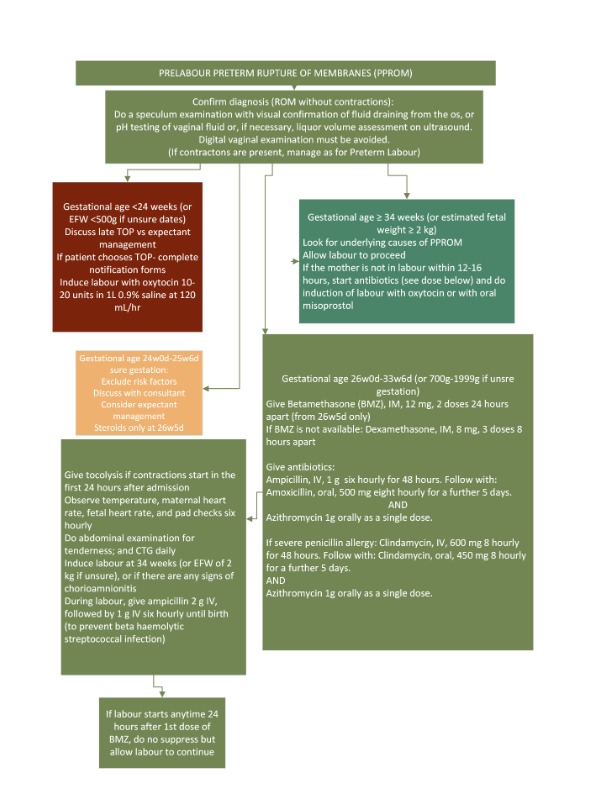
Click on the image to enlarge
Click here to open the above image PDF view
Click here to open the above content in the original PDF view
Tygerberg Hospital, Department of Obstetrics and Gynaecology; Protocol for the acute management of spontaneous preterm prelabour rupture of membranes; Version: May 2013; Last checked for updates by EMGuidance: Oct 2023