Purpose and Organisation of the Guidelines
Organisation of the guidelines These guidelines provide evidence-based practices for TPT to reduce the risk of progressing to TB in people who experience significant exposures or are immunocompromised, thus reducing the overall burden of TB in South Africa. These guidelines are informed by the latest WHO guidance for TB screening 20 and treatment of latent TB infection 21 and are adapted t
Organisation of the guidelines
These guidelines provide evidence-based practices for TPT to reduce the risk of progressing to TB in people who experience significant exposures or are immunocompromised, thus reducing the overall burden of TB in South Africa. These guidelines are informed by the latest WHO guidance for TB screening 20 and treatment of latent TB infection 21 and are adapted to South Africa’s TB epidemiology, local evidence, the availability of regimens, formulations, resources, health infrastructure and other national determinants.
Organisation of the Guidelines
The guidelines are organised into sections by TPT patient type (Sections 4 to 9). Within each section, there are considerations listed for (a) eligibility criteria that define the patient type in that section, and (b) management of TPT patients described in that section including: (i) the TPT test and treat algorithm, (ii) regimen options, and (iii) dosing instructions per regimen.
There are three groups of potential TPT patients:
1) those (regardless of age and HIV status) who experience a significant exposure to TB (contacts),
2) those who are living with HIV and
3) other high-risk groups (people with silicosis, on dialysis, on anti-TNF treatment, on dialysis, preparing for organ or haematological transplant, or other risk groups in national guidelines).
There is some overlap between sections and readers are encouraged to follow the text directing them to other sections as appropriate.
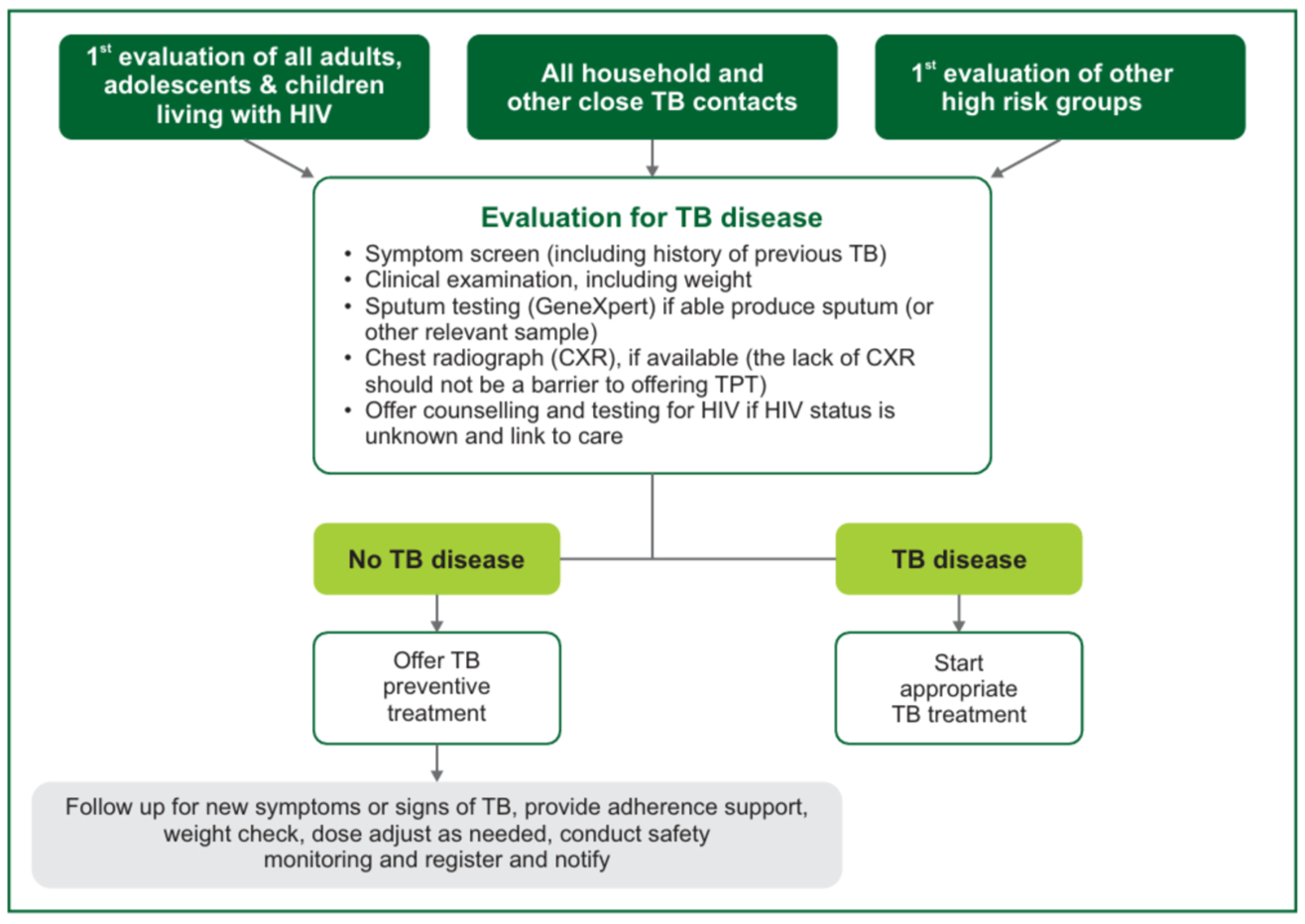
The overall guiding principle is a test and treat approach: TPT must be offered to all people (regardless of age and HIV status) who experience significant TB exposure or who are immunocompromised, after TB disease has been excluded – see Figure 1 for the overarching principles and groups of individuals requiring TPT.
Figure 1. General algorithm for provision of TB preventive treatment using the test and treat approach
Click on the image to enlarge.
Further, where feasible, a ‘family-centred’ or ‘household-centred’ approach to integrated TB treatment and TPT should be followed to simplify adherence support, reduce the risk of stigmatisation and minimise the therapeutic burden on families. As significant TB exposure occurs in places like households, some residents will be on TB treatment (for active disease) and the others on TPT concurrently.
The management of contacts of DR-TB is addressed in the latest South African National DR-TB Guidelines.
National Guidelines on the Treatment of Tuberculosis Infection, February 2023
Purpose and Organisation of the Guidelines