Rabies
Rabies Guidelines
Pre-Exposure Prophylaxis (PrEP)
Post-Exposure Prophylaxis (PEP)
Hotline: National Institute for Communicable Diseases Hotline for Clinical Advice: 0800 212 552.
Rabies is a fatal disease of humans and all other mammals.
In South Africa between 5-30 human rabies cases are laboratory confirmed annually and the majority of the cases are associated with domestic dog exposures.
Nearly all human rabies cases are associated with domestic dog exposures, although all terrestrial mammals and, in certain locations, some bat species may transmit the virus.
Children and young adults are most affected by rabies and are most at risk of potential exposures.
Rabies can be prevented in humans by pre-exposure prophylaxis (PrEP) and timely, appropriate, post-exposure prophylaxis (PEP).
High Risk Exposure
- An animal with abnormal behaviour
- An unprovoked animal attack
- Animals that appear ill and especially animals that die within seven to ten days after the attack
- Category ll and lll exposures (see below)
- Any close contact with bats (transmission can occur with very minor/unapparent contact)
High Risk Areas – Dog Rabies
- Rural Limpopo
- Mpumalanga
- Eastern Cape
- North West
- Free State
- KwaZulu-Natal
Rabies Vaccine
- The rabies vaccine is recommended for travellers that travel to dog rabies affected areas and may be exposed due to their planned activities at those locations
- Rabies vaccine may be administered by the IM and ID route
Rabies Vaccination
- Rabies vaccine may be administered by either ID or IM routes, for all ages ID sites are the deltoid region and either the anterolateral thigh or suprascapular regions. One ID dose is 0.1ml of vaccine and one IM dose is an entire vial of vaccine, irrespective of vial size
- ID PrEP schedules are dose sparing and cost effectiveness increases with number of patients treated
- If a repeat exposure occurs within 3 months of completing the course of PEP, only wound treatment is required and neither vaccine nor RIG is needed
- Changes in PEP rabies vaccine product and/or the route of administration during the PEP course are acceptable if to ensure PEP course completion
- Should a vaccine dose be delayed for any reason the PEP schedule should be resumed(not restarted)
- Individuals with documented immunodeficiency should be evaluated on a case-by- case basis and receive a complete course of IM PEP, including RIG despite previous vaccination
Pre-Exposure Prophylaxis (PrEP)
- Rabies vaccine may be administered by either ID or IM routes for PrEP the ID dose for PrEP is 0.1ml at 2 different sites on Day 0 and 7 (all ages ID sites are the deltoid region and either the anterolateral thigh or suprascapular regions in infants).
- ID PrEP schedules are dose sparing and cost effectiveness increases with number of patients treated.
- One IM dose is an entire vial of vaccine, irrespective of vial size on Day 0 and 7.
Post-Exposure Prophylaxis (PEP)
There is NO BLOOD TEST to confirm or exclude rabies virus transmission from animals to humans
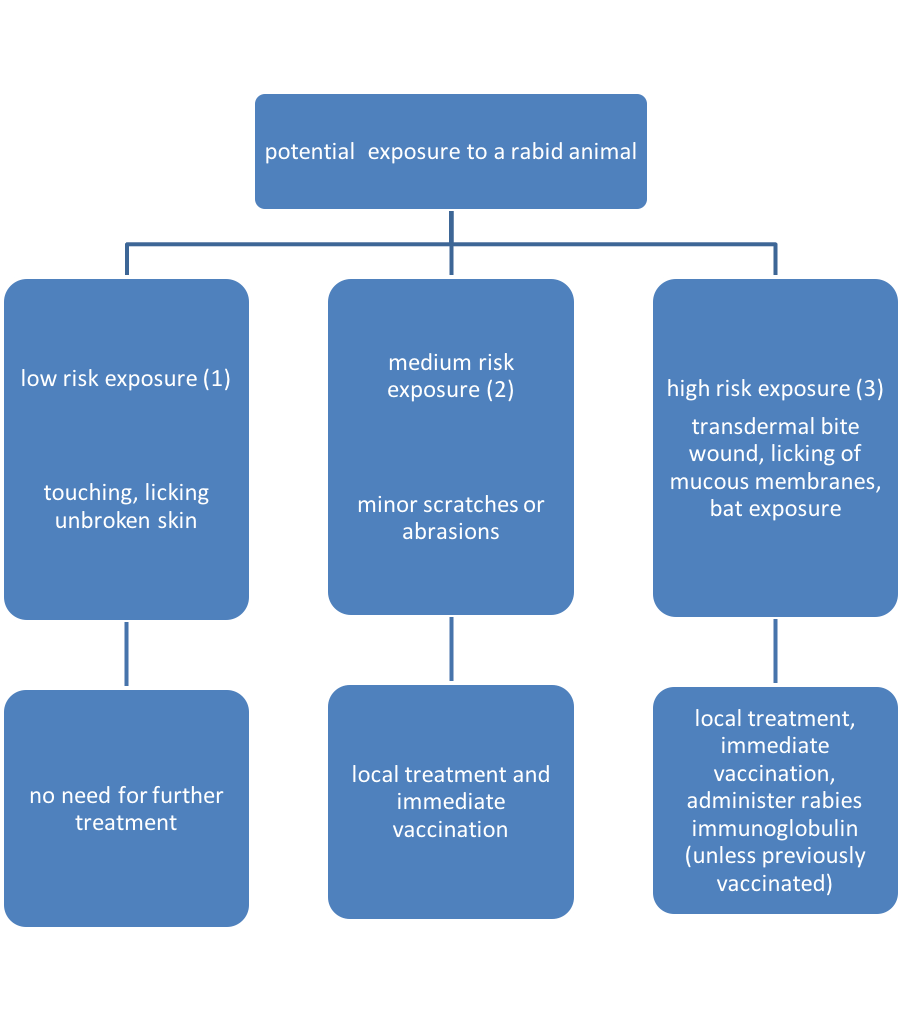
WORLD HEALTH ORGANIZATION (WHO) POST-EXPOSURE PROPHYLAXIS GUIDELINES BASED ON THE CATEGORY OF EXPOSURE TO A RABID ANIMAL
| Exposure to rabid animal* | Treatment | |
| Category I | Touching or feeding; licked unbroken skin | None |
| Category II | Nibbled uncovered skin; minor scratches or abrasions without bleeding | Local treatment of the wound and immediate vaccination |
| Category III | One or more transdermal bites or scratches; licked broken skin; contamination of mucous membranes with saliva from licks; any degree of exposure to potentially rabid bats | Local treatment of the wound. immediate vaccination, and administration of rabies immunoglobulin (RIG) |
| *Exposure to a confirmed or suspected rabid animal or to an animal unavailable for testing. Wound cleansing with soap, water, and a virucidal agent is a cheap and effective part of post-exposure prophylaxis and has been shown to substantially increase survival rates | ||
Wound Treatment
- DO not suture
- Do not use local anaesthetic
- Flush the wound (5-10 minutes)
- Apply local disinfectant,
- Consider antibiotics and tetanus toxoid
Rabies Immunoglobulin (RIG)
- Currently only the IM route is registered in South Africa for PEP, this consists of 4 doses on Days 0, 3, 7 and a final dose any day between 14 and 28 after exposure.
- This is administered in the deltoid muscle in adults and anterolateral thigh in children < 2 years old once again one IM dose is an entire vial of vaccine, irrespective of vial size.
- If previously vaccinated for rabies no RIG is needed and they only require a booster PEP dose on day 0 and 3.
- RIG must be administered for all category 3 exposures, 20IU (HRIG) 40IU (ERIG) per kilogram of body weight infiltrate directly into the tissue surrounding the wound giving as much as anatomically possible (no need to administer remainder at a distant site).
- It is important that RIG is administered immediately but not beyond 7 days after the first day of vaccine administration.
Special considerations
- Individuals with documented immunodeficiency if exposed (categories 2 and 3) should receive a complete course of IM PEP and RIG despite previous vaccination history.
- Please refer to the following infographic on the NICD website for further information https://www.nicd.ac.za/diseases-a-z-index/rabies/.
Click on the image to enlarge
South African Society of Travel Medicine Guideline, 2023