Rabies: Prevention in Humans
Prevention of Rabies in Humans
Prevention of rabies in humans
What is rabies?
Symptoms in animals
Transmission to humans
Management of patient exposed to potential rabid animal
Perform an exposure risk assessment
Symptoms of rabies in humans
Diagnosis of rabies in humans
Treatment of rabies in humans
Further information
Prevention of rabies in humans

What is rabies?
- Rabies is a fatal but entirely preventable viral disease which is primarily spread through the bite from an infected animal.
- The rabies virus infects the central nervous system (brain and spinal cord) and causes disease in the brain.
- Once symptoms begin, there is no effective treatment and death is inevitable. However, infection can be prevented through vaccination of animals and effective management of animal bites in humans.
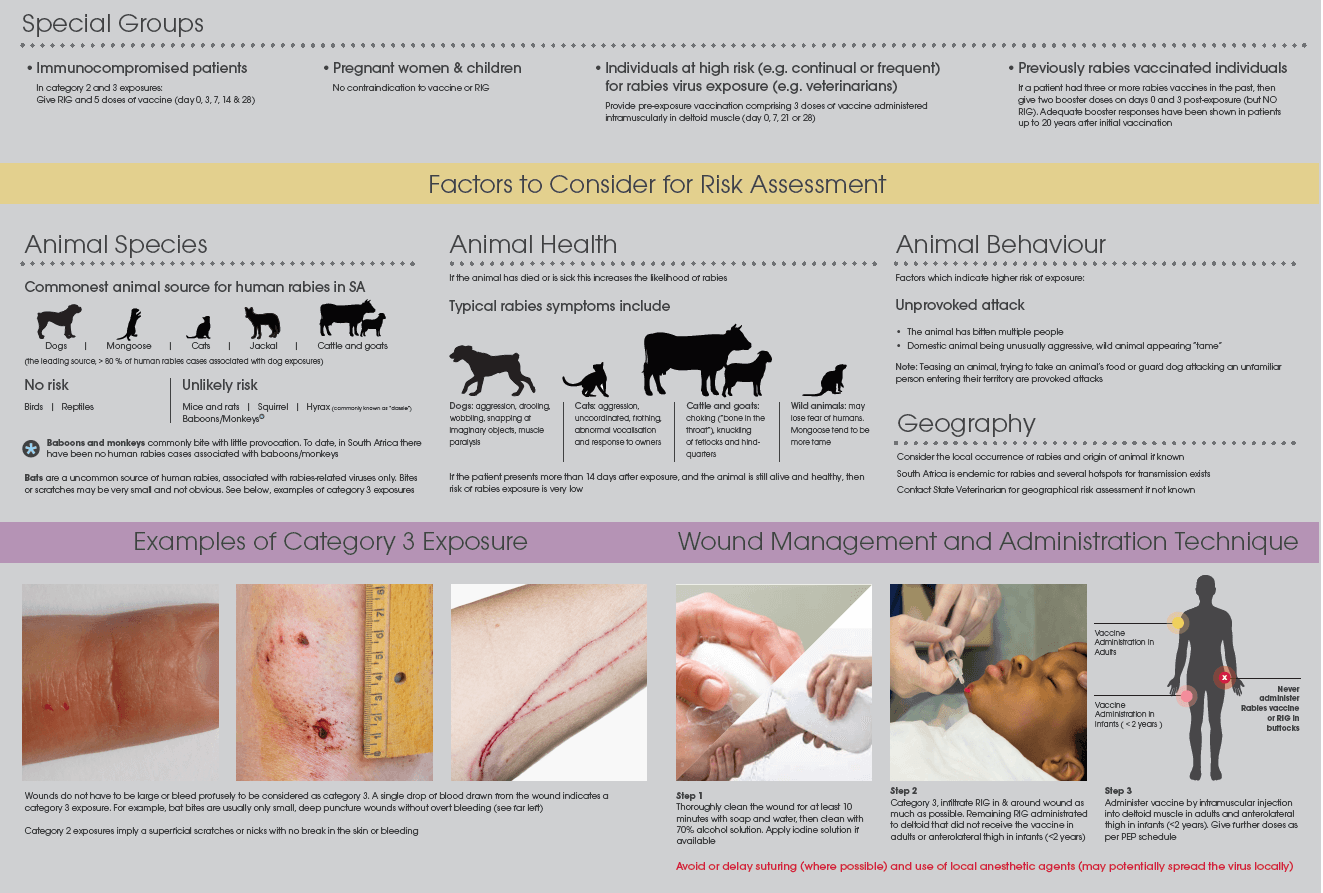
- Animals, mainly dogs and mongoose are the major reservoirs for rabies in South Africa, but cats, cattle, foxes and bats can be affected.
- Children are commonly at highest risk of rabies, due to their inquisitive nature and are less likely to report bites or scratches.
- Western Cape is known to be endemic for animal rabies (bat-eared foxes) in the Central Karoo (Beaufort West) and West Coast districts, thus healthcare workers should be aware of the risk of transmission from these animals, and the possibility that other species of mammals may become infected (including other wildlife, livestock and domestic animals).
Symptoms in animals
- Rabid animals behave abnormally.
- Domestic animals show aggression, disorientation and paralysis. They may foam at the mouth and bite people and other animals without provocation.
- Wild animals, on the other hand, may show unusually ‘tame’ behaviour.
- Animals are infectious approximately a day before they develop any signs of unusual behaviour.
- All infected animals will die from rabies, usually within several days, but occasionally up to 14 days from the first signs of the disease.
Transmission to humans
- The rabies virus is present in the saliva of infected animals and transmitted by:
- a bite or scratch from infected animals
- a lick on broken skin
- a lick on mucous membranes (eyes or mouth)
- The virus cannot be transmitted through a lick on intact skin. The size of a bite may vary, however even a small bite, scratch or tooth mark with a drop of blood poses a risk of infection.
Management of patient exposed to potential rabid animal
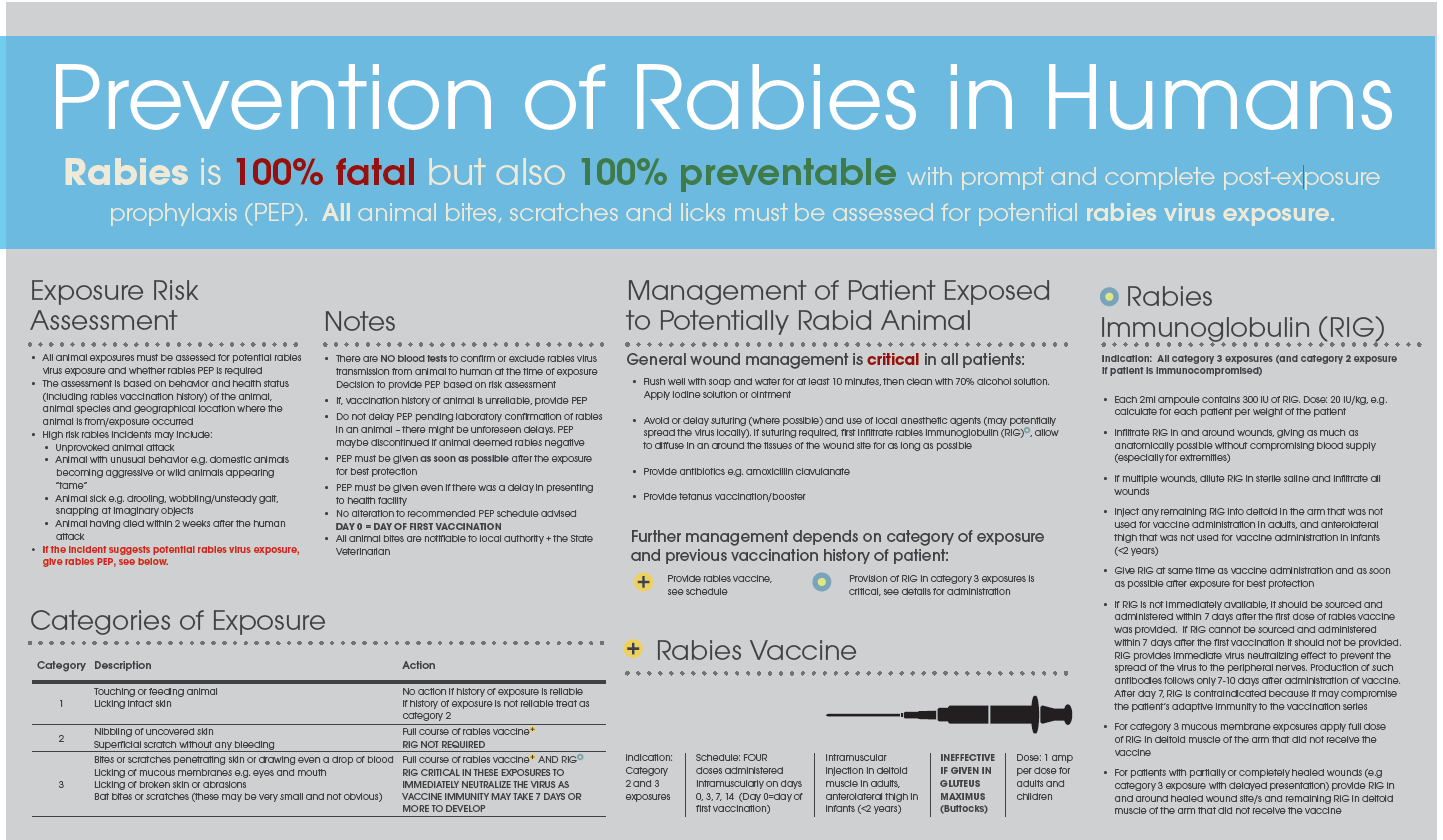
- General wound management is critical in all patients.
- All wounds should be thoroughly cleaned with soap and water for at least 10 minutes, and disinfectant, e.g. 70% alcohol or iodine solution (Betadine) should be applied.
- Do not suture the wound or use local anaesthetic as this may potentially spread the virus.
- Consider anti-tetanus treatment and antibiotics if indicated.
Perform an exposure risk assessment which includes
Animal assessment
- All animal exposure must be assessed for potential rabies virus exposure and whether rabies PEP is required.
- The assessment is based on behaviour and health status (including rabies vaccination) of the animal, animal species and geographical location where the animal is from/exposure occurred.
- Bat-eared fox bites should be considered a significant risk for rabies in the Central Karoo (Beaufort West) and West Coast districts.
- Other animal exposures should be assessed according to the type of animal plus the behaviour and state of health of the animal as well as the ability to assess the animal.
- High risk incidents may include:
- Unprovoked animal attack
- Animal with unusual behaviour e.g. domestic animals becoming aggressive or wild animals appearing “tame”
- Animal sick e.g. drooling, wobbling/unsteady gait, snapping at imaginary objects
- Animal having died within 2 weeks after the human attack.
- It is critical to contact the local State Veterinarian (see contact list below) that are critical with further investigations related to animal assessments when suspected animal bite cases are reported and assessed for potential rabies exposure. Alternatively; contact Dr P. Koen (082-907-2808 all hours, 021-808-5052 office hours, email - pieterk@elsenburg.com) as first contact for Veterinary Services, who will be able to task the relevant local State Veterinarian to investigate.
- If the incident suggests potential rabies virus exposure, give rabies post-exposure prophylaxis (PEP), see below.
Exposure Category
- Category 1 exposure: a reliable history of touching/feeding an animal or licking of intact skin does not require rabies vaccine or immunoglobulin. If history of exposure is not reliable treat as category 2.
- Category 2 exposure: where a superficial scratch has occurred without bleeding or nibbling of uncovered skin, rabies vaccine should be administered on days 0, 3, 7, 14, 28 but immunoglobulin is not required.
- Category 3 exposure: where a bite/scratch has penetrated the skin or a lick has occurred on mucous membranes or broken skin, rabies vaccine should be given on days 0, 3, 7, 14, 28 and rabies immunoglobulin (dosage according to weight, 20 IU/kg) should be given into and around the wound.
- Previous rabies immunisation
- If an exposed person has a reliable history of previous rabies immunisation they do not require rabies immunoglobulin after a category 2 or 3 exposure, but should receive booster doses of rabies vaccine into their arm on days 0 and 3 after exposure.
- Rabies vaccine should be administered into the deltoid muscle in the arm, and never into the gluteus.
- Immunoglobulin should be infiltrated into and around the wound, with the remainder being given into the deltoid of the opposite arm. For multiple wounds, immunoglobulin should be diluted in equal volumes of saline and infiltrated into all wounds.
- If immunoglobulin is not immediately available, continue with the rabies vaccine course and the immunoglobulin can still be given up to 7 days after the first dose of rabies vaccine.
- For availability of rabies vaccine and immunoglobulin (see Circular 143/2012). The following public health facilities should have vaccine and immunoglobulin available: Groote Schuur Hospital, Tygerberg Hospital, Swartland Hospital, Paarl Hospital, Vredenburg Hospital, Vredendal Hospital, Stellenbosch Hospital, Swellendam Hospital, Worcester Hospital, Beaufort West Hospital, George Hospital, Khayelitsha District Hospital.
- Provincial Pharmacy Services has rabies vaccine and immunoglobulin stock-holding at facility level information available.
Symptoms of rabies in humans
- The incubation period may vary from a week to a year after the initial exposure.The closer the bite is to the brain, the shorter the incubation period.
- The first symptoms of rabies are flu-like symptoms, such as fever, headache, fatigue, along with abnormal sensations or hyperparasthesia at the bite site.
- There may be signs of hallucinations or hyperactivity (‘furious’ rabies) or paralysis (‘dumb’ rabies). Spasms affecting the muscles involved in swallowing result in the classical ‘hydrophobia’ (‘fear of water’).
- In the early stages, patients will be awake and fully aware between spasms; progression of the disease results in convulsions, coma and death. Rabies should always be suspected in presentations of encephalitis; even where a history of an animal bite may not be forthcoming.
Diagnosis of rabies in humans
- There are several tests to confirm rabies disease in humans once a person becomes ill, but there is no diagnostic test to determine if someone has been exposed to rabies from an animal bite.
- Do not delay performing a risk assessment and providing preventive treatment following an animal bite.
- For rabies testing, please see the following documents:
- Rabies Case Investigation form
- Rabies: Ante-mortem and Post-mortem Specimen Collection Guide
Treatment of rabies in humans
• There is no effective treatment for rabies once symptoms develop, and death is inevitable.
Further information
For further information about rabies, please refer to:
- Rabies Guide for the Medical, Veterinary and Allied Professions, Second Edition 2010
- Rabies Poster: Prevention of Rabies in Humans
The NICD Hotline 082-883-9920 (Health professional ONLY) can be contacted for further advice on management of animal bites and/or suspected rabies cases.