GuidelinesOther guideline
Rabies Prophylaxis
Rabies Prophylaxis
Assessment
Definition
- Rabies is a viral infection transmitted by the saliva of infected animals.
- It causes acute encephalitis.
- Rare in the Western Cape BUT 100% mortality once symptomatic: Err on the side of caution and assume exposure
- Post-exposure prophylaxis prevents fatalities
ALL ANIMAL BITES SHOULD BE CONSIDERED A POTENTIAL RABIES RISK
If unsure call the Advice Line
NICD CLINICAL ADVICE LINE: 082 883 9920
ALL ANIMAL BITES ARE NOTIFIABLE
Reservoirs are: Mongooses, Cats, Jackals, Bats, Dogs
HIGH RISK ATTACKS
- Stray animals
- Animals displaying abnormal behaviour: aggressive, wild animals appearing tame
- Unprovoked animal attack
- Animal that cannot be traced after the attack
- Category 2 or 3 exposures
- The animal should be followed up if possible to see whether it dies.
- Prophylaxis can be stopped if the animal remains healthy after 10 days.
- A deceased or sacrificed animal should be sent for post-mortem testing for rabies infection
- There is no blood test that can confirm or exclude rabies transmission to humans
History
- Ask about behaviour of the animal
- Ask about vaccination history of the animal (this may be unreliable)
- Note that symptoms are delayed – Do not delay PEP if suspicion is high
- If exposed to a potentially Rabid Animal
Categorise the wound according to Exposure Risk
| Risk Category 1 No Wound | Risk Category 2 Skin not Intact | Risk Category 3 Transdermal Wound |
| Touching or feeding rabid animal | Nibbling of uncovered skin | Bites or scratches that penetrate skin and draw blood |
| Licks on intact skin | Superficial scratch without bleeding | Lick of mucous membranes |
| Lick of broken skin |
Management
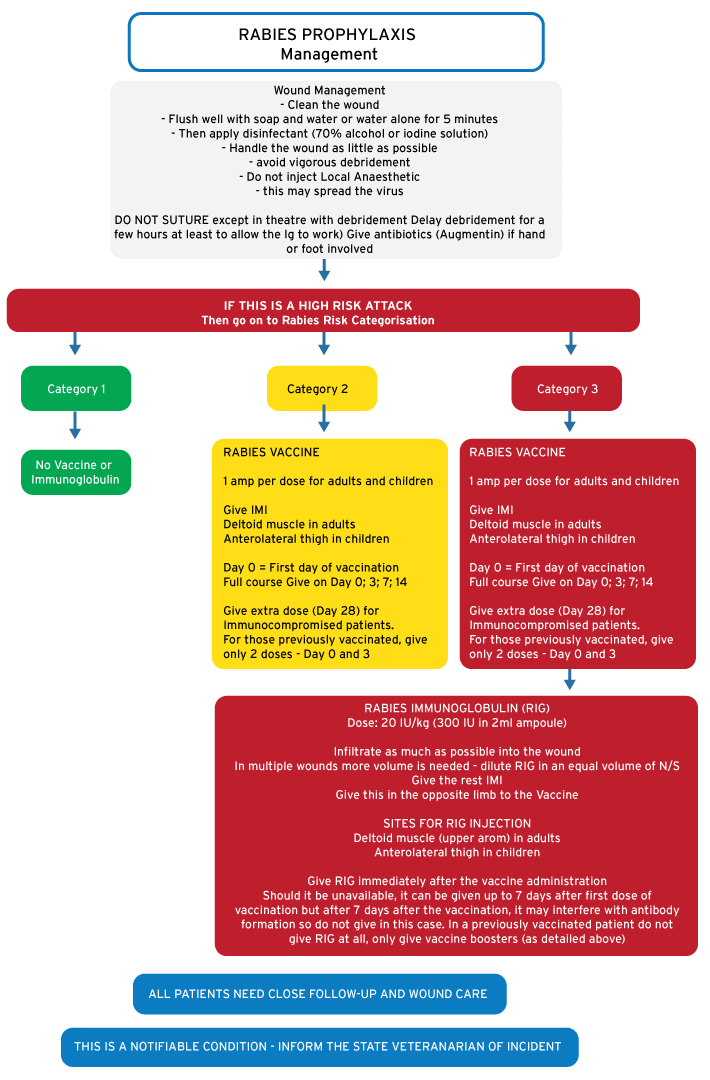
Wound Management
- Clean the wound
- Flush well with soap and water or water alone for 5 minutes
- Then apply disinfectant e.g. 70% alcohol or iodine solution
- Debride dirty wounds – surgical debridement may be needed
- Do not suture
- Give antibiotics if hand or foot involved: Augmentin
Immunisation Management according to Rabies Risk Categorisation
| Types of Exposure | Category 1 | Category 2 | Category 3 |
| *Rabies Vaccine | No | Full Course | Full Course |
| **Rabies Immunoglobulin | No | No | Yes |
*GUIDE FOR RABIES VACCINE
- Dose: 1 amp per dose for adults and children
- Give IMI – Deltoid muscle in adults and Anterolateral thigh in children (Never into gluteus maximus)
- Day 0 = First Day of vaccination
- Full Course: Give Day 0; 3; 7; 14; 28
**GUIDE FOR RABIES IMMUNOGLOBULIN (RIG)
- Dose: 20 IU/kg (300 IU in 2ml ampoule)
- Infiltrate half around wound and give remainder IMI – opposite limb to bite
- IMI dose - Deltoid muscle in adults and Anterolateral thigh in children (Never into gluteus maximus)
- If there are multiple wounds, dilute RIG in an equal volume of saline
- Give RIG immediately after vaccine administration
- RIG can be given up to 7 days after first dose of Rabies vaccine
ALL PATIENTS NEED CLOSE FOLLOW UP AND WOULD CARE : INFORM STATE VETERINARIAN OF INCIDENT
Rabies Prophylaxis Management