Rapid Sequence Intubation (RSI)
Description Medicine treatment Healthcare professionals engaged in intensive care must undergo appropriate training, with junior doctors working under appropriate supervision. Endotracheal intubation should usually be performed using the rapid sequence technique and must be undertaken by the most experienced clinician during emergencies. For Neonatal Care see: Prematurity and Neonatal Conditions.
Healthcare professionals engaged in intensive care must undergo appropriate training, with junior doctors working under appropriate supervision. Endotracheal intubation should usually be performed using the rapid sequence technique and must be undertaken by the most experienced clinician during emergencies.
For Neonatal Care see:
Prematurity and Neonatal Conditions.
DESCRIPTION
Rapid Sequence Intubation (RSI) is a coordinated, sequential approach to emergency endotracheal intubation designed to optimise success and safety. This technique is recommended for most scenarios necessitating endotracheal intubation. The sequential steps involved in RSI are (The 7 ‘P’s):
- Preparation (10 minutes pre-intubation) – best achieved with the use of a checklist. Focussed history and examination to assess for presence of a difficult airway and conditions which will influence choice of drugs for the procedure. All necessary equipment must be present and checked prior to the administration of any sedatives. A plan for what to do should intubation be unsuccessful is mandatory.
- Pre-oxygenation (5 minutes pre-intubation) – 100% oxygen (or highest concentration available) should be started as soon as the decision to intubate is taken. A minimum of 3 minutes is needed to increase the time to desaturation during intubation.
- Pre-treatment (3 minutes pre-intubation) – optional. Atropine may be beneficial to counteract bradycardia during intubation for the following: if suxamethonium is going to be used; for infants and in children with septic or late-stage hypovolaemic shock.
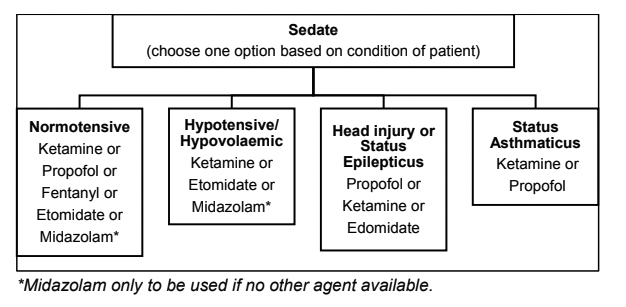
- Paralysis post sedation (Induction) – Sedation must be administered prior to the paralytic agent. The choice of agents will be determined by the clinical characteristics of the patient.
- Protection and Positioning (30 seconds post induction) – cricoid pressure is not recommended for airway protection. External laryngeal manipulation may be utilised to improve the view of the anatomy during intubation.
- Placement with confirmation (45 seconds post induction) – end-tidal CO2 detection is strongly recommended, in addition to auscultation and visualisation of symmetrical chest rise.
- Post intubation management (60 seconds post induction) – secure the endotracheal tube appropriately and obtain a chest X-ray. Commence ongoing analgosedation.
NOTES:
- If intravenous (IV) access is not available, intraosseous (IO) is preferred to intramuscular (IM) administration.
- Pre-treatment (see table below) is no longer routinely recommended as there is limited evidence of routine benefit.
- Factors influencing choice of sedative:
- Haemodynamically stable – propofol or ketamine or etomidate.
- Haemodynamically unstable – ketamine or fentanyl or etomidate.
- Status asthmaticus – ketamine or etomidate.
- Status epilepticus – propofol or midazolam. If hypotensive – ketamine or etomidate.
- With respect to paralytic agents, suxamethonium (unless contraindicated) remains the agent of choice. Among the nondepolarizing agents, rocuronium is preferred to vecuronium.
- While etomidate does cause adrenal suppression, it remains an efficacious induction agent for most indications with the potential exception of sepsis.
- Fentanyl can be used in patients with haemodynamic instability, but at a lower starting dose and then titrated to effect (1 µg/kg vs 3 µg/kg in haemodynamically stable patients). It is a good option in patients with either suspected myocardial ischaemia or catecholamine depletion. Fentanyl must be administered slowly (30–60 seconds).
- While midazolam remains a very popular induction agent, it is not recommended for routine use unless it is the only agent available.
Click on the image to enlarge
Suxamethonium contraindications:
- Absolute:
- Chronic myopathy or denervating neuromuscular disease.
- 48 to 72 hours post burns, polytrauma, or an acute denervating event.
- Extensive rhabdomyolysis.
- Pre-existing hyperkalaemia.
- Personal or family history of malignant hyperthermia.
- Relative:
- Renal dysfunction with normal serum potassium.
- Organophosphate poisoning or any other known pseudocholinesterase deficiency.
MEDICINE TREATMENT
Pre-treatment
| Drug | IV Dose | Indication |
| Atropine or Glycopyrrolate |
0.02 mg/kg Minimum: 0.1 mg Maximum: 0.5 mg (1 mg adolescents) |
For patients at increased risk of bradycardia (vagally induced, reflex, succinylcholine). Prior to ketamine administration. |
| 0.01–0.08 mg/kg | As per atropine. | |
| Lidocaine |
1–2 mg/kg Maximum: 200 mg |
Consider in patients with suspected raised ICP. |
| Fentanyl | 2–3 µg/kg | Consider in patients with suspected raised ICP. |
Sedatives (Induction)
| Drug | IV Dose | Time to Effect | Duration of Effect |
| Ketamine | 1–2 mg/kg | 60 seconds | 5–10 minutes |
| Propofol | 1–3.5 mg/kg | 30 seconds | 3–10 minutes |
| Fentanyl | 1–5 µg/kg | 1–2 minutes | 30–40 minutes |
| Etomidate | 0.3 mg/kg Maximum: 20 mg |
15–45 seconds | 10–12 minutes |
| Midazolam | 0.2–0.3 mg/kg Maximum: 10 mg |
2–3 minutes | 30–45 minutes |
Paralytic Agents (Neuromuscular Blockers)
| Drug | IV Dose | Time to Effect | Duration of Effect |
| Suxamethonium | 1–2 mg/kg | 30–60 seconds | 5–10 minutes |
| Rocuronium | 1 mg/kg | 1–3 minutes | 60–90 minutes |
| Vecuronium | 0.1 mg/kg | 2–3 minutes | 30–40 minutes |
| Cisatracurium | 0.1–0.15 mg/kg | 3 minutes | 30–45 minutes |
Options if no IV or IO access available
| Drug | IM Dose | Onset | Comments |
| Atropine | 0.02–0.03 mg/kg | 4–8 minutes | Not routinely recommended. |
| Ketamine | 6–10 mg/kg | 3–4 minutes | Peak effect after 10–30 minutes. |
| Midazolam | 0.25–0.5 mg/kg Maximum: 10 mg |
5– 10 minutes | Peak effect after 10–30 minutes. |
| Suxamethonium | 4 mg/kg Maximum: 150 mg |
3–6 minutes | Commonly results in significant local muscle pain. |
| Rocuronium | 1–1.8 mg/kg | 5–9 minutes | 1 mg/kg for infants, 1.8 mg/kg for children > 1 year. |
Standard Treatment Guidelines And Essential Medicines List For South Africa, Hospital Level, Paediatrics, 2023 Edition
Chapter 23: Paediatric Intensive Care, 23.1 Rapid Sequence Intubation (RSI)