Recommendations
Only offer PCa screening to informed, asymptomatic men, in line with their personal values and preferences, who have a life expectancy of >10 years Use the PSA blood test as the first screening test Offer early PSA testing to asymptomatic, well-informed men with a life expectancy of >10 years who are at high risk of CaP Individualise screening intervals for PSA testing in men who had a norm
Use the PSA blood test as the first screening test
Individualise screening intervals for PSA testing in men who had a normal initial PSA test
Only offer PCa screening to informed, asymptomatic men, in line with their personal values and preferences, who have a life expectancy of >10 years
In medicine, multiple options are available for testing or treatment for certain conditions. This choice may be easy if one test or course of therapy is supported by scientific evidence. In other situations, selecting the optimal option can be challenging if there is no correct answer. The decision in these cases is referred to as ‘preference sensitive’, since the informed patient’s choice, that is in line with their personal values and preferences, is the ‘best’ option. PCa screening is one such situation. Shared decision-making is considered state of the art in patient counselling for preference-sensitive decisions.[5] PCa screening should only be offered after a detailed, comprehensive explanation of its risks and benefits. The possible benefit of reducing rates of PCa-specific mortality and metastases needs to be weighed against the side-effects of screening and increased diagnosis, which lead to over-treatment of mainly clinically insignificant, harmless PCa, and subsequent treatment-related effects.[6] PCa screening should not be offered to an uninformed patient.
Do not offer PCa screening to men who are unlikely to accept therapy even if a significant treatable cancer is subsequently found.
Do not offer PCa screening to men aged >70 years or with a life expectancy of <10 years based on age or comorbidities, because the potential survival benefits from treatment are statistically minimal, and they do not outweigh the significant adverse effects that the patient may experience due to treatment.
Men aged >70 years have been reported to have the highest incidence of PCa overdiagnosis, with several studies suggesting that screening in this age group is likely not to be beneficial. Data from the European Randomised Study of Screening for Prostate Cancer trial showed that starting screening at age >70 did not result in a reduction in PCa mortality.[7] Similarly, in patients with a <10-year estimated life expectancy, screening is not likely to provide a benefit in terms of disease-specific or overall mortality.[5]
Moreover, the evidence obtained from randomised trials that compared surgery, radiation and monitoring has demonstrated that curative treatment becomes less beneficial and more hazardous as age increases.[8-10] While we note the challenges in estimating life expectancy, we recommend against offering PCa screening in asymptomatic men aged >70 years or with a life expectancy <10 years, where their competing risks of mortality are likely to compromise any benefit from PCa screening. For men who are interested, and in excellent health at age 70, PSA testing can be considered, provided the patient is informed about the risks and benefits.
Use the PSA blood test as the first screening test
Although it lacks specificity, PSA is still the recommended screening test for early diagnosis of PCa.[5] PSA levels tend to escalate as individuals grow older, and the rate of increase is more rapid in elderly men. The accepted threshold for PSA level is typically ≤4 ng/mL. Age-specific ranges have been established to decrease the identification of less-developed cancers in older men and enhance the identification of large yet potentially treatable tumours in the younger age category. The age-specific normal ranges for PSA levels are set out in Table 1.
The role of digital rectal examination (DRE) as part of the initial PCa screening evaluation in asymptomatic patients has recently been reviewed. A comprehensive meta-analysis and systemic review that evaluated eight studies, involving 85 738 participants, found that there was no benefit in terms of the cancer detection rate or the positive predictive value of combined DRE and PSA testing over PSA testing alone.[11,12] Another meta-analysis specifically evaluating the diagnostic accuracy of DRE in the primary healthcare setting came to a similar conclusion, and recommended that routine DRE screening for PCa in the primary care setting could be omitted.[13] It must be stressed that DRE in primary care still plays a statistically significant role in evaluating and diagnosing symptomatic patients.[14]
Table 1. Age-specific normal ranges for prostate-specific antigen levels
| Age group (years) | Reference range (ng/mL) |
| 40 - 49 | 0 - 2.5 |
| 50 - 59 | 0 - 3.5 |
| 60 - 70 | 0 - 4.5 |
Offer early PSA testing to asymptomatic, well-informed men with a life expectancy of >10 years who are at high risk of CaP
Initiate PSA screening in the following patients who are at high risk for CaP:
- From the age of 50 years in all men
- From the age of 45 years in black African men, and in men with a positive family history of prostate and/or breast cancer in a first-degree relative
- In men who have undergone genetic testing and who are carriers of the BRCA2, BRCA1, HOXB13, AT M or CHEK2 genes, screening should be performed at 40 years of age or at 10 years younger than the age of onset of the youngest affected family member if this was before 40 years of age.
Individualise screening intervals for PSA testing in men who had a normal initial PSA test
The optimal intervals for PSA testing are unknown, and it is therefore recommended to determine further PSA testing on an individual basis based on the initial PSA level. International guidelines suggest that that interval may be extended up to 8 years between tests.[15] However, considering that black African men have historically been under-represented in trials[16] and that they have a higher incidence of and mortality from PCa compared with men of other races,[17] more frequent PSA testing is recommended (Fig. 1).
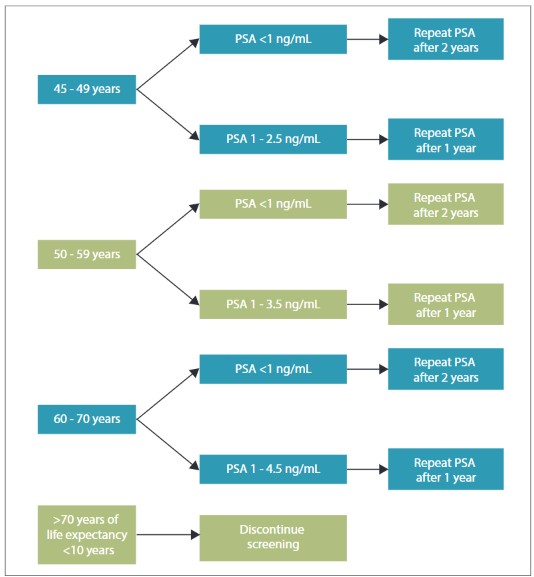
Fig. 1. Recommended age-related screening intervals for prostate-specific antigen screening.
Click on the image to enlarge.
Discontinue PSA screening in men aged >70 years or with a life expectancy of <10 years, based on age or comorbidities, because the potential survival benefits from treatment are statistically minimal, and they do not outweigh the significant adverse effects that the patient may experience due to treatment.
Defer PSA screening when factors are present that may transiently elevate PSA enough to affect its performance as a screening test
Apart from age, PCa and benign prostatic hyperplasia, other factors may transiently falsely elevate PSA. It is recommended that screening be deferred in the following situations, for long enough for the PSA elevation to resolve:[18,19]
- Bacterial prostatitis – defer PSA testing for 6 - 8 weeks after resolution of symptoms
- Acute urinary retention – defer PSA testing for 6 weeks
- Urethral instrumentation – defer PSA testing for 6 weeks
- Recent transurethral resection of the prostate – defer PSA testing for 6 weeks.
Repeat the PSA test in asymptomatic men in whom the initial PSA level is raised but <10 ng/mL (i.e. the ‘grey zone’) and who have normal findings on DRE
Of individuals who have recently had an increase in their PSA levels, 25 - 40% may expect a return to normal levels upon undergoing a subsequent test.[20] Of the 1 686 patients who underwent a biopsy in the Stockholm 3 study and had a PSA level between 3 and 10 ng/mL, and had two PSA tests taken 8 weeks apart, 283 (16.8%) had a subsequent PSA level <3 ng/mL.[21] Sexual activity can minimally elevate the PSA level (usually in the 0.4 - 0.5 ng/mL range) for ~48 - 72 hours after ejaculation.[22] Vigorous bicycle riding has also been reported to cause significant elevations in PSA, although studies contradict this. It is therefore recommended to verify the elevated PSA measurement after abstaining from ejaculation or cycling for at least 48 hours before continuing with additional assessment. It is worth noting that a DRE may cause minor transient elevations that are clinically insignificant.[23,24]
Improve the specificity of cancer detection when total PSA is in the ‘grey zone’ by determining the free/total PSA ratio
We recommend using the free/total PSA ratio to improve the sensitivity of cancer detection when the initial total PSA level is elevated, but still <10 ng/mL in the presence of a normal DRE.[25]A free/total PSA ratio ≤0.10 (10%) carries a cancer probability of >80%, and a ratio ≥0.25 (25%) carries a cancer probability of <10%. Free/total PSA is of no clinical use if the total serum PSA is >10 ng/mL or during follow-up of known PCa.[26]
Apply a correction factor to obtain a more accurate PSA level in men on 5-alpha-reductase inhibitors (5ARIs): finasteride or dutasteride
Finasteride and dutasteride are 5ARIs that are used either as monotherapy or, more commonly, as combination therapy in the medical management of benign prostatic enlargement.[27] They act by chemically blocking dihydrotestosterone production and shrinking the prostate volume by inducing apoptosis of prostate epithelial cells.[28] Over a period of 6 - 12 months, treatment with 5ARIs reduces the prostate size by ~20%, with a 50% decrease in PSA.[29,30] It is recommended that in men who are using either of these drugs, the PSA level should be multiplied by 2.
Do not use antibiotics for asymptomatic men with no clinical features of bacterial infection to reduce the PSA.
In the past, it was routine practice to treat asymptomatic men with an elevated PSA with antibiotics to see if a possible infection may be responsible for the PSA increase. This practice may be detrimental and predispose the patient to increased risk of infection after prostate biopsy at a later stage, Clostridium difficile infection and antibiotic resistance, and is therefore not recommended.[5,31,32]
Do not use alpha-blockers (tamsulosin/doxazosin/alfuzosin) for asymptomatic men to reduce the PSA.
Refer men with a persistently elevated age-adjusted PSA level or abnormal DRE to the urologist for further work-up
The foundation of a definitive PCa diagnosis is histopathological confirmation through transperineal or transrectal prostate biopsy. However, considering that the likelihood of high-grade PCa has been estimated to be as high as 98.5%[33] in men with a PSA level >50 ng/mL, in the absence of another cause for increased PSA, biopsy can be delayed or omitted in situations where biopsy is risky (patients on anticoagulation or frail patients with significant comorbidities) or will delay treatment (spinal cord compromise from metastases).[34] This recommendation is based on the condition that the urologist communicates the risk of PCa and the patient is involved in the decision-making process.
In the same light, authors have reported a positive predictive value for detecting PCa with needle biopsy of 100% in patients with PSA levels ≥100 ng/mL. Of the patients with a PSA level ≥100 ng/mL, all (100%) had extraprostatic disease, 7% had locally advanced disease, and 93% had metastatic disease.[35] Similarly, an SA study also showed that a clinical diagnosis of advanced PCa can be made based on the basis of serum PSA, DRE findings and supportive clinical features.[36]
We therefore recommend, in select patients (elderly with multiple comorbidities), especially in resource-limited settings, that a clinical diagnosis (without needle biopsy) of advanced PCa can be made in order to start androgen deprivation therapy without delay and avoid the associated costs and complications of a prostate biopsy. This recommendation is based on the condition that the urologist informs the patient of the likelihood of metastatic disease and the consequences of delaying treatment, and that the patient is involved in the decision-making process.All other patients should be risk-stratified, staged and managed according to the local treatment guidelines.
South African Urology Association and the Prostate Cancer Foundation of South Africa: The South African Prostate Cancer Screening Guidelines (SAMJ_CME)_May 2024, Vol. 114, No. 5