Red Cell Components
SANBS Clinical Guideline, 6th Edition, 2023
Indications for red cell components
Blood for exchange transfusion in adults
Paediatric red cell transfusion
Red cell transfusion in older children (>1 years)
Specific components for neonates and infants
The transfusion of red cells, when prescribed in the correct clinical setting, has the ability to save lives and markedly improve survival rates and morbidity in patients. Optimal use of RBCs should involve administering enough (minimal amount of) RBCs to maximise clinical outcomes while at the same time avoiding unnecessary transfusions that expose patients to potential – albeit rare – infectious or noninfectious risks as well as increased costs.
There is no consistently accepted haemoglobin (Hb) level below which red cell transfusion should occur for every patient, in every situation. Rather, the decision to transfuse red cells to an anaemic patient should be based primarily on the clinical situation, guided by the Hb level.
Various clinical factors should be considered, in addition to the Hb level, when deciding whether a red cell transfusion is warranted:
- Cardiopulmonary reserve: Effective oxygen delivery depends not only on the patient’s Hb level, but also on their cardiovascular condition and ability to compensate for decreased Hb. Patients with normal cardiopulmonary function will likely be able to tolerate lower Hb levels than those with limited cardiopulmonary reserve
- Acuity: Patients who develop anaemia slowly develop compensatory mechanisms to allow them to tolerate lower Hb values than patients who become acutely anaemic
- Presence/risk of ongoing blood loss: These patients may require a higher Hb target
- Age: The normal Hb levels of infants and children vary from those seen in adults, so transfusion triggers and the usual blood component dose will also vary according to age (see below for guidelines on neonatal and paediatric transfusions)
RBCs are not given for volume replacement or for any reason other than correction of acute or chronic anaemia and to restore/improve tissue oxygenation. RBCs should be given only after non-transfusion alternatives have been either assessed and excluded or found to not adequately manage anaemia.
The early application of appropriate PBM principles is required for all patients. Depending on the underlying cause of anaemia, alternative treatments should be considered, e.g. iron (oral/intravenous), vitamin B12, folic acid and erythropoietin stimulating agents. In the surgical setting, cost-effective pharmaceutical preparations that prevent, minimise or control blood loss should be used. Monitoring the patient while treating the underlying conditions contributing to anaemia may be an alternative to transfusion for some patients.
RBC transfusion is usually indicated if Hb <7g/dl and is rarely indicated if Hb >10g/dl. For patients with Hb levels between 6 g/dl and 10 g/dl, other factors should be considered, e.g. age, co-morbidities, risk of ischaemia, and rate and volume of blood loss.
Many studies and guidelines recommend the use of a restrictive transfusion strategy, including in the ICU setting and with post-operative anaemia:
- In hospitalised adult patients who are haemodynamically stable, including critically ill patients, a restrictive RBC transfusion threshold in which the transfusion is not indicated until the Hb level drops to <7g/dl, is recommended.
- For patients undergoing orthopaedic or cardiac surgery and for those with pre-existing cardiovascular disease, a restrictive RBC transfusion threshold of 8 g/dl is recommended. Although the restrictive transfusion threshold of 7 g/dl is likely comparable with 8 g/dl, randomised controlled trial (RCT) evidence is not available for these patients and this more lenient cut-off is therefore recommended.
These recommendations do not apply to patients with:
- Acute coronary syndrome
- Severe thrombocytopenia (patients treated for haematological or oncological conditions who are at risk of bleeding)
- Chronic transfusion-dependent anaemia (there is insufficient evidence)
Of note, patients with thrombocytopenia plus anaemia are more likely to bleed than those with thrombocytopenia alone. The primary aim of red cell transfusions in patients with chronic anaemia is to ameliorate symptoms as opposed to achieving a specific Hb level.
Transfusions are associated with increased morbidity and mortality in high-risk hospitalised patients. Single-unit red cell transfusions should be the standard for non-bleeding hospitalised patients, as this is often adequate to relieve symptoms or raise the Hb to an acceptable level. Additional units should only be prescribed after re-assessment of the patient and their Hb value.
Summary of recommendations for red cell transfusions
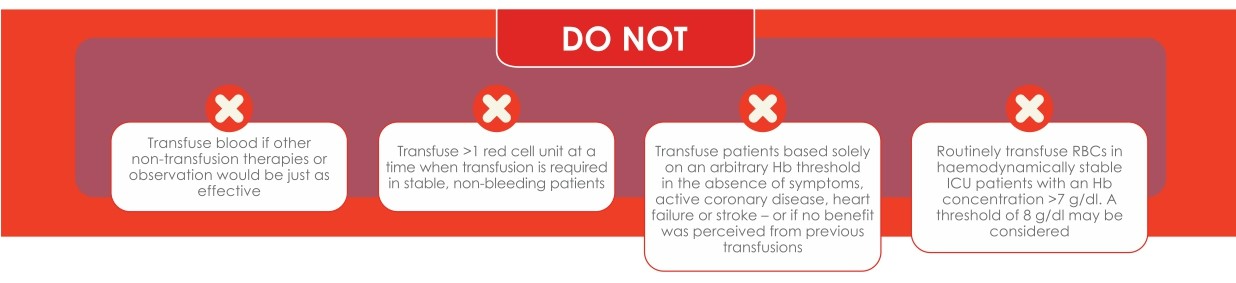
A restrictive RBC transfusion threshold is recommended in hospitalised adult patients who are haemodynamically stable, including in critically ill patients. Transfusion should not be indicated until an Hb level of 7 g/dl is reached.
This recommendation excludes the following conditions, in which transfusion is not indicated until an Hb level of 8 g/dl is reached:
- Orthopaedic surgery
- Cardiac surgery
- Pre-existing cardiac conditions
This recommendation also excludes patients with the following conditions:
- Acute coronary syndrome: Insufficient evidence; a transfusion trigger of 8 g/dl – 10 g/dl may be considered
- Severe thrombocytopenia at risk of bleeding: These patients are more likely to bleed so, although there is insufficient evidence, a transfusion trigger of 8 g/dl may be considered
- Chronic transfusion-dependant anaemias: Aim is to ameliorate symptoms of anaemia, not treat an Hb level
Click on image to enlarge
Indications for red cell components
The primary indication for RBC transfusion is the restoration of oxygen-carrying capacity. Red cell concentrates (and in specific situations, whole blood) are used to improve tissue oxygenation when this is impaired by haemorrhage or anaemia.
Acute blood Loss
Acute blood loss of >30% of blood volume (about 1 200 ml – 1 500 ml blood in an adult) will often result in the need for a red cell transfusion. There must be no delay in ordering blood in situations where blood loss is acute and rapid or where there is a possibility of recurrence or continuation of bleeding.
In patients with acute blood loss, volume replacement is often required and, depending on the clinical circumstances, plasma and platelets may also be transfused.
General surgery
Consider transfusion if:
- The pre-operative Hb level is <8 g/dl and the surgery is associated with major blood loss (>500 ml)
- The intra- or post-operative Hb falls below 7 g/dl. A higher Hb level may be indicated in patients who are at risk for myocardial ischaemia or who are >60 years of age
Pre-operative anaemia must be investigated and corrected in every case, as medical management to raise the Hb level may be more appropriate than transfusion.
In surgical patients, the effect of plasma and blood-volume expansion should be considered when determining the red cell transfusion threshold based on the Hb concentration only, and the limitations of the haematocrit (Hct) level should be taken into account when assessing the need for RBC transfusion in hypovolaemic anaemic patients.
In situations of massive transfusion, the number of RBC units transfused can be used as a surrogate for determining the transfusion requirements of FFP, platelet concentrate and cryoprecipitate. All hospitals should have a protocol in place that addresses massive blood transfusion.
Anaemia in acute coronary syndromes
In patients with acute coronary syndromes (ACS), the latest review of the guidelines cannot recommend for or against a liberal or restrictive RBC transfusion threshold. Further research is needed to determine the threshold.
Transfusion to an Hb level of 8 g/dl – 10 g/dl should be considered acceptable, but the effect of each unit transfused must be evaluated for the risk of heart failure due to fluid overload.
Anaemia
Early investigation and correct management of anaemia is required for all patients. The aetiology of the anaemia should be investigated and, as far as possible, a definitive diagnosis should be made in every case. Medical management will be determined by the cause of the anaemia.
Appropriate alternatives to blood transfusion must be considered. Consider transfusion in normovolaemic patients only if they are severely symptomatic, e.g. shortness of breath at rest, angina, incipient cardiac failure, tachycardia.
Patients with an Hb level <7 g/dl should be considered for a transfusion. In chronic nutritional anaemias, however, an Hb level of >6 g/dl is often well tolerated without associated medical complications and should respond well to treatment of the deficiency without a transfusion being required.
The target (post-transfusion) Hb level will be determined by many factors, including the primary diagnosis. The target Hb will be higher in individuals who require chronic RBC transfusions (e.g. patients with thalassaemia). In general, the target Hb level will be higher in patients with a “medical” anaemia as opposed to patients with a “surgical” anaemia with blood loss. In the latter, the bone marrow is usually normal; whereas in the former, the bone marrow and other organs may be impaired.
The patient’s clinical condition should be reassessed after each unit is transfused and the need to continue transfusion therapy should be evaluated. In many cases, transfusion can be stopped when an Hb level is reached where the patient is asymptomatic.
Cardiac surgery
Current guidelines recommend a restrictive transfusion strategy in which transfusion is not indicated until the Hb level drops below 8 g/dl.
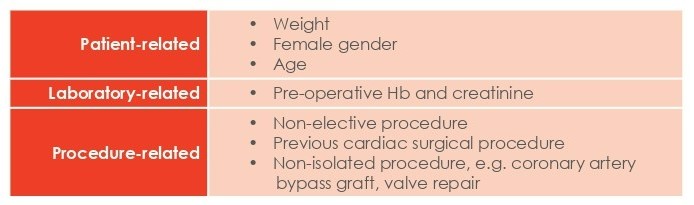
The TRUST (transfusion risk understanding score) index is a validated tool to predict the likelihood of blood transfusion requirements of patients undergoing cardiac surgery, based on pre-operative clinical variables including:
Table 1
Click on table to enlarge
Using this scoring index to stratify patients pre-operatively enables clinicians to anticipate the patient’s transfusion needs and prepare the patient and blood bank accordingly.
Obstetric haemorrhage
During an obstetric haemorrhage, RBCs should be administered to maintain the patient free of signs and symptoms of inadequate tissue oxygen delivery. The Hb should be maintained between 6 g/dl and 10 g/dl during the resuscitation phase.
Special attention must be given to maintaining adequate fibrinogen levels. Fibrinogen replacement in the form of cryoprecipitate may be required.
Red cell compatibility
Compatibility tests (“cross-matching”) should be performed prior to transfusion of red cells. Red cell transfusions must be ABO compatible.
As far as possible, RBC transfusions should also be Rh-D compatible but in an emergency (e.g. massive blood transfusion or shortage of Rh-D negative blood), Rh-D positive blood may be transfused to Rh-D negative patients provided that the patient does not have pre-formed anti-Rh-D antibodies.
Rh-D positive blood should also be avoided in females of childbearing age who are Rh-D negative.
Antigen negative blood should always be transfused to patients with specific and clinically significant red cell antibodies.
Red cell products are preserved and stored at 1 °C – 6 °C for up to 42 days. While previous guidelines have recommended “fresh” blood (<7 days old) in specific clinical settings, recent recommendations state that patients, including neonates, should receive RBC units selected at any point within their licensed dating period (42 days) rather than limiting patients to transfusion of only fresh (<10 days old) units.
Some guidelines still recommend that the following may warrant the use of RBCs with shorter storage times:
- Intrauterine transfusion
- Large-volume transfusion
- Paediatric transfusions (>25 ml/kg)
- Exchange transfusion
- Cardiac surgery
- Use of irradiated blood products
During the storage of banked blood, changes occur which may be clinically significant. The characteristics of stored blood should be taken into account when transfusing red cell products. Some of the impacting factors are discussed below.
Anticoagulant
Donated blood is collected into a solution containing sodium citrate. Citrate is a stable, minimally toxic anticoagulant with pH-buffering properties. Citrate is metabolised in the Krebs cycle (of respiration) and – after transfusion – is rapidly metabolised by most cells in the body, particularly in the liver, muscle and renal cortex.
However, certain clinical conditions (e.g. liver disease, hypothermia and hypoparathyroidism) may place patients at risk for “citrate toxicity” during rapid transfusion of whole blood or FFP. Newborns without adequate calcium stores, and with immature livers, are also at risk. In these circumstances, citrate has been considered to be the cause of cardiac arrhythmias and decreased cardiac contractility owing to its ability to lower plasma-ionised calcium through chelation.
The flow rate of citrate determines the degree of toxicity. A rate corresponding to 0.04 mmol/kg/min is associated with a significantly increased plasma citrate level and a prolonged QT interval. This situation may especially arise in massive, rapid transfusion of whole blood, but it may – to a much lesser extent – also arise in the transfusion of RBC concentrates.
If possible, ionised calcium levels should be monitored and 10 ml of 10% calcium gluconate administered intravenously (a rule of thumb is 10 ml for every 2 units whole blood given in under 10 minutes).
Calcium and any other drug or solution should never be directly added to blood components. If calcium depletion is suspected, most blood gas analysers will give a very rapid measurement of ionised calcium. Any level <0.7 mmol/l should be treated.
Calcium depletion alone is seldom a cause of impaired coagulation as the levels required to reduce coagulation are very low (<0.5 mmol/l).
2,3 Diphosphoglycerate
The function of erythrocyte 2,3 diphosphoglycerate (2,3 DPG) is to facilitate oxygen transport. Its binding with deoxyhaemoglobin, and its interaction with oxyhaemoglobin shifts the oxygen-dissociation curve to the right, decreasing the oxygen affinity of Hb and enhancing oxygen delivery to tissues.
The concentration of 2,3 DPG in blood decreases significantly after approximately 1 week of storage, which results in the oxygen-dissociation being shifted to the left, decreasing oxygen delivery to tissues. After transfusion, however, levels of 2,3 DPG are regenerated in-vivo, with approximately 50% being regenerated within 7 hours, although full restoration of RBC 2,3 DPG can take up to 72 hours.
In clinical situations of hypoxia and lactic-acid production, and with decreasing pH, the oxygen dissociation curve is also shifted to the right, increasing oxygen delivery. Increased oxygen delivery also occurs with an increase in cardiac output.
It is therefore generally considered that low 2,3 DPG levels in stored blood are not usually clinically significant, e.g. fresh blood and aged stored blood have been shown to be equally efficacious in immediately reversing anaemia-induced brain oxygenation deficits in humans. Lower 2,3 DPG red cell concentrations during the first 24 hours of intensive care are also not associated with higher ICU mortality.
Nevertheless, in certain clinical situations, transfusion of blood which has been stored for <5 days may be optimal, including:
- Patients in shock who cannot increase cardiac output to compensate
- Patients receiving large volumes of stored blood, e.g. massive transfusion
- Patients undergoing red cell exchange procedures
Preservative solutions
RBC concentrates are prepared by removing most of the plasma and the buffy coat layer – which is rich in leucocytes and platelets – from a unit of whole blood. A preservative solution (111 ml volume) is added to the residual red cells. It contains:
- Adenine: Helps maintain adenosine triphosphate (ATP) levels during storage
- Glucose: Provides a substrate for RBC energy pathways
- Saline
- Mannitol: Reduces the haemolysis of the banked red cells during the 42-day storage period
Separating off the buffy layer results in the removal of approximately 70% – 80% of leukocytes present in the original whole blood donation and significantly decreases the occurrence of non-haemolytic febrile transfusion reactions.
The volume of a unit of red cell concentrate is approximately 300 ml – 350 ml (including the additive solution) and the Hct is 0.55 l/l – 0.70 l/l. One unit of RBC concentrate (at a dose of 4 ml/kg) can be expected to increase the Hb level of an average (70 kg) adult by approximately 1 g/dl – 2 g/dl.
Stored red cells experience loss of deformability so on day 42 of storage about 75% of red cells are viable.
Hyperglycaemia has been observed in certain clinical situations (e.g. massive transfusion in orthotopic liver transplantation or following cardiac surgery in infants) and has been attributed to the high glucose concentration in RBC concentrates stored in adenine additive solutions.
Electrolyte changes
At standard storage temperatures of 1 °C – 6 °C, the sodium-potassium pump is essentially non-functional and intracellular and extracellular levels gradually equilibrate.
Plasma potassium concentration increases nearly eightfold over 28 days of storage although, at expiry, the total potassium load in red cell concentrates is only about 5.5 mmol.
The potassium load is therefore rarely a clinical problem, except in the setting of pre-existing hyperkalaemia. In these situations, fresh (<5 days) or washed red cell concentrates should be used.
Leucocyte-depleted red cells
See Leucocyte Depletion and Irradiation of Blood Components.
Washed red cells
Washed red cells are prepared by the removal of plasma and the buffy layer from whole blood donations. The residual red cells are suspended in isotonic saline and centrifuged. The saline from the first saline “wash” is then removed and the red cells are re-suspended in isotonic saline.
Because washed cells are manipulated in an open system, with a possibility of bacterial contamination, they must be transfused within 24 hours of preparation.
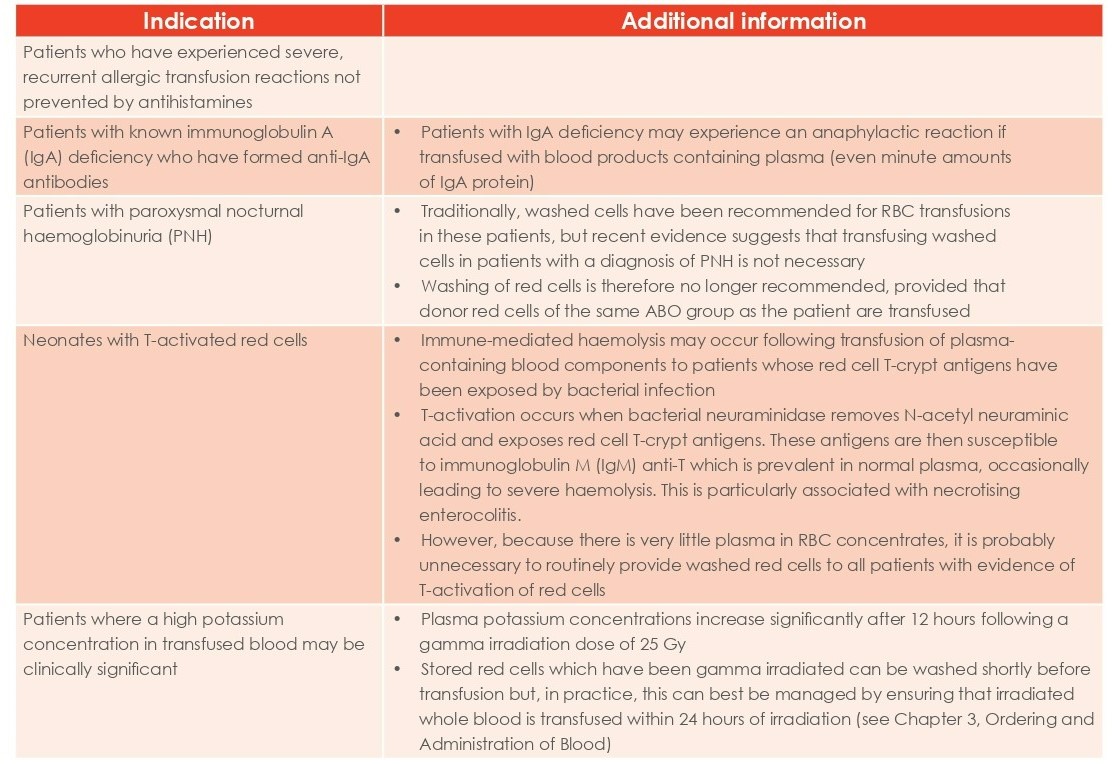
Indications for washed red cells
Table 2
 Click on table to enlarge
Warming blood for transfusion
In general, blood should not be warmed when individual units are being transfused slowly (over a period of 2 – 4 hours per unit). Transfusing ice-cold blood rapidly, however, has been associated with an increased incidence of cardiac arrest. Blood should therefore be warmed to 35 °C – 37 °C when large volumes are being transfused rapidly.
A blood warmer may be indicated for:
- Large-volume rapid transfusions (i.e. >50 ml/kg/hour in adults or >15 ml/kg/hour in children)
- Exchange transfusions
- Plasma exchange for therapeutic apheresis in adults
- Intrauterine transfusions, at the discretion of the specialist
- Patients with clinically significant cold agglutinins
- Trauma situations in which core-rewarming measures are indicated
- The patient-rewarming phase during cardiopulmonary bypass surgical procedures
The best method for warming blood is to use a heat exchanger in which coils of tubing are warmed by electric heating plates. Microwave ovens/hot water/heaters must never be used to warm blood for transfusion – they may damage red cells and cause harm to the patient.
Whole blood
Whole blood is a complex tissue from which clinically appropriate components are processed. Many of the components, particularly platelets and clotting factors, deteriorate in whole blood within hours of donation. It is therefore necessary to physically separate the components soon after donation so that they are available for use in the appropriate clinical situation.
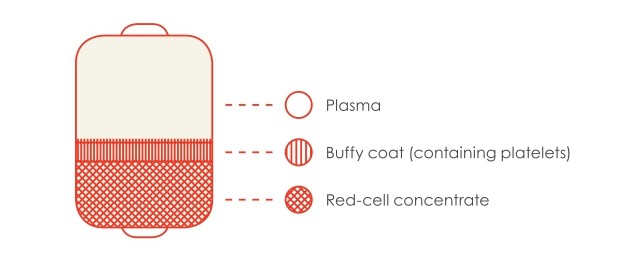 Click on image to enlarge
The clinical indications for using whole blood are limited, since RBC concentrates are more appropriate in most situations in which oxygen-carrying capacity needs boosting.
Indications for whole blood
- Exchange transfusion in neonates
- Massive haemorrhage
Irradiated red cells
See Plasma Components and Derivatives.
Blood for exchange transfusion in adults
Red cell exchange transfusion may be performed in:
- Patients with malaria who have a high parasite load
- Patients with acute sickle cell crisis
Erythrocytes infected with Plasmodium falciparum have been shown to have decreased 2,3 DPG activity. Because of the large volume of red cells transfused over a short period, it is recommended that – for exchange transfusion in adults – red cells that are no older than 5 days be transfused.
Paediatric red cell transfusion
Table 3
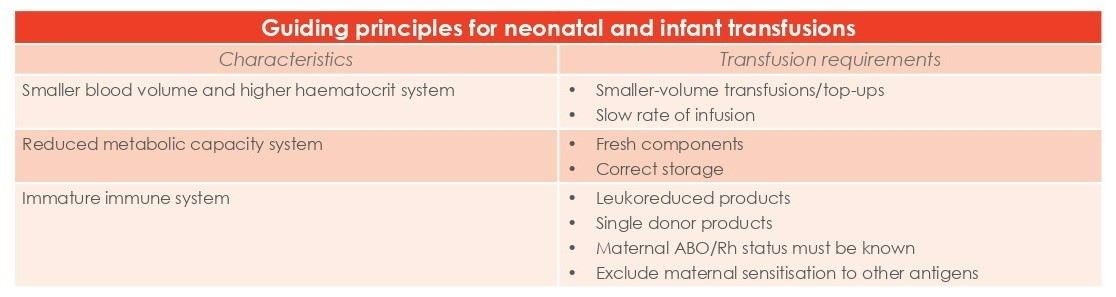 Click on table to enlarge
Intrauterine transfusion
Intra-uterine transfusion (IUT) should be done only by specialised units. It is most commonly indicated for correction of foetal anaemia caused by red cell allo-immunisation.
Intra-uterine platelet transfusions are rarely indicated and are essentially used only to correct foetal thrombocytopenia caused by platelet allo-immunisation. However, the use of intravenous immunoglobulin in mothers with allo-immunisation has largely replaced foetal platelet transfusions.
Red cell products for IUT are specially prepared by the blood transfusion service on request by the clinician. They are usually:
- Group O
- Rh-D negative (preferably also Kell negative)
- Cross-match compatible with maternal plasma/serum
- <5 days old
- Leucocyte depleted
- Irradiated
Neonatal transfusion
Exchange transfusion
Exchange transfusion may be used to manage severe anaemia at birth and to treat severe hyperbilirubinaemia, usually caused by haemolytic disease of the foetus and newborn (HDFN). The aim in exchange transfusion is to remove Rh-D positive red cells, reduce bilirubin levels and remove maternally derived anti-D.
The bilirubin level at which an exchange transfusion is indicated varies according to the weight and gestational age of the baby and the South African Neonatal Academic Hospitals’ Consensus Guidelines should be followed.
The early administration of intravenous immunoglobulin (dose: 1 g/kg) to Coombs-positive infants with neonatal jaundice significantly reduces the level of exchange transfusions for hyperbilirubinaemia.
The red cell component used for exchange transfusion varies nationally and internationally. Some centres use unmodified whole blood while others plasma-reduce whole blood to an Hct of 0.5 l/l – 0.6 l/l.
Some centres, particularly in the USA, reconstitute RBC concentrates with FFP, but this increases donor exposure and is not recommended unless whole blood is unavailable.
The unit should be:
- Group O (or ABO compatible with maternal and neonatal plasma)
- Rh-D negative
- Cross-match compatible with maternal and neonatal plasma
- <5 days old
- Irradiated (must be transfused within 24 hours of irradiation)
- Leucocyte depleted
An exchange of double the infant’s circulating blood volume is recommended: 180 ml/kg – 200 ml/kg for pre-term infants and 160 ml/kg – 180 ml/kg for term infants. For bigger infants, where the calculated volume needed exceeds the amount in 1 unit of whole blood, only 1 unit should initially be ordered. Serum bilirubin results post-exchange transfusion will determine whether further blood is required.
Blood should not be transfused directly from cold storage. It should be warmed during the procedure with care taken to avoid overheating.
In normal-term infants, the routine use of calcium gluconate is unnecessary, but monitoring of ionised calcium is advisable in ill preterm neonates as the citrate toxicity may result in hypocalcaemia.
Small-Volume Red Cell Transfusion
Estimated blood volume (EBV) is 100 ml/kg – 120 ml/kg in extremely preterm infants and is 80 ml/kg – 85 ml/kg in term infants. In neonates, the transfusion volume is calculated using the following equation:
Transfusion volume (ml) = patient weight (kg) x EBV (ml/kg) x desired Hb (g/dl) – patient Hb (g/dl)/Hb of donor unit)
Hb content of RBCs can vary. In general, each 10 ml/kg – 15 ml/kg transfused is expected to increase the infant’s Hb level by approximately 1 g/dl – 2 g/dl.
The usual volume of RBCs administered to neonates is 10 ml/kg – 20 ml/kg per transfusion. Some suggest a volume of 15 ml/kg for infants ≤1 500 g or <32 weeks’ gestational age (GA), because an association has been reported between a greater total volume of infused blood and transfusion-related necrotising enterocolitis in infants with very low birth weight.
Blood bank pre-transfusion testing during the first 4 months of life differs from adult testing. If there are no clinically significant red cell antibodies in the infant or maternal plasma and the direct antiglobulin test is negative, a full cross-match is not necessary – although the ABO and Rh-D group should be re confirmed prior to each subsequent transfusion.
Table 4
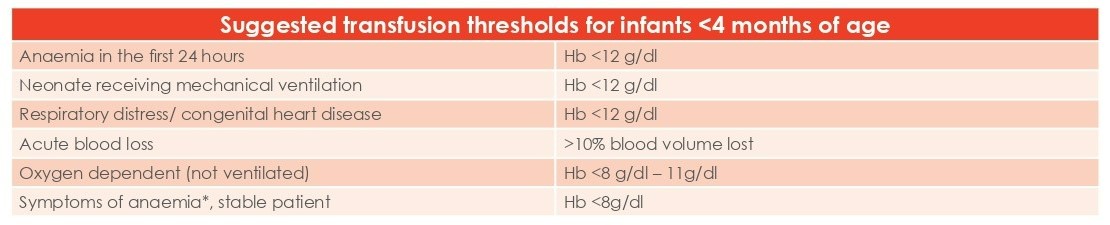 Click on table to enlarge
The age of the unit does not matter for small-volume top up transfusions, but large-volume transfusions (exchange transfusion or acute blood loss) should be <5 days old in order to avoid hyperkalaemia and reduced 2,3 DPG levels with impaired oxygen release.
Leucocyte-depleted products are also recommended for infants (see Leucocyte Depletion and Irradiation of Blood Components).
Neonatal units should arrange with their blood banks that those neonates with extended transfusion needs are placed on a “limited donor exposure” programme, where the transfusion requirements of an infant are met by reserving units bled from a single donor for that specific infant. This minimises the infectious risk and red cell antigen exposure.
Red cell transfusion in older children (>1 years)
Older children tolerate low Hb levels relatively well, unless there is accompanying respiratory or cardiac compromise. An Hb threshold of 7 g/dl is suggested, unless there is underlying severe cardiopulmonary disease. The recommended threshold would then be 10 g/dl – 12 g/dl.
As in adults, there is a tendency to more restrictive strategies since recent studies have shown no significant increase in morbidity as a result.
The recommended top-up transfusion dose for children is 10 ml/kg – 20 ml/kg via a standard blood administration set or syringe with equivalent filtration. An initial dose of 15 ml/kg is ideal, but as much as 20 ml/kg may be transfused in a haemodynamically stable patient if further transfusions are required.
A 40 kg child receiving 1 standard red cell concentrate (± 300 ml) is receiving <10 ml/kg and therefore older children may require >1 unit, even with a restrictive strategy. Another approach is to use the following formula:
Hb(target) – Hb(actual) x weight x transfusion factor (4 for RBC concentrates and 6 for whole blood)
In normovolaemic patients, furosemide (1 mg/kg) may be prescribed to prevent volume overload.
All infant and paediatric small-volume RBC concentrates are leucocyte depleted but, in older children where adult RBC concentrates are used, a specific request must be made for a leucocyte-depleted product. The guidelines for which patients require leucocyte-depleted products are given in Leucocyte Depletion and Irradiation of Blood Components, but they bear repeating:
- Patients who have previously experienced febrile non-haemolytic febrile reactions
- Patients receiving multiple or lifelong transfusions
- Patients likely to receive organ or haemopoietic stem-cell transplants
- Patients at high risk for CMV infection
- Critically ill patients and those who undergo cardiac surgery
If anaemia is accompanied by thrombocytopenia at a level requiring a platelet transfusion, fluid overload may result if platelets are rapidly transfused first.
The blood bank can usually issue group-specific RBC concentrates within 20 minutes of receiving the cross-match request – or immediately if the patient’s blood group has previously been documented. In the event of a dire emergency, uncrossmatched Group O blood can be given from the emergency fridge.
Since Rh-D negative blood is usually in short supply, this should generally be reserved for females. Males can usually quite safely be given Group O Rh-D positive blood in emergency situations.
Specific components for neonates and infants
Given the volumes required, the use of an adult RBC concentrate, FFP or platelet concentrate for infants and small children would result in significant wastage. The blood services therefore prepare special products for paediatric use as follows:
Table 5

Click on table to enlarge
Further reading
- Horn AR, Kirsten GF, Kroon SM, et al. Phototherapy and exchange transfusion for neonatal hyperbilirubinaemia: neonatal academic hospitals’ consensus guidelines for South African hospitals and primary care facilities. S Afr Med J. 2008;96(9):819.doi:10.7196/SAMJ.1256
- Villeneuve A, Arsenault V, Lacroix J, Tucci M. Neonatal red blood cell transfusion. Vox Sang. 2021;116(4):366-378. doi:10.1111/vox.13036
- Carson JL, Guyatt G, Heddle NM, et al. Clinical practice guidelines from the AABB: red blood cell transfusion thresholds and storage. JAMA. 2016;316(19):2025-2035. doi:10.1001/jama.2016.9185
- Australian and New Zealand Society of Blood Transfusion, Australian College of Nursing. Guidelines for the administration of blood products. 2018. Accessed March 7, 2023. https://anzsbt.org.au/wp-content/uploads/2018/06/ANZSBT_Guidelines_Administration_Blood_Products_3rdEd_Jan_2018.pdf
- Carson JL, Triulzi DJ, Ness PM. Indications for and adverse effects of red-cell transfusion. N Engl J Med. 2017;377(13):1261-1272. doi:10.1056/NEJMra1612789
- European Committee (Partial Agreement) on Blood Transfusion (CD-P-TS ). Guide to the preparation, use and quality assurance of blood components. 20th Edition. European Directorate for the Quality of Medicines & HealthCare. Accessed March 7, 2023. https://www.quotidianosanita.it/allegati/allegato8291904.pdf
- Wise R, Bishop D, Gibbs M, et al. South African Society of Anaesthesiologists perioperative patient blood management guidelines 2020. Southern African Journal of Anaesthesia and Analgesia. 2020;26(6):S1-68. https://www.sajaa.co.za/index.php/sajaa/article/view/2496
Clinical Guidelines for the Use of Blood and Blood Products in South Africa, 6th Edition, 2023