Schistosomiasis (Bilharzia)
Description General Measures Medicine Treatment Referral ICD-10 codes: B65.0-3/B65.8-9 Note: Notifiable medical condition. DESCRIPTION A parasitic infestation with: Schistosoma haematobium : primarily involves the bladder and renal tract, or Schistosoma mansoni : primarily involves the intestinal tract. Infestation occurs during washing, bathing or paddling in water harbouring
Description
General Measures
Medicine Treatment
Referral
ICD-10 codes: B65.0-3/B65.8-9
Note: Notifiable medical condition.
DESCRIPTION
A parasitic infestation with:
- Schistosoma haematobium: primarily involves the bladder and renal tract, or
- Schistosoma mansoni: primarily involves the intestinal tract.
Infestation occurs during washing, bathing or paddling in water harbouring snails shedding this parasite.
Clinical features vary with the location of the parasite.
Most cases are asymptomatic.
Chronic schistosomiasis may present with local or systemic complications due to fibrosis, including urinary tract obstruction with ensuing renal failure, portal hypertension or other organ involvement.
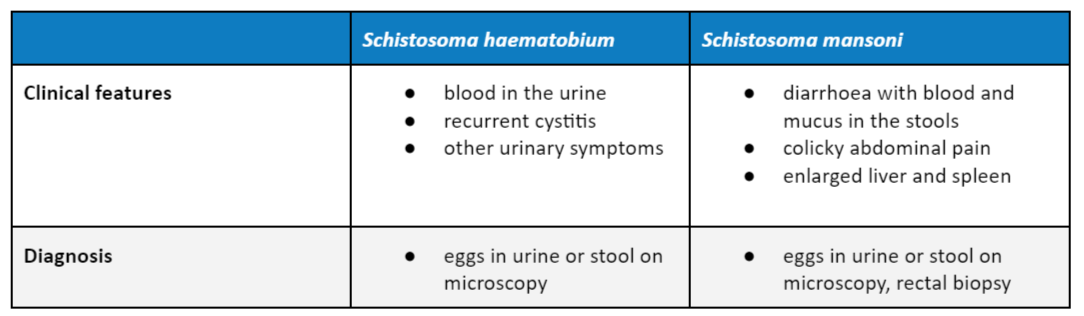
Click on table to enlarge
Table 10.2: Differences between Schistosoma haematobium and Schistosoma mansoni
Acute schistosomiasis occurs several weeks after exposure and may present with non-specific signs such as fever, cough, headache, and urticaria.
Life threatening cardiac and neurological complications may occur.
Refer all suspected cases for diagnosis and further management.
Diagnosis is made by assessing for eosinophilia and conducting serological testing.
GENERAL MEASURES
If bilharzia is endemic, educate the community to avoid contact with contaminated water:
- Do not urinate or pass stools near water used for drinking, washing or bathing.
- Do not swim in contaminated water.
- Collect water from rivers and dams at sunrise when risk of infestation is lowest.
- Boil all water before use.
MEDICINE TREATMENT
-
In endemic areas where urine microscopy cannot be done patients should be treated empirically after first excluding possible glomerulonephritis, i.e. no raised blood pressure, no oedema, and no shortness of breath. See: Glomerular diseases (GN).
- In non-endemic areas treatment should be given only if eggs of S. Haematobium or S. mansoni are found in the urine/ faeces.
Children
- Praziquantel, oral, 40mg/kg as a single dose. See: dosing table.
Adults
- Praziquantel, oral, 40mg/kg as a single dose.
LoE:Ia7
Note:
Praziquantel may cause life-threatening deterioration if given in acute schistosomiasis. If the acute phase is suspected, consult with a specialist.
REFERRAL
- Children <2 years of age.
- Ongoing urinary tract symptoms including haematuria persisting for 60 days after treatment.
- Signs of bleeding disorders or glomerulonephritis.
- Suspected acute schistosomiasis.
Standard Treatment Guidelines and Essential Medicines List for South Africa, Primary Healthcare, 2020-2024_Version 1.1_20 January 2025
Chapter 10: Infections and Related Conditions_10.12 Schistosomiasis (Bilharzia)