Sedation
Description General measures Description Most patients may not require routine sedation, however, patients with the following conditions may require pharmacological sedation: severe acute respiratory failure status epilepticus raised intracranial pressure/ traumatic brain injury status asthmaticus General Measures For patients whom sedation is indicated, a combination with analgesia (analgo-sedat
Description
Most patients may not require routine sedation, however, patients with the following conditions may require pharmacological sedation:
- severe acute respiratory failure
- status epilepticus
- raised intracranial pressure/ traumatic brain injury
- status asthmaticus
General Measures
For patients whom sedation is indicated, a combination with analgesia (analgo-sedation) is recommended. This means that the pain is treated first, with consideration made for sedation where required.
Its use is guided by a sedation assessment tool, e.g. Richmond agitation sedation scale (RASS; See Table 23.3). The target RASS score is -2 to 0, with lighter sedation preferred over deeper sedation. It is important to exclude and manage delirium before routine sedation is administered (see Delirium in Critical Care).
Table 23.3: Richmond agitation sedation scale (RASS)
| Score | Term | Description | Type of stimulation |
| +4 | Combative | Overly combative, violent, immediate danger to staff | Without Stimulation |
| +3 | Very agitated | Pulls or removes tube(s) or catheter(s); aggressive | |
| +2 | Agitated | Frequent non-purposeful movement, fights ventilator | |
| +1 | Restless | Anxious but movements not aggressive or vigorous | |
| 0 | Alert and calm | Verbal Stimulation | |
| -1 | Drowsy | Not fully alert, but has sustained awakening (eye opening/ eye contact) to voice (≥10 seconds) | |
| -2 | Light sedation | Briefly awakens with eye contact to voice (<10 seconds) | |
| -3 | Moderate sedation | Movement or eye opening to voice (but no eye contact) | |
| -4 | Deep sedation | No response to voice, but movement or eye opening to physical stimulation | Physical Stimulation |
| -5 | Unarousable | No response to voice or physical stimulation |
Taken From: Khan BA, Perkins AJ, Gao S, Hui SL, Campbell NL, Farber MO, et al. The CAM-ICU-7 Delirium Severity Scale: A Novel Delirium Severity Instrument for Use in the Intensive Care Unit. Crit Care Med. 2017 May;45(5):851–7.
The properties of the different sedative agents can be used to help select an appropriate choice. See Table 23.4 for commonly used sedative agents and their properties in critically ill patients. The choice of agent being dictated by patient clinical presentation and any contraindications.
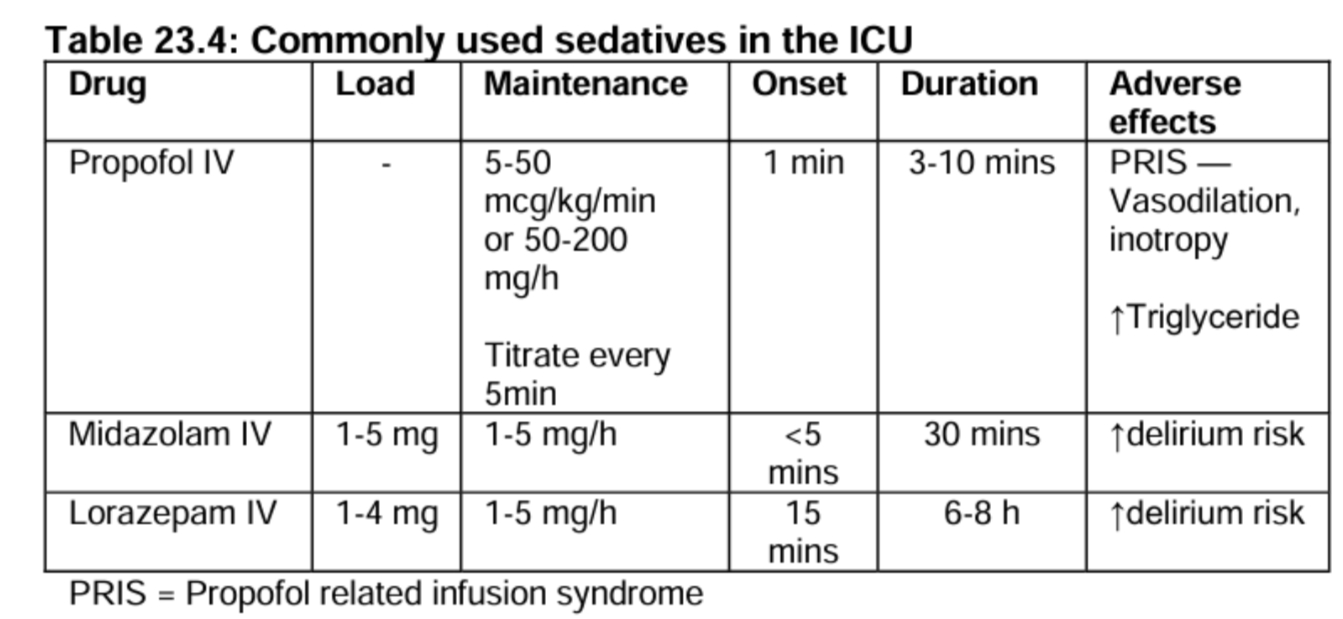
Click on the image to enlarge
Standard Treatment Guidelines and Essential Medicines List for South Africa Adult Hospital _Chapter 23: Adult Critical Care_NEMLC Medicine Recommendations Review Cycle_ 2020_2023