Sepsis in ICU
Initial Resuscitation Haemodynamic Support Antimicrobial Therapy Adjunctive Therapy Initial Resuscitation Medicine Treatment Balanced-salt solution crystalloid, IV, 30ml/kg over 3 hours. Aim for an initial haemodynamic target of MAP >65mmHg. Further fluid challenge should be guided by one or more of the following: Dynamic markers of fluid responsiveness, e.g. passive leg raising, pulse
Initial Resuscitation
Medicine Treatment
- Balanced-salt solution crystalloid, IV, 30ml/kg over 3 hours.
- Aim for an initial haemodynamic target of MAP >65mmHg.
- Further fluid challenge should be guided by one or more of the following:
- Dynamic markers of fluid responsiveness, e.g. passive leg raising, pulse pressure variation, stroke volume variation.
- Lactate clearance: aim for a lactate clearance of >20% over 2 hours.
- Capillary refill time: aim for a capillary refill time of <3 seconds.
CAUTION
Avoid colloids for shock resuscitation in patients with sepsis and acute kidney injury.
Haemodynamic Support
Medicine Treatment
If fluid therapy alone does not rapidly correct MAP to ≥65mmHg:
- Adrenaline, IV, 0.01-1.0mcg/kg/min given as an infusion.
- Aim to achieve a target MAP >65 mmHg within 30 minutes.
- Increasing the adrenaline infusion rate above 1 mcg/kg/min is not recommended in the absence of clear, reversible causes such as hypovolaemia, bleeding, tension pneumothorax etc.
In patients with significant left ventricular dysfunction and no improvement with adrenaline:
ADD
- Dobutamine, IV, 500 mg in 200 ml 0.9% saline as a continuous infusion.
- Start infusion at 5ml/hr
- Check MAP regularly (every 10-30 minutes until target is reached) and titrate infusion rate by 2.5 ml/hr to reach target MAP (≥65mmHg).
- Infusion rates exceeding 20 ml/hr are usually not required.
Note:
- While noradrenaline is recommended in international guidelines as a first-line vasopressor for septic shock, there is no evidence that it offers additional benefits over adrenaline.
- Given the lack of availability and increased cost of noradrenaline, its routine use is not recommended.
- Dopamine should not be used due to an increased risk of mortality and arrhythmias.
Antimicrobial Therapy
Description
Early administration of antimicrobial therapy is one of the most effective interventions to reduce mortality in patients with sepsis and should be treated as an emergency. Various aspects including timing of antimicrobials, choice of antimicrobial agent, and dosing require careful consideration.
Timing
- Start empirical antimicrobials therapy within 1 hour of the presumptive diagnosis of sepsis or septic shock.
- Take appropriate samples for microbiology, ideally prior to commencing or changing antimicrobials. However, do not delay antimicrobial administration to collect samples as the risk of mortality increases hourly in untreated sepsis.
Dosing
- See Appendix 1: Antimicrobial Medicines for antimicrobial-specific guidance on dosing.
- Prescribe the higher dose of an antimicrobial dosing range, provided there that it is safe to do so.
- Consider extending the duration of infusion for certain antimicrobials (notably beta-lactams, see note on continuous infusions below).
- The initial or loading dose does not need to be adjusted in the presence of renal dysfunction. However, subsequent dosing may require dose adjustment depending on renal function and the use of renal replacement therapy.
- Extending the infusion duration of beta-lactam antimicrobials may improve effectiveness by increasing the time above the MIC (See Table 23.7).
Table 23.7. Examples of possible continuous infusion dosing regimens
| Antimicrobial | Loading dose | Maintenance dose |
| Amoxicillin/Clavulanic acid | 1.2 g over 30 mins. |
1.2 g infusion given over 4 hours, 6 hourly dosing interval. |
| Piperacillin/Tazobactam | 4.5 g over 30 mins. |
4.5 g infusion given over 4 hours, 6 hourly dosing interval. |
| Meropenem | 1 g over 30 mins. | 1 g infusion given over 4 hours, 6 hourly dosing interval. |
Choice of antimicrobial
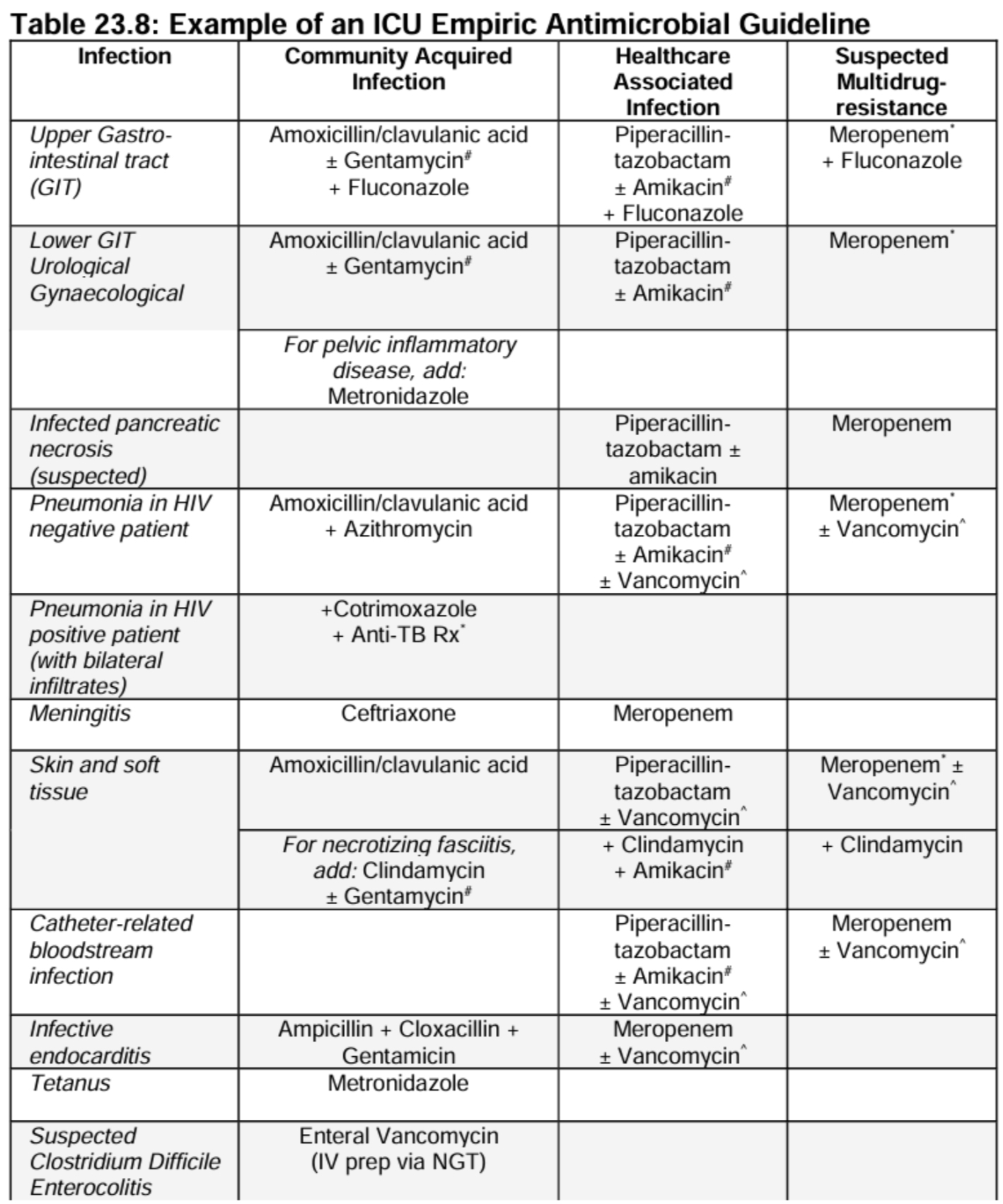
The causative organism is usually not known at the time of clinical deterioration. In view of this critically il patients should receive a broader spectrum agent while awaiting culture results followed by subsequent deescalation to an agent with the narrowest spectrum that will treat the causative organism.
Choose appropriate broad-spectrum empiric antimicrobial therapy based on the following factors:
- Site of sepsis
- Likely causative organisms
- Risk factors for healthcare-associated infections: Hospitalisation for >48 hours, previous antimicrobial therapy or hospitalisation within 3 months, residence in long-term care facility, or chronic wound care.
- Local antibiograms
- Patient factors: organ dysfunction, allergies
When culture and sensitivity results are available and the clinical picture allows, change empiric antimicrobial therapy to the agent that has the narrowest spectrum and that is the most cost-effective. De-escalation is crucial in reducing selective pressure and combatting antimicrobial resistance.
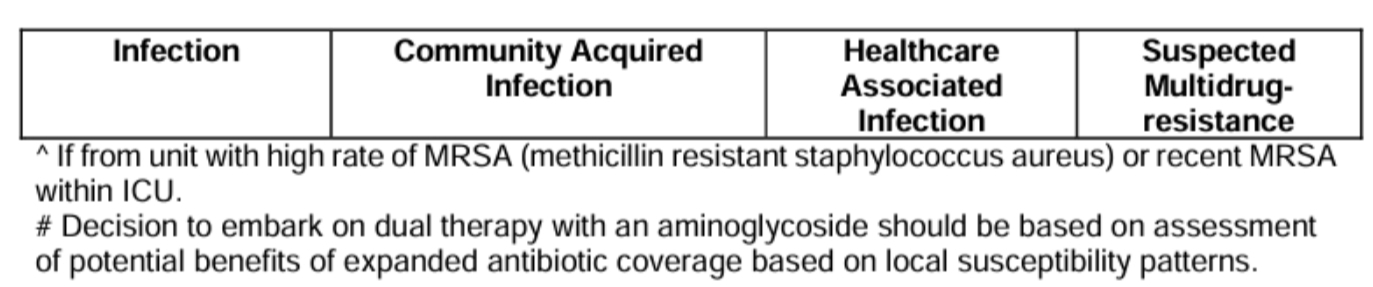
Additional antimicrobials that are prescribed empirically to treat suspected atypical and anaerobic organisms, MRSA, or invasive fungal infections should be carefully considered based on current local epidemiology, and deferred until microbiology results are available if possible. Discuss with a clinical microbiologist. Source control is essential in managing infections in all patients, including those in ICU. Effective source control should be achieved as soon as possible.
Click on the image to enlarge
Click on the image to enlarge
Note:
- Recommendations included in the table may require modifications subject to local resistance patterns
- The choice of carbapenem depends on unit policy/most cost-effective option. If the patient has seizures/ CNS disorder, consider meropenem over imipenem.
- For patients with AKI (acute kidney injury): If serious gram-negative sepsis suspected, consider continuing aminoglycoside with therapeutic drug monitoring, or prescribe beta-lactam antimicrobial as monotherapy, depending on clinical scenario.
Carbapenem-resistant Enterobacterales bacteraemia
ICD-10 code: U83.7
Carbapenem-resistant Enterobacterales (CRE) are Gram-negative bacteria with reduced susceptibility to at least one of the carbapenem antimicrobials. The clinical outcomes of patients infected with CREs are worse than for other infections and it is imperative that these organisms do not spread to other patients in the unit. Strict adherence to infection control is essential.
These patients should be discussed with clinical microbiologists and infectious disease physicians. Choose an antimicrobial agent that tests susceptible and is active at the site of the infection. Often, limited therapeutic options are available.
In these cases, ceftazidime-avibactam can be considered for CRE bacteraemia, in consultation with a specialist and antimicrobials stewardship team, where the infecting organism is proven to be sensitive to ceftazidimeavibactam on bacterial culture. Use should be avoided in patients with a poor prognosis. Duration of treatment is dependent on indication and clinical response. Duration of treatment should not exceed 14 days.
Medicine Treatment
- Ceftazidime-avibactam, 2.5 g, IV, 8 hourly (Microbiologist or Infectious Disease specialist initiated).
Use should be avoided in patients with a poor prognosis.
- Duration of treatment is dependent on indication for treatment and clinical response.
- Duration of treatment should not exceed 14 days.
If the patient is suspected to have a fungal infection, start empirical therapy:
- Amphotericin B, IV, 1 mg/kg/day for 2 weeks or until diagnostic results confirm/exclude fungal infection.
OR
- Fluconazole, IV:
- Loading dose: 800 mg daily.
- Maintenance dose: 400 mg daily.
Note:
The choice between these antifungals should be determined by:
- presence of kidney disease and other organ dysfunction.
- previous anti-fungal therapy.
- local fungal sensitivity patterns.
- site of infection.
Duration of antimicrobial therapy
- Shorter durations of antimicrobial therapy may be effective. Please monitor clinical response closely.
- Duration of antimicrobial therapy may be individualised by the use of clinical response and biomarkers.
- Antimicrobials may be stopped 48 hours after clinical response or if procalcitonin levels drop below 0.5 ng/l or 80% of peak.
- The failure to respond to a short course of antimicrobials should prompt consideration of antimicrobial resistance or inadequate source control.
- Certain infections (infective endocarditis, empyema, septic arthritis, invasive fungal infections) may, however, still require prolonged antimicrobial therapy.
Source control
The specific anatomical site of infection should be identified as soon as possible and if source control is required (e.g. by surgical intervention) this should be done as soon as medically and logistically possible. Patients with sepsis and septic shock should undergo a period of stabilisation and optimisation prior to source control. This should have clearly defined targets, interventions, and timelines.
Adjunctive Therapy
Medicine Treatment
Steroid Therapy
If the patient with shock requires ≥0.25 mcg/kg/min of adrenaline for >4 hours:
- Hydrocortisone 50mg, IV, 6 hourly until resolution of shock.
Glycaemic control
- Blood glucose should be maintained between 6-10 mmol/l, using insulin therapy if required. See: Hypoglycaemia and Hyperglycaemia for further details.
Standard Treatment Guidelines and Essential Medicines List for South Africa Adult Hospital _Chapter 23: Adult Critical Care_NEMLC Medicine Recommendations Review Cycle_ 2020_2023