Shock: Paediatric Emergency Management
Guidance on Paediatric Shock Emergency Management
Lead Authors: Dr Beyra Rossouw & Dr Baljit Cheema
Acknowledgements: Dr Shamiel Salie & Prof Mignon McCulloch
Paediatric shock algorithm
Recognise shock
Airway
Breathing
Endotrachael intubation
Circulation - Fluid Boluses
Fluid overload signs
High risk groups
Whilst starting fluids
If shock persists
Transfer
Paediatric shock algorithm
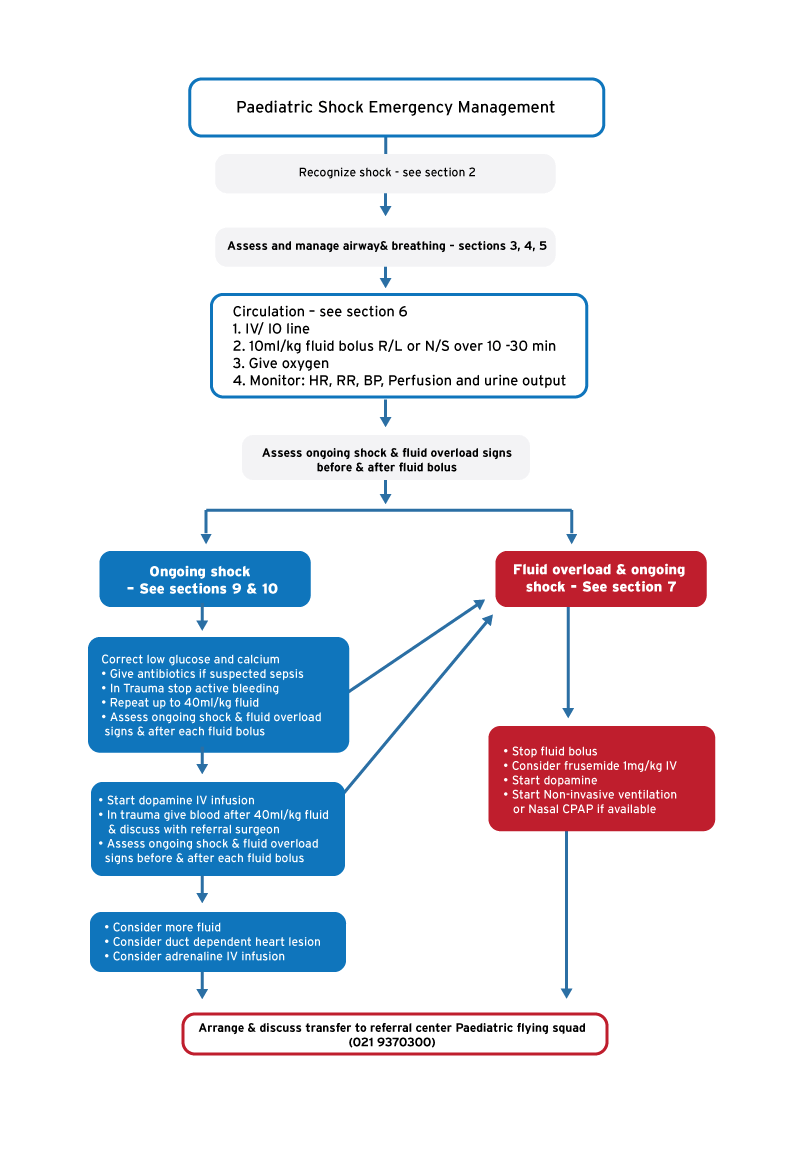 Click on image to enlarge
Recognise shock
Shock is likely if there is evidence of decreased perfusion in 2 or more of the following organ systems:
- CNS: agitated, drowsy, reduced level of consciousness
- Skin: cold, mottled, pale, capillary refill time (CRT) 3 seconds or more
- Respiratory: ↑ Respiratory Rate(see above) or pre terminal ↓ in Respiratory Rate
- Kidney: < 1ml/kg/hr urine
- CVS:
- ↑heart rate or pre-terminal bradycardia
- Reduced peripheral pulse volume compared to central pulse volume
- Low BP:
- SBP < 60 for < 1year
- SBP <65+ (2x age in years) for child > 1year
- premature baby & neonates mean BP < gestation age
- Blood gas: Base Excess ≥-5, lactate ≥ 4 (if available)
| Tachycardia | Bradycardia | Respiratory rate | |
| Infants ≤1 yr | >180/min | <80/min | >50/min |
| Children 1-5yr | >140/min | <70/min | >40/min |
| Children 5-12yr | >120/min | <60/min | >30/min |
Resuscitation (follow Airway-Breathing-Circulation approach)
Airway
- Is airway open?
- Can patient maintain open airway?
- If not -> Do airway opening manoeuvres, consider Bag- Mask- Ventilation (BVM) & refer to RSI guideline
Breathing
- Start high flow oxygen via mask or nasal prongs
- Apply O2 saturation, ECG & BP monitoring
- Evaluate work of breathing & efficacy of breathing
- Consider respiratory support if severe respiratory difficulty:
- Start Non-invasive respiratory support if severe distress
- Consider Bag-Valve-Mask & endotracheal intubation if imminent respiratory failure
Endotracheal Intubation
Intubating a shocked child is high risk procedure.
- Prepare well – See RSI Guidance. Calculate & draw up all drug doses needed. Get correct size equipment. Have suction ready. Site NGT to empty & deflate stomach.
- Get help – ask for senior support & if available ICU/PICU or anaesthetic help.
- Give fluid &/or start inotropes before giving induction agents
- Draw up adrenaline 1:1000 1ml into 9mls of water. Label syringe: “1:10,000 Adrenaline” – if child has cardiorespiratory arrest – initiate CPR & give 0.1ml/kg of 1:10,000 adrenaline every 4 mins.
Circulation - Fluid Boluses
- Get peripheral IV or IO access without delay
- Attach Ringers Lactate (R/L) or normal saline (N/S) or via an extension set & 3-way stopcock to line. Give fluid bolus over 10- 30 minutes
- 1st Fluid bolus 10ml/kg R/L or N/S
- After bolus - reassess for signs of persistent shock & fluid overload
- Stop bolus fluids if signs of fluid overload develop
- Repeat above up to 40ml/kg fluid if shock persists AND liver & lungs stay unchanged
- If respiratory distress worsens with fluid, start inotropes & arrange transfer
Check for signs of shock and fluid overload BEFORE and AFTER every fluid bolus
NOTE:
Individualise fluid resuscitation according to clinical response and history of fluid losses e.g. patients with meningococcal septicaemia or ongoing large diarrhoeal losses may need more fluid.
Fluid overload signs
Gradual or sudden signs of worsening after fluid – signs may include:
- Increasing liver size
- ↑HR
- ↑RR
- ↓O2 saturation
- New bi-basal crepitations &
- Worsening respiratory distress
High risk groups
Be cautious with fluid boluses in children with malnutrition, DKA & suspected myocarditis/ cardiomyopathy. Give smaller volume fluid boluses (e.g. 5ml/kg) slowly and consider inotropes early.
Whilst starting fluids
- Correct hypoglycaemia if glucose <3 mmol/L with 5ml/kg 10% dextrose (4ml 50%dextrose + 16ml N/S = 20mls of 10% Dextrose), re-check after 20-30 mins (see Hypoglycaemia guidance)
- Correct hypocalcaemia if ionised Ca2+<1mmol/L with 0.5ml/kg 10% calcium gluconate IV over 30 min
- Consider duct dependent cardiac lesion in neonates (Suggestive signs include e.g. Cyanosis not improving with O2, cardiomegaly, gallop, large liver, murmur, absent femoral pulses)
- Start Prostin IV or oral & discuss with referral centre cardiology
- Details of Prostin dosing see Approach to Cyanosed Baby with Congenital Heart Disease
- In trauma with bleeding: stop active bleeding & give blood after 40ml/kg fluid & discuss with referral centre surgeon. If clinically urgent use uncross matched O negative blood
- Give IV antibiotics if sepsis is suspected. 50mg/kg ceftriaxone IV bolus
- Start glucose containing maintenance fluid (e.g. 5% dextrose/0.45 saline or ½ Darrow’s Dextrose)
If shock persists after 40ml/kg fluid or signs of fluid overload develop
- Consider more fluid boluses especially if there is a history of large fluid losses AND no sign of fluid overload
- Consider starting inotropic support as follows:
- Start DOPAMINE infusion & discuss with senior/ referral centre.
- Mix 6mg/kg dopamine in 50 ml 5% DW. 1ml/hr = 2mcg/kg/min. Start at 5ml/hr.
- Assess: signs of persistent shock & fluid overload
- Watch for extravasation injury around IV line
- If not improving in 30 minutes, discuss with referral centre
- Start ADRENALINE infusion if shock persists while on dopamine 5ml/hr.
- Mix 0.06mg/kg adrenaline in 50 ml 5% DW. 1ml/hr = 0.02mcg/kg/min. Start at 2 ml/hr
- Assess: signs of persistent shock & fluid overload
- Watch for extravasation injury around IV line
- If not improving in 30 minutes, discuss with referral centre
- In suspected myocarditis/cardiomyopathy (cardiomegaly, gallop, large liver bi-basal crepitations) - use DOBUTAMINE instead of dopamine.
- Mix 6mg/kg dobutamine in 50 ml 5% DW. 1ml/hr = 2mcg/kg/min. Start at 5ml/hr.
- If not improving in 30 minutes, discuss with referral centre
- If signs of fluid overload develop – consider:
- Stop bolus fluids
- Furosemide 1mg/kg stat dose & place urine catheter
- Nasal CPAP if available
Transfer
Arrange transfer to referral centre – ideally with Paediatric Flying Squad (if in Cape Town - 021 937 0300)
Methodology
Where possible, appropriate evidence has been sought and appraised using standard appraisal methods. High quality evidence is not always available to inform recommendations. Best Practice guidance relied on the consensus of senior physicians and invited experts.
Disclaimer
This guideline cannot cover all possible scenarios and situations. The ultimate responsibility for the interpretation and application of this guideline, the use of current information and the child’s overall care resides with the treating clinician.
These guidelines were created in May 2015.