Snakebite Emergencies
This guideline was approved in December 2014 and will be reviewed in December 2016, or sooner if important evidence becomes available.
PART A - Algorithm
PART B - Introduction and Description
Contact numbers
- TBH Poison Centre: 021-9316129
- South African Antivenom Unit 011-386 6016
Level of Training needed: Doctor to administer antivenom personally.
Part A Algorithm
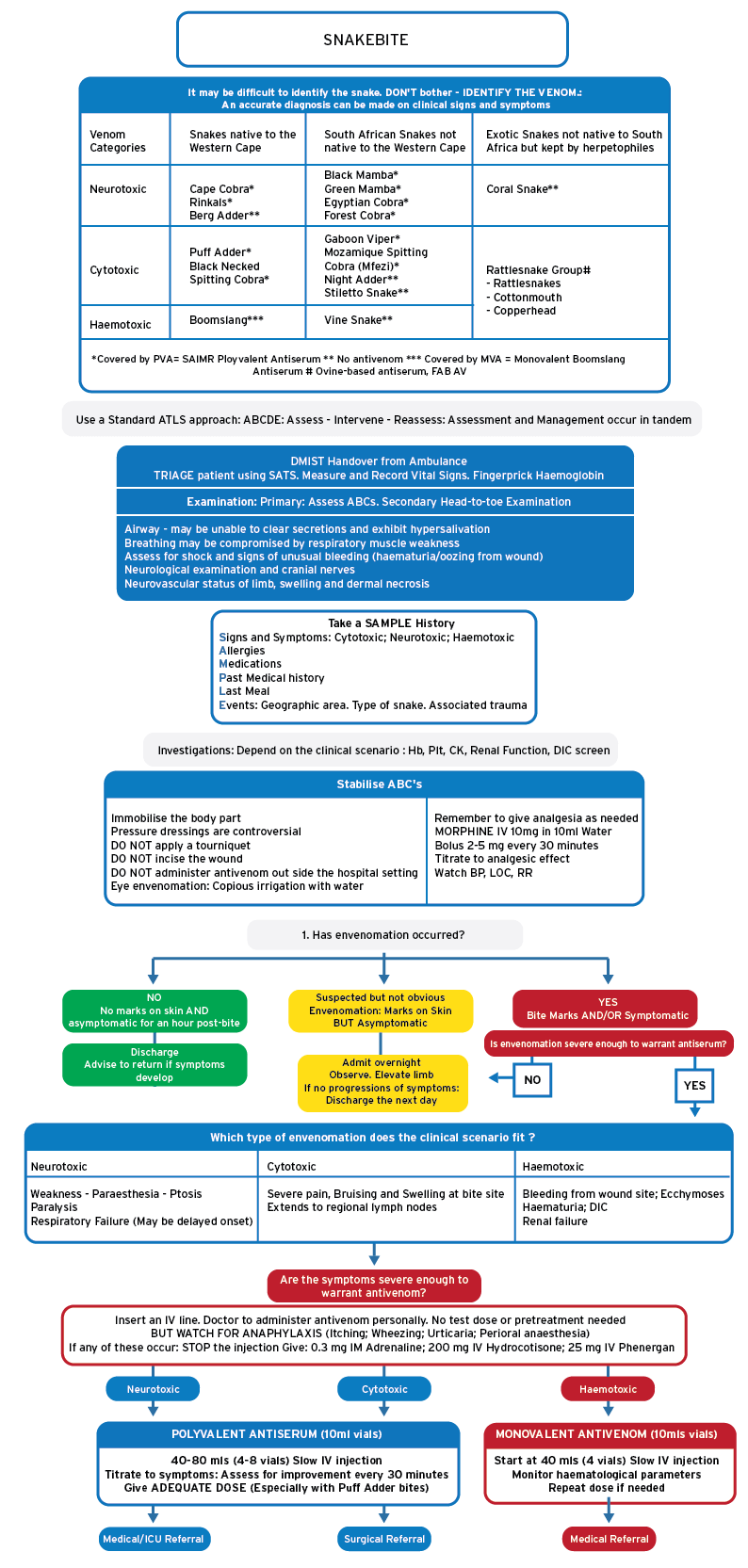
Part B Algorithm
Introduction/Description
- It may be difficult to identify the snake. DON'T bother - IDENTIFY THE VENOM.
- An accurate diagnosis can be made on clinical signs and symptoms.
- Venomous snakes in South Africa result in mainly neurotoxic, cytotoxic or haemotoxic effects.
- The polyvalent antiserum (PVA = SAIMR Polyvalent Antiserum) covers many neurotoxic and cytotoxic venoms. A separate antiserum exists for the boomslang, which is haemotoxic. (MVA = Monovalent Boomslang Antiserum).
- There are numerous South African snakes that cause minor symptoms of envenomation, are not lethal and for which antivenom is not necessary. (Skaapstekers, Night adders, Horned Adders)
- 95 % of Western Cape envenomations are Puff Adder or Cape Cobra.
- Snake Handlers who get bitten can usually accurately identify the offending snake.
| VENOM CATEGORIES | Snakes native to the Western Cape | South African Snakes not native to the Western Cape | Exotic Snakes (Kept by herpeto- philes) |
| NEUROTOXIC | Cape Cobra * Rinkals * Berg Adder ** |
Black Mamba * Green Mamba * Egyptian Cobra * Forest Cobra * |
Coral Snake ** |
| CYTOTOXIC | Puff Adder * Black-Necked Spitting Cobra * |
Gaboon Viper * Mozambique Spitting Cobra (Mfezi) * Night Adder ** Stiletto Snake ** |
Rattlesnake Group # Rattlesnakes Cottonmouth Copperhead |
| HAEMOTOXIC | Boomslang *** | Vine Snake ** |
* Covered by PVA = SAIMR Ployvalent Antiserum
** No antivenom
***Covered by MVA = Monovalent Boomslang Antiserum
# Ovine-based antiserum, FAB AV; available on enquiry
Diagnosis of problem and differential diagnosis
There have been cases of allergy to snake VENOM itself, amongst snake handlers. Consider anaphylaxis in the setting of a snake handler presenting in shock.
ASK FOUR IMPORTANT QUESTIONS
- Has envenomation occurred?
- NO: No marks on skin AND asymptomatic for an hour post-bite
- Suspected but not obvious: Marks on Skin BUT Asymptomatic
- YES: Bite Marks AND/OR Symptomatic
- Are there clinical symptoms consistent with one of the three main types of envenomation in the Western Cape?
- Neurotoxic: Weakness - Paraesthesia – Ptosis; Paralysis; Respiratory Failure (May be delayed onset)
- Cytotoxic: Severe pain, Bruising and Swelling at bite site. Extends to regional lymph nodes
- Haemotoxic: Bleeding from wound site; Ecchymoses; Haematuria; DIC; Renal failure
- Is there an antivenom to cover this clinical picture?
- Are the symptoms severe enough to warrant antivenom?
Triage
TRIAGE patient using SATS: ALL PATIENTS WITH ENVENOMATION ARE AT LEAST ORANGE (VERY URGENT SIGN: POISONING, BUT MAY BE RED DEPENDING ON THE TEWS SCORE.
Management (based on severity)
Use a standard ABCDE approach: Assess - Intervene - Reassess: Assessment and Management occur in tandem
Immediate action: Stabilise ABC's. O2; IV line; Attach monitors
Non-drug treatment:
FIRST AID
- Immobilise the body part
- Pressure dressings are controversial
- DO NOT apply a tourniquet
- DO NOT incise the wound
- DO NOT administer antivenom out side the hospital setting
- Eye envenomation: Copious irrigation with water
No envenomation:
- Discharge.
- Advise to return if symptoms develop
Suspected but not obvious:
- Admit overnight.
- Observe.
- Elevate limb.
- If no progressions of symptoms: Discharge the next day
Envenomation:
- Admit.
- Give antiserum if symptoms severe enough to warrant this.
- Observe. Elevate limb.
- Discharge once symptoms resolved.
Drug treatment
ANTIVENOM:
- Insert an IV line
- Doctor to administer antivenom personally.
- No test dose or pretreatment needed BUT WATCH FOR ANAPHYLAXIS (Itching; Wheezing; Urticaria; Perioral anaesthesia). If any of these occur:
- STOP the injection
- Give: 0.3 mg IM Adrenaline; 200 mg IV Hydrocotisone; 25 mg IV Phenergan
Dose chart
- POLYVALENT ANTISERUM (10ml vials)
- 40-80 mls (4-8 vials) Slow IV injection
- Titrate to symptoms
- Assess for improvement every 30 minutes
- Give ADEQUATE DOSE( Especially with Puff Adder bites)
- MONOVALENT ANTIVENOM (10mls vials)
- Start at 40 mls (4-8 vials) Slow IV injection
- Monitor haematological parameters
- Repeat dose if needed
- ANALGESIA
- MORPHINE IV 10mg in 10ml Water
- Bolus 2-5 mg every 30 minutes
- Titrate to analgesic effect
- Watch BP, LOC, RR
Monitoring chart
History
- DMIST Handover from Ambulance
- SAMPLE HISTORY
- Signs and Symptoms: Cytotoxic; Neurotoxic; Haemotoxic
- Allergies
- Medications
- Past Medical history
- Last Meal
- Events: Geographic area. Type of snake. Associated trauma.
Examination
- A: Airway - may be unable to clear secretions and exhibit hypersalivation
- B: Breathing may be compromised by respiratory muscle weakness
- C: Assess for shock and signs of unusual bleeding (haematuria/oozing from wound)
- D: Neurological examination and cranial nerves
- E: Neurovascular status of limb, swelling and dermal necrosis
- Measure and Record Vital Signs
- Fingerprick Haemoglobin
Investigations
Depend on the clinical scenario: Hb, Platelets, CK, Renal Function, DIC screen
Referral Criteria (L1/2/3)
- Critical patients need ICU admission
- Neurotoxic and Haematoxic envenomations are managed by the medical team
- Cytotoxic envenomations are managed by the surgical team
Discharge and Admission Criteria/Checklist
- No envenomation: Discharge. Advise to return if symptoms develop
- Suspected but not obvious: Admit overnight. Observe. Elevate limb. If no progressions of symptoms: Discharge the next day
- Yes: Admit. Give antiserum if symptoms severe enough to warrant this. Observe. Elevate limb.
References
- Rosens Emergency Medicine 7th ed.
- Tintinallis 4th ed.
- Roger Blalock: The identification and syndromic management of snakebite in South Africa (SA Fam Pract 2005; 47 (9): 48-53))
- Darryl Wood: Severe snakebites in northern KwaZulu-Natal: treatment modalities and outcomes. S Afr Med J. 2009 Nov; 99 (11): 814-8.
- Wood D1, Webb C, DeMeyer J.