Spinal Cord Compression
An approach to symptom management to guide decision-making in the management of patients with life-threatening illness
Appropriate assessment to identify cause and severity of symptoms
Explanation to patient and family
Prescribe appropriate first-line treatment
Referral to appropriate service: Acute oncology centre
Review assessment and management
Explanation to patient and family
Involvement of interdisciplinary team
Introduction
Spinal cord compression (SCC) occurs in 3-5% of patients with cancer. 10% of patients with spinal metastases develop spinal cord compression, the frequency being highest in multiple myeloma and cancers of the prostate, breast and bronchus.
Cancers with the highest frequency of SCC
- Multiple myeloma
- Breast
- Prostate
- Bronchus
- Renal cell
- Lymphoma
The site of the compression
- Thoracic 70%
- Lumbosacral 20%
- Cervical 10%
80% of cases are caused by extradural deposits due to direct extension from the vertebral body into the anterior epidural space. Lesions above L1 (lower end of spinal cord) may produce upper motor neurone signs and a sensory level, whereas lesions below L1 may produce lower motor neurone signs and peri-anal numbness (cauda equina syndrome)
Appropriate assessment to identify cause and severity of symptoms
Those looking after such patients should always be vigilant in checking for early signs and symptoms of spinal cord compression.
It is important for all health professionals to have a high index of suspicion for possible spinal cord compression because of the catastrophic consequences of a delay in diagnosis, such as paraplegia and urinary and faecal incontinence.
Symptoms and signs of spinal cord compression
- Back pain 90% (Central pack pain aggravated by movement, coughing, straining, lying down, leg raising.)
- Weak legs
- Absent and hyperactive reflexes
- Sensory level
- Urinary hesitancy or retention
- Back pain, a sensation of weakness in the legs and often vague sensory symptoms may be early manifestations. Patients may complain of a band-like pain, particularly on coughing and sneezing.
- For those presenting with profound weakness, a sensory ‘level’ and bladder and anal sphincter disturbance, which are relatively late features, the outcome is poor and the compression is much less likely to be reversible.
Early and late clinical signs
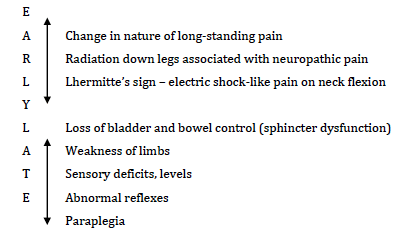
Deciding whether a course of treatment is appropriate for a particular patient involves an overall assessment. Spinal cord compression is an emergency and two questions need to be answered urgently.
1. Does this patient have a reasonable likelihood of having spinal cord compression? Even the most skilled clinician is unable to diagnose early spinal cord compression with absolute certainty. Often by the time clinical signs are ‘classical’ the damage is irreversible. Once the compression has fully developed, treatment outcome is very poor. Thus, if intervention to prevent paraplegia is to be meaningful, spinal cord compression needs to be diagnosed early.
Checklist
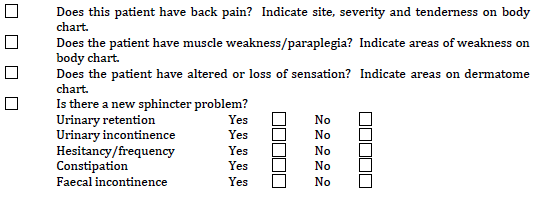
Note: Check anal tone and saddle area sensation. Indicate on body chart.
2. Would this patient benefit from instituting emergency investigation and treatment? – once the possibility of spinal cord compression has been raised, the patient may now be committed to a course of management that will include urgent transfer to a specialised unit, where an MRI scan can be carried out and radiotherapy or other compression-relieving procedure performed.
- Consider the patient’s overall condition and prognosis.
- Consider the patient’s goals and wishes.
- An urgent multidisciplinary management decision is ideally needed to decide on appropriate treatment options.
The keys to diagnosing spinal cord compression include:
- Having a high index of suspicion in patients with spinal metastases, particularly those with multiple myeloma, breast, lung and prostate cancer.
- Taking patient's complaints about back pain, difficulty in walking and in passing urine, seriously.
Explanation to patient and family
Patients at risk of developing SCC should be encouraged to report any new or worsening symptoms. If spinal cord compression is suspected the patient needs to know the urgency associated with the referral to radiation oncology for further assessment and treatment.
Prescribe appropriate first-line treatment
- If the patient is still walking, emergency treatment gives a 1 in 3 chance of regaining leg strength and treatment should be started immediately with high dose Dexamethasone, while arrangements are made for urgent transfer to oncology centre.
- Dexamethasone 8-16 mg stat. (Give oral or by injection SC or i/v if patient vomiting.) Give i/v if symptoms have developed rapidly in past 48 hours (8 mg po bd) Note – do not delay urgent referral in order to obtain dexamethasone.
- Treat pain and other symptoms whilst awaiting further treatment
Referral to appropriate service: acute Oncology centre
- Any patient suspected of having a SCC or being at risk of having a SCC must be discussed with the patient’s oncologist or the palliative care specialist on an emergency basis.
- Where suspicion of spinal cord compression is high, it is quickest to involve the oncology team who have been managing the patient and who will be able to co-ordinate the necessary scans and appropriate treatment rapidly. Investigations include an MRI scan (the investigation of choice) and /or a myelogram.
Consider disease-specific palliative therapy
- Radiotherapy
- Occasionally – chemotherapy
- Rarely – surgical decompression
Indications for radiotherapy
- Radio-sensitive tumour
- Multiple levels of compression
- Unfit for major surgery
- Patient choice
Indications for surgical decompression
- Uncertain cause – to obtain histology
- Radiotherapy has not been effective or symptoms persist or worsen despite radiotherapy
- Radio-resistant tumour, e.g. melanoma, sarcoma
- Unstable spine
- Major structural compression
- Cervical cord lesion
- Solitary vertebral metastasis
Review assessment and management
- Although the overall outcome from treatment is not good, the potential difference that successful treatment can make to a patient’s quality of life is enormous. Treatment outcome is better, the earlier it is started
- Corticosteroids alone may be appropriate for some patients with very advanced cancer, especially if their mobility or performance status was already poor. Nevertheless, making an urgent appropriate management decision is the emergency
- Overall, 30% of patients with spinal cord compression may survive for one year. Function will be retained in 70% of patients who were ambulant prior to treatment, but will return in only 5% of those who were paraplegic at the outset
- Return of motor function is better in those with an incomplete block and particularly with partial lesions of the cauda equina. Loss of sphincter function is a bad prognostic sign
- In practice, most patients with an established diagnosis are relatively unwell and have multiple metastases and will be referred for radiotherapy, achieving similar results to those of surgery
Explanation to patient and family
As always in Palliative care, involvement of the patients and their family is a vital component of the management of a patient with a Spinal Cord Compression. This potentially devastating complication has many issues that need attention, including loss of control, loss of mobility and loss of independence.
Not surprisingly patients with paralysis resulting from SCC often feel hopeless, helpless and depressed. Thorough explanation and repeated reassurances are required as well as the involvement of a counselling social worker and/or psychologist.
Involvement of interdisciplinary team
Such patients provide great challenges to the multidisciplinary team. These challenges include
- Mobility management, within the limits considered safe for the compromised spinal cord. Physiotherapy. Occupational therapy
- Skin care in a patient confined to bed
- Bowel interventions
- Urinary system management
- Psychological and social support