Status Epilepticus
Please click on the link below to access the most up-to-date version of this guideline. The content on this page is currently being updated to align with the latest publication. Always check the version number at the bottom of the screen to confirm which version you are using. Click here to access the Adult Hospital Level Chapter 14: Neurological Disorders with Supporting NEMLC Report-2020-4-Revi
Please click on the link below to access the most up-to-date version of this guideline. The content on this page is currently being updated to align with the latest publication. Always check the version number at the bottom of the screen to confirm which version you are using.
Adolescents (13 – 18 years) and adults
G41.0-2; G41.8-9
DESCRIPTION
In status epilepticus, the seizures do not stop, or they occur repeatedly in close succession with impaired consciousness between seizures. Status epilepticus may be ‘convulsive’ (associated with prominent motor symptoms) or ‘non convulsive’ (i.e., without prominent motor symptoms).
Convulsive status epilepticus:
- Convulsive status epilepticus is defined as ≥ 5 minutes of either:
- a continuous generalised, or bilateral tonic clonic seizure, or
- two or more discrete generalised, or bilateral tonic clonic seizures with incomplete recovery of consciousness between the seizures.
- Convulsive status epilepticus is a medical emergency. There are two critical time points:
- Time point 1: 5 minutes from the onset of the initial epileptic seizure (i.e., at the point of diagnosis). Immediate treatment is needed to prevent ongoing epileptic seizure activity.
- Time point 2: 30 minutes of epileptic seizure activity, timed from the onset of the seizure. After 30 minutes of seizure activity, irreversible brain damage related to hypoxia, acidosis, depletion of local energy stores, cerebral oedema and structural damage, is likely to occur.
- Complications of convulsive status epilepticus include:
- hyperpyrexia
- disturbances of blood glucose
- respiratory depression
- cerebral oedema
- renal failure
- acidosis
- blood pressure disturbances
- inappropriate antidiuretic hormone (ADH) secretion
- hypoxic ischaemic damage to brain, myocardium and muscles
Non-convulsive status epilepticus:
- Non-convulsive status epilepticus refers to abnormally prolonged or rapidly recurring epileptic seizures with impaired consciousness but no major motor symptoms (e.g., focal seizures with autonomic, sensory or perceptual manifestations or absence seizures).
- The presentation is often subtle, and the seizures may not be recognized. Diagnosis is confirmed on EEG. Treat as for convulsive status epilepticus below.
- See Epileptic seizures and status epilepticus in adolescents (13 – 18 years) and adults. Identify and manage all underlying causes.
Causes of epileptic seizures and status epilepticus
- With every epileptic seizure, the underlying cause of the seizure must be determined and treated, including in people with epilepsy.
- Important causes of epileptic seizures that must be considered include:
- Infectious conditions e.g., meningitis or encephalitis.
- Encephalopathy e.g., hypertensive encephalopathy or cerebral hypoxia
- Metabolic conditions e.g., hypoglycaemia, hypo- or hypernatraemia, hypocalcaemia.
- Brain lesions e.g., brain tumours, stroke and post-stroke sequelae, trauma and post-traumatic sequelae.
- Substance withdrawal e.g., alcohol or benzodiazepines. » Substance intoxication e.g., cocaine or amphetamines.
- Poisoning or toxin ingestion (accidental or intentional as in an overdose) e.g. isoniazid.
- Other neurological (e.g., cerebral palsy) or neurodegenerative (e.g., Alzheimer’s dementia) conditions.
- Suboptimal treatment of epilepsies e.g., breakthrough seizures, treatment non-adherence, recent changes to antiseizure medicine (ASM), antiseizure medication toxicity.
EPILEPTIC SEIZURES AND STATUS EPILEPTICUS IN ADOLESCENTS (13 – 18 YEARS) AND ADULTS
Additional causes of epileptic seizures to consider in adolescents and adults are categorised below:
| Pregnancy related | Infections | Substances & poisoning |
| - eclampsia (See Eclampsia) - electrolyte abnormalities (e.g., in hyperemesis gravidarum) - stroke - reduced blood concentrations of antiseizure medication |
- meningitis - encephalitis - brain abscess - neurocysticercosis |
- substance abuse (e.g. cocaine, amphetamines) - withdrawal syndromes (e.g., benzodiazepine, alcohol) - medicine toxicity and overdose (e.g., antiseizure medications, antidepressants, antipsychotics, isoniazid) - environmental toxins (e.g. pesticides) |
| Metabolic conditions | Systemic disorders | Primary cerebral causes |
| - hypoglycaemia - hypocalcaemia - hypomagnesaemia - hyponatraemia - hypernatraemia |
- vasculitis - hypertensive encephalopathy - uraemia (renal failure) - hyperammonaemia (liver failure) |
- tumour - trauma - neurodegenerative conditions - idiopathic/unknown |
Special considerations
Adolescents and young adults:
- High risk for substance intoxication or withdrawal, and traumatic brain injuries.
- Mental health conditions are common, and may present as ‘epilepsy imitators’ (see differentials of epileptic seizures above and https://www.epilepsydiagnosis.org/epilepsy-imitators.html).
- Idiopathic generalised epilepsies (including epilepsy with generalised tonic-clonic seizures, juvenile myoclonic epilepsy, juvenile absence epilepsy) may first present in this age group. » High risk for poor adherence to ASMs and breakthrough seizures.
- Often require intensive individual and family counselling and support, with appropriate involvement of social welfare and education sectors.
Girls and women in child-bearing age group:
- Exclude pregnancy and pregnancy related complications.
- ASM concentrations may become sub therapeutic in pregnant women with epilepsy, causing breakthrough seizures. An increase in ASM dose may be required during pregnancy (reduce dose after delivery). Where possible monitor.
CAUTION
Children born to women taking valproate are at significant risk of birth defects (11%) and persistent developmental disorders (40%). Valproate is contra-indicated and should be avoided in pregnancy and in adolescents and women of child-bearing potential.
LoE:IIIbxxvi
People > 65 years of age
- Common reversible conditions include metabolic abnormalities, medications, alcohol withdrawal.
- The risk of developing epilepsy increases with age. Epilepsy in this age group is commonly caused by stroke, brain tumours and dementias. Continued ASM may be advisable after a single seizure in these patients.
GENERAL MEASURES
On arrival/ while fitting:
- Ensure the environment is safe. Remove all sharp objects and hot liquids.
- Place the patient in a lateral position to prevent aspiration of secretions or vomitus, on the floor if necessary (see figure 2).
- Do not place anything (spoon or spatula, etc.) in the patient's mouth.
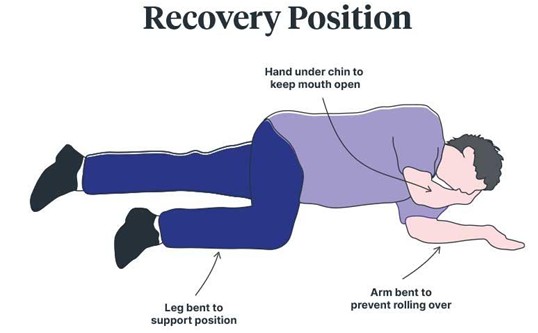
Click on the image to enlarge.
Figure 2: Recovery position for adults experiencing a seizure
Source: Ausmed: Adult Basic Life Support
LoE:IVbxxvii
- Obtain an eyewitness account of the seizure onset and any associated impaired consciousness. If seizure duration is ≥ 5 minutes, commence urgent medicine treatment for convulsive status epilepticus (refer to Table 1 on medicine management and supportive care of status epilepticus in adolescents and adults).
- Ensure the airway is not obstructed and administer oxygen via face mask or nasal cannula to maintain SaO2 ≥ 95%.
- Intubation should be performed if airway, ventilation, or oxygenation cannot be maintained, or if seizure is prolonged.
- Examine for fever, dehydration, meningism, hypoglycaemia, evidence of toxin or poison ingestion, head, neck or other trauma, obvious focal neurology and other possible causes of the seizure. » Secure intravenous access.
- Monitor vital signs every 15 minutes.
- Keep nil per mouth.
- Ensure the family/caregiver/escort is attended to; social worker or auxiliary staff member should obtain all contact details and provide counselling as needed.
Convulsive status epilepticus:
- If the seizure does not resolve by 5 minutes of its onset, commence urgent medicine treatment.
MEDICINE TREATMENT
Aim to control the seizure within 30 minutes of its onset, prevent complications of status epilepticus with supportive care, and identify and correct underlying causes. Follow standard resuscitation protocols, such as the ABCDE approach.
Table 1: Medicine management and supportive care of status epilepticus in adolescents and adults
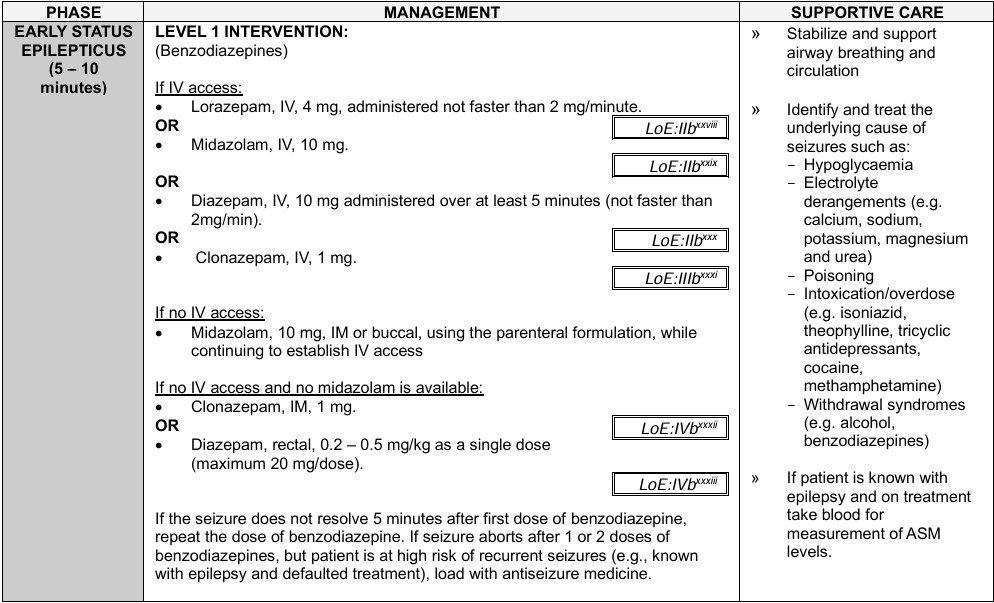
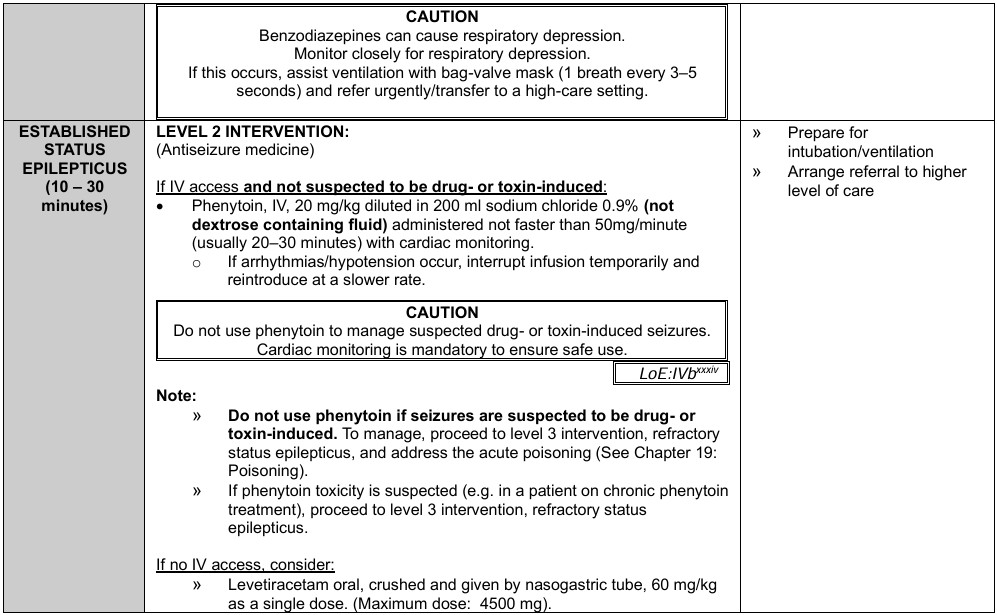
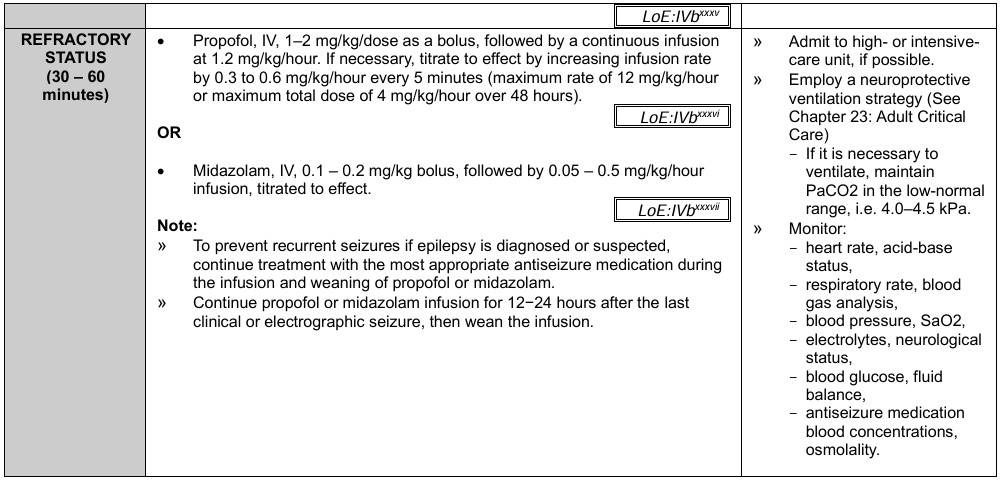
Click on the image to enlarge.
After The Seizure
Post Ictal Phase:
- Keep nil per mouth and haemodynamically stable until patient has regained consciousness and is aware of themself and their surroundings.
- If there is agitation or disturbed behaviour, consider post-ictal delirium and manage as for delirium – see Section 20.8: Delirium.
- Clarify the cause of the seizure and manage appropriately. Further investigations (e.g., lumber puncture and neuroimaging) are driven by clinical signs and seizure onset (e.g., focal onset).
- If meningitis is suspected, commence antibiotic therapy urgently.
- Counsel the patient and their family regarding the cause of the seizure, management given and likely sequelae of the seizure. Offer only as much information as the family or patient is able to receive at that time.
- If reversible causes of the epileptic seizure have been addressed, wean and stop ASMs. Consider whether the person meets the criteria for a diagnosis of epilepsy (see: Epilepsy) and requires ongoing ASMs.
- On discharge, set up a follow-up appointment to reinforce the counselling messages.
Active follow up:
- Wean any residual ASMs, unless ongoing maintenance treatment is indicated, or epilepsy has been diagnosed.
REFERRAL
- Refractory status.
- Need for more intensive care than can be provided at the facility.
Standard Treatment Guidelines and Essential Medicines List for South Africa, Adult Hospital Level, 2020-4_Version 2.0_6 June 2025
Chapter 14 Neurological Disorders_14.5 Status Epilepticus