Sterilisation and Disinfection
SADA COVID-19 Guidelines, May 2020
Sterilisation and Disinfection Protocol
Implement Environmental Work Controls
Disinfection (Surfaces) and Housekeeping
Assessment of the Disinfectant Comparison List
Hard Surfaces (Floors/Chair and Accessories/Cabinets/Fixed Fixtures)
Protocol Before Seating Patient
Protocol After Seating Patient
Protocol During Patient Treatment
Protocol After Patient Treatment
Sterilisation and Disinfection Protocol
During the extraordinary circumstances experienced during the lockdown and global pandemic, this protocol must be used in conjunction with the infection control ‘Guidelines for Oral Health Care South in Africa’ (Oosthuysen et al., 2020). The following sections of the guidelines have special significance: Section 3: Environmental and Work Controls, Section 4: Surface Contamination Management, Section 9: Sterilisation Practices, and Section 10: Safe Sharps Handling.
It is imperative to maintain a very high degree of suspicion by all OHC personnel, whilst strictly adopting the Standard Precautions and transmission-based precautions, including hand hygiene practices, appropriate use and application of PPE, precautions when performing AGP, practising efficient and effective aseptic procedures, disinfection and cleaning of household surfaces, and also safe and efficient recirculation, sterilisation, storage and distribution of instruments needed during all OHC procedures.
Reduce Facility Risk
Restrict the OHC workload as set out in the document that refers to scope of practice during COVID-19 emergency regulations. Use teledentistry when possible.
Isolate symptomatic patients as soon as possible. Set up separate, well-ventilated triage areas, place patients with suspected or confirmed COVID-19 in areas where the door can be closed. Reserve AIIR’s for patients with COVID-19 undergoing AGPs and for care of patients with pathogens transmitted by the airborne route, such as tuberculosis.
Implement Environmental Work Controls
In Contact
Dedicated medical equipment should be used when caring for patients with known or suspected COVID-19.
All non-dedicated, non-disposable medical equipment used for patient care should be cleaned and disinfected according to the manufacturer’s instructions and facility policies (refer to the SADA published document). Ensure that environmental cleaning and disinfection procedures are followed consistently and correctly.
- Office disinfection: doorknobs, handles, phones, computer keyboards, light switches, chair arms, head rests, toilet handles, faucets, countertops, handrails, elevator buttons, etc.
- Sterilising/disinfecting instruments: apply Spaulding’s Modified Classification to determine which to use (ADA 2013; Oosthuysen et al., 2020; CDC 2020)
- Use protective environmental barriers on objects such as plastic wrap/ aluminium paper: radiographic devices, light handles, chair switches, keyboards and computer mice, etc. (change with each patient)
Post Contact
Routine cleaning and disinfection procedures—such as using cleaners and water to pre-clean surfaces prior to applying an approved, hospital-grade disinfectant to frequently touched surfaces or objects for appropriate contact times as indicated on the product’s label—are appropriate for SARS-CoV-2 in OHC settings, including those patient-care areas in which AGPs are performed (CDC 2020).
- Use disinfectant to wipe debris, then disinfect again. Use disposable gloves and effective wipes/sprays. CDC suggested disinfectant: hypochlorite 0.1% for one minute (mix 1 part of bleach with 9 parts of water)
- 0.5% Hydrogen peroxide for one minute.
- Benzalkonium has mixed efficacy with COVID-19.
In the presence of body fluids, such as saliva, nasal excretions and blood in OHC produced aerosols, smears and spatter, a significantly more thorough disinfection is required. Also refer to the infection control ‘Guidelines for Oral Health Care South Africa’ (Oosthuysen et al., 2020) and the referenced research information from Clinicians Report TRAC Research (CR Foundation 2020).
Post-Contact Sterilisation
- Required sterilisation: Critical items are all surgical instruments that are used to penetrate soft tissue or bone in sterile areas of the body. Instruments such as surgical and cutting instruments, forceps, chisels, periodontal scalers, burs and those classified as critical instruments should be sterilised.
- Hand pieces, all, including all attachments: sterilised after each patient (CDC 2016). Acceptable methods: steam under pressure (autoclave is the gold standard, wrapped cycle pre- and post-vacuum Type B autoclave 5 min @ 132°–135°C plus drying time, wrapped cycle Steam-flush Pressure-pulse Type S autoclave 14-17.5 min @ 132°-135°C plus drying time, wrapped cycle Gravity Displacement Type N autoclave 15-30 min @ 121°-123°C plus drying time, chemical vapour, dry heat (static air dry heat 120 min @ 160°C, forced air dry heat 12 min @ 190°C).
- Semi-critical items that are used to touch only mucous membranes (do not penetrate soft tissues), such as hand instruments, mirrors, mouth props, curing light guards, and cheek protectors, if heat tolerant: sterilised, otherwise high-level disinfection (10–12 hours’ exposure).
- The tips of air/water syringes should not be reused or sterilised. These should be single- use disposable items and should be replaced for every patient. In cases where metal reusable tips are still used, replace all tips of air/water syringes to be single-use disposable tips. Metal air/water syringe tips get severely contaminated during procedures and cannot effectively be cleaned and sterilised.
Disinfection (Surfaces) and Housekeeping
Pre-Contact
- Prepare the facility.
- Know how to contact your health department.
- Step up precautions when the virus is spreading in your community.
- Assess and restock supplies now and on a regular schedule as available, check the SADA site.
- Communicate with patients.
- Ask patients about symptoms during reminder calls.
- Consider rescheduling non-urgent appointments.
- Post signs at entrances and in waiting areas about prevention actions.
- Prepare the waiting area and patient rooms.
- Provide supplies—tissues, alcohol-based hand sanitiser, trash cans and soap at basins.
- Place chairs 1.5 m apart when possible. Use barriers (like screens), if possible.
- If your facility has toys, reading materials, or other communal objects, remove them (CDC).
In Contact
For appropriate chemicals to use for disinfection, refer to the disinfectant comparison chart (Table 1) and the List of Disinfectants on the SADA website for approved disinfectants and also disinfectants that have qualified under the EPA’s emerging viral pathogens programme for use against SARS-CoV-2 (List N: Disinfectants for use against SARS-CoV-2 accessed 20 April 2020 from https://www.epa.gov/pesticide-registration/list-n-disinfectants-use-against-sars-cov-2-covid-19).
Table 1: Disinfectant comparison chart
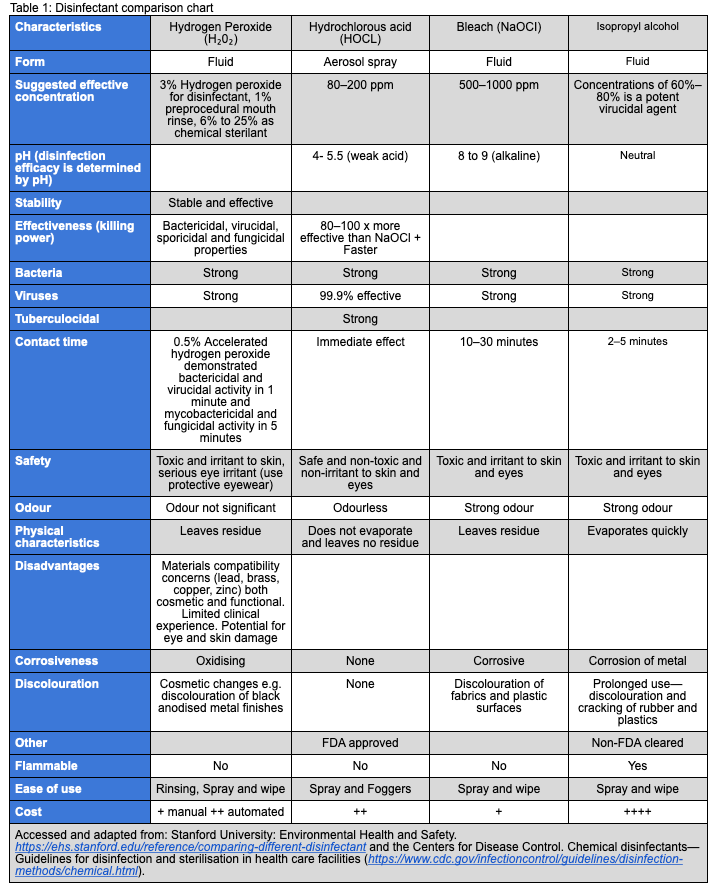
Click on image to enlarge or click here for the link to the above table
- Only H202 NaOCl (household bleach), alcohol, and hydroclorous acid ( are effective disinfectants with virucidal efficacy.
- Each has its ow n advantages and disadvantages, in different formulations ( fluids wipes, sprays, etc.), and required contact times for optimum disinfection differ.
- We cannot present the full prescription and instead refer to the main SADA document published.
- Our clinical recommendations as best practices policy are as follows
Assessment of the Disinfectant Comparison List
| Alcohol | As an environmental surface disinfectant, it is no longer recommended. Apart from the fact that it fixates protein, such as blood and saliva on hard surfaces, it is, furthermore, volatile and inflammable. |
| Accelerated hydrogen peroxide | Costly and takes too long to disinfect |
| Bisguanide | Not virucidal |
| Citric acid | Corrosive and irritating to eyes |
| Chlorine dioxide | Corrosive to metals, irritation to eyes and skin, unstable and must be prepared fresh daily |
| Glutaraldehyde | Toxic fumes causing irritation and other adverse effects—not recommended |
| Halogen compounds | Intermediate disinfection, corrosive skin and eye irritation. Can only use on hard surfaces |
| Hydroclorous acid (HOCl) | Clean, deodorise and intermediate disinfectant effective against viruses similar to COVID-19 on hard, non-porous surfaces. Also applied for wound healing. |
| Hydrogen peroxide | High-level disinfection, compatible with plastic surfaces but not metal surfaces. Serious eye damage with contact |
| Iodophors | Discolouration and corrosive |
| Formaldehyde | Toxic |
| Peracetic acid | Good materials compatibility, but can cause serious eye and skin damage |
| Phenolics | May degrade plastics and etch glass |
| Quaternary ammoniums | Not recommended and can cause damage to materials |
| Sodium hypochlorite (bleach) | Intermediate-level disinfection, inexpensive but corrosive, damages plastics, vinyl fabrics and irritating to skin and eyes |
| Super-oxidised water (e.g. Ozone) | High-level disinfection requires equipment and additional cost—expensive |
(The information outlined in the table above was extracted from the EPA List N document)
Take Home Information to the Oral Health Care Profession
Alcohol as a surface disinfectant is not recommended because it fixates protein and also due to its volatility and flammability.
- NaOCl (bleach) is inexpensive but not compatible with plastics and fabrics. It is, furthermore, corrosive and may cause irritation of eyes and skin (intermediate-level disinfectant).
- HOCl (Hydroclorous acid): moderately expensive, compatible with fabrics, plastics and metals (high-level disinfectant).
- H2O2 (Hydrogen peroxide): Compatible with plastics and elastomers but poor metal compatibility and serious eye damage with contact (high-level disinfectant).
Considering efficacy (virucidal and bactericidal), ease of use, cost, compatibility with plastics and metals, and safety—HOCl comes out with most boxes ticked!
Hard Surfaces (Floors/Chair and Accessories/Cabinets/Fixed Fixtures)
Post Contact
- Cleaning is an essential part of disinfection. Organic matter can inactivate many disinfectants. Cleaning reduces the soil load, allowing the disinfectant to work. Removal of organisms, such as the virus that causes COVID-19, requires thorough cleaning followed by disinfection.
- The length of time that SARS-CoV-2 (the cause of COVID-19) survives on inanimate surfaces will vary depending on factors such as the amount of contaminated body fluid (e.g. respiratory droplets or soiling present and environmental temperature and humidity). SARS-CoV-2 can remain viable in aerosol and survive up to three days on inanimate surfaces at room temperature, with a greater preference for humid conditions (Van Doremalen, Bushmaker, Morris et al., 2020) (https://doi.org/ 10.1056/NEJMc2004973).
- Corona viruses can survive on surfaces for many hours but are readily inactivated by cleaning and disinfection. It is good practice to routinely clean surfaces as follows:
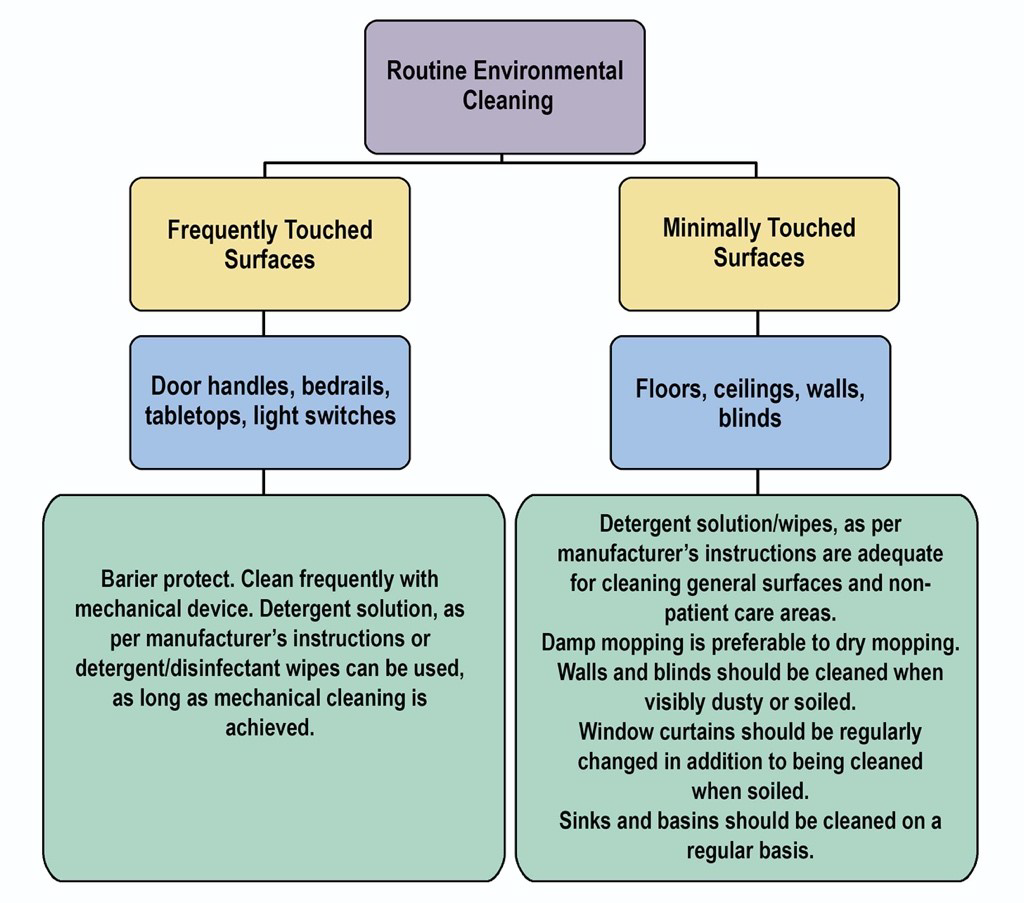
- Clean frequently touched surfaces with detergent solution (Diagram 2).
- Clean general surfaces and fittings when visibly soiled and immediately after any spillage.
Click on image to enlarge
Figure 2: Routine environmental cleaning requirements can be divided into two groups.
[Adapted from Australian Guidelines for the Prevention and Control of Infection in Healthcare, Canberra: National Health and Medical Research Council (2019).] https://www.health.gov.au/sites/default/files/documents/2020/03/coronavirus-covid-19-environmental-cleaning-and-disinfection-principles-for-health-and-residential-care-facilities.pdf - Clinical personnel should make sure to disinfect hard surfaces using chemicals recently approved for COVID-19 and maintain a dry environment to curb the spread of SARS-CoV-2 (List N: EPA’s registered antimicrobial products for use against novel coronavirus SARS-CoV-2, the cause of COVID-19 (United States Environmental Protection Agency). (https://www.epa.gov/pesticide-registration/list-n-disinfectants-use-against-sars-cov-2-covid-19)
- The management of laundry, utensils and health care waste should also be performed in accordance with routine procedures (https://www.cdc.gov/coronavirus/2019-ncov/hcp/infection-control-recommendations.html#adhere).
Essential Moveable Furniture
Post Contact
- SARS-CoV-2 can remain viable in aerosol and survive up to three days on inanimate surfaces at room temperature, with a greater preference for humid conditions (Van Doremalen, Bushmaker, Morris et al., 2020) (https://doi.org/10.1056/NEJMc2004973).
Clinical personnel should make sure to disinfect hard surfaces using chemicals recently approved for COVID-19 and maintain a dry environment to curb the spread of SARS-CoV-2 (List N: EPA’s registered antimicrobial products for use against novel coronavirus SARS-CoV-2, the cause of COVID-19 (United States Environmental Protection Agency). (https://www.epa.gov/pesticide-registration/list-n-disinfectants-use-against-sars-cov-2-covid-19).
Pre-Contact
- Waiting areas in OHC facilities are common areas where a higher likelihood of cross-infection or increased exposure between patients and accompanying persons or OHC personnel is a pertinent threat.
- Further guidance includes frequent cleansing of ‘high-touch’ surfaces, such as the reception counter, toilet doors, doorknobs and handles, etc.), using a neutral pH detergent (Ge, Yang, Xia, Fu, & Zhang, 2020). In addition, patient-related infographic images, demonstrations of optimum hand hygiene techniques, management of cough etiquette, illustrations of the concept of ‘social distancing’ that are easy to read and understand should be exhibited in the common areas (New Zealand Dental Association, Jamal, Shah, Almarzooqi, Aber, Khawaja, El Abed, Zuhair, & Samaranayake, 2020) (https://www.preprints.org/manuscript/202004.0357/v1).
Post Contact
- Provide at-home care instructions to patients with respiratory symptoms. Consider telephone or other options for follow-up.
- After patients leave, clean frequently touched surfaces and work areas using an approved disinfectant.
- Use disposable (single-use) devices, such as mouth mirrors, syringes and blood pressure cuffs, to prevent cross-contamination is encouraged.
Protocol Before Seating Patient
Put on protective clothing, protective eye wear, mask/respirator, gloves, and clean and disinfect those surfaces that may be touched during patient treatment that will not be protected by surface barriers. These surfaces can include the following:
- Cuspidor rim and control knob
- Countertops
- Draw er pulls and top edges of drawers that may be used
- Basin faucet handles
- Hand piece connectors
- Clean and disinfect items brought into the area to be used during patient procedures.
- Disinfection procedure
- Spray surface with the surface disinfectant that has been prepared properly
- Clean surface by vigorously wiping with paper towels or 4×4 gauze pads.
- Disinfect the pre-cleaned surface by respraying it and letting it air dry or by wiping it dry if it is still wet after the prescribed contact time
- Alternatively, wipe with a disinfectant towelette, discard towelette, wipe with a second fresh towelette, and let dry - Remove and discard the mask/respirator and gloves and wash hands (Doffing).
- Obtain surface barriers, supplies and sterile instruments and other equipment from the supply area
- Cover the following surfaces with the appropriate barriers:
- Headrest
- Control buttons on side of chair
- Light handles
- Unit light switch and view box switch - Air/water syringe buttons/handles
- Cover the following surfaces with the appropriate covers:
- High volume evacuator control
- Unit control switches and hand piece, air/water syringe and HVE holders
- Saliva ejector, hand piece and air/water syringe hoses
- Bracket table
- Stool backs - Remove all items not used during patient treatment from countertops
- Make sure a sanitised sharps container is available at chairside.
Protocol After Seating Patient
- Adjust chair and headrest
- Place patient napkin
- Take or update medical history, discuss treatment and do necessary paperwork.
- Remove the chart from the countertop.
- Open instrument packages or trays without touching the instruments.
- Put on mask and eyeglasses.
- Perform hand hygiene, preferably in view of the patient.
- Handwashing procedure:
- Perform surgical scrub for procedures indicated - Put on gloves, preferably in view of the patient
- Use sterile gloves for procedures as indicated; otherwise, use non sterile examination gloves.
- Use powder free gloves. Rinse with plain, cool water (no soap) to remove any residue and towel dry before making impressions and bite registrations n on sterile)
- Connect sterile hand pieces and sterile or disposable air/water syringe tip, HVE tip, and saliva ejector tip.
Protocol During Patient Treatment
- Restrict the spread of microorganisms, other potentially infectious materials and aerosols from the patient’s mouth:
- Use a rubber dam
- Use the HVE
- Touch as few surfaces as possible with saliva-coated fingers
- Keep gloved hands out of hair; do not rub eyes or bare skin or adjust mask/glasses.
- If leaving chairside during treatment is necessary, remove and discard the gloves
- Wash hands and re-glove with fresh gloves on return
- Remove contaminated gloves and wash hands before handling cameras for intra-oral photographs. - Do not use items dropped on the floor or on other non sterile surfaces Obtain sterile replacements. Remove and replace gloves, preferably in view of the patient.
- If gloves are torn during treatment, remove, discard, wash hands, and re glove with fresh gloves.
- Do not recap needles by hand. Insert the needle into the cap using the one handed ‘ technique or a cap holder that will not permit contact of the needle with any part of the body.
- Look before reaching for a sharp instrument.
- When placing sharp instruments back on the instrument tray, make sure sharp tips are not pointed up and make sure they are placed in a stable position.
- If equipment such as a curing light or other apparatus, is brought to the chairside, make sure it is protected with a surface barrier or has been disinfected before use.
- Use an aseptic retrieval technique to obtain supplies from bulk containers at chairside.
- If one must obtain supplies, such as amalgam, composite, or cavity liner from a storing area, do not take a container to the unit unless it is covered with plastic wrap or is cleaned and disinfected after use.
- Disinfect contaminated items before taking them to the dental laboratory.
- Do not handle charts with contaminated gloves. Use an over glove or remove gloves and wash hands prior to touching anything else.
- If exposed to a patient’s blood or saliva, immediately contact the appropriate responsible person to institute a post exposure medical evaluation.
Protocol After Patient Treatment
- Remove gloves and then the mask/respirator by touching only the ties or elastic band; discard them in a plastic lined waste container at the unit, and then wash hands or use an alcohol hand rub.
- Send the patient to the front desk for dismissal or reappointment.
- Put on fresh gloves and mask
- Place all instruments back on the tray or, preferably, in an instrument cassette with a lid that can lock securely.
- Place all disposable sharps, including capped or uncapped needles, directly into the sanitised sharps container at chairside.
- Place non sharp disposable items in the plastic lined health care risk waste container (red) at the unit.
- Flush the air/water syringe, high speed hand piece and ultrasonic scaler into the basin, cuspidor or container for 20 to 30 seconds and disconnect them from hoses.
- Remove all surface barriers without touching the underlying surface; discard them in plastic lined health care risk waste containers (red) at the unit.
- Clean and disinfect patient care related surfaces that were not covered and were contaminated during treatment
- Take instruments and headpieces to the decontamination/sterilisation area.
- Remove and wash contaminated protective eyewear; rinse and dry them. Avoid contaminating hair.
- Remove and dispose of the disposable gown (if used) in the plastic lined health care risk waste container (red) at the unit.
- Remove gloves and discard them in the plastic lined health care risk waste container (red)
- Wash, rinse, and dry hands or use an alcohol hand rub. If hands are visibly soiled of feel tacky, soap and water is the preferred method of practising hand hygiene.
- If UV C lights or disinfectant fogger equipment are available, it can be used, based on established protocols from the manufacturer/distributor.
Laboratory Asepsis (Miller, 2018)
- Gloves, mask, protective eyewear and protective clothing are used until items in the laboratory are decontaminated.
- Before items are used in the laboratory, all dental prostheses and prosthodontic materials are cleaned and disinfected.
- Manufacturers are consulted when needed.
- Specific information regarding the disinfection technique used is included when laboratory cases are sent off site and returned.
- Heat tolerant items used in the mouth are cleaned and heat sterilised.
- Manufacturers’ instructions are followed for cleaning and sterilising or disinfecting items that become contaminated but that do not normally come into contact with the patient.
Suction
During high-fluid and aerosol-producing procedures:
Limit the number of patients seen, relevant to your own environment, risk and ventilation requirements. Have a dental assistant designated for constant HVE to eliminate aerosol spray.
For OHC procedures, add 20–30 minutes per patient per procedure to help mitigate any contamination and allow for the best patient–OHC waste management.
Post Contact
End of Day: OHC Team Procedures
- Remove disposable protective clothing.
- If possible, protective clothing must be cleaned at the facility. If not, bring a change of clothing to change into, and properly store clinical wear in a plastic bag to wash when returning home.
- After disposal of PPE, wash hands with soap and water for at least 45 seconds.
Disinfectant Fogging
Perform disinfectant fogging only for extraordinary circumstances and purposes in patient-care areas. Disinfectant fogging recommendations refer to the spraying of chemicals, such as formaldehyde or phenol-based agents, to decontaminate environmental surfaces or disinfect the air in health care facilities. Newer technologies involving fogging for room decontamination fogging-type applications, such as ozone mists or vaporised hydrogen peroxide, have become available and are preferred.