Summary, Objectives and Position Statement Development
Summary Asthma prevalence is increasing worldwide, and surveys indicate that most patients in developed and developing countries, including South Africa, do not receive optimal care and are therefore not well controlled. Standard management guidelines adapted to in-country realities are important to support optimal care. The South African Thoracic Society (SATS) first published a guideline
Summary
Asthma prevalence is increasing worldwide, and surveys indicate that most patients in developed and developing countries, including South Africa, do not receive optimal care and are therefore not well controlled. Standard management guidelines adapted to in-country realities are important to support optimal care. The South African Thoracic Society (SATS) first published a guideline for the management of chronic persistent asthma in 1992, which has subsequently been revised several times.
The main aim of the present document was to revise and update SATS’ statement on the suggested management of chronic asthma, based on the need to promote optimal care and control of asthma, together with the incorporation of new concepts and drug developments. This revised document reinforces optimal care and incorporates the following primary objectives to achieve the recent advances in asthma care:
- continued emphasis on the use of inhaled corticosteroids (ICS) as the foundation of asthma treatment
- to reduce the reliance on short-acting beta-2 agonist (SABA) monotherapy for asthma symptoms
- to incorporate the evidence and strategy for the use of the combination of an ICS and formoterol for acute symptom relief (instead of a SABA)
- to incorporate the evidence and strategy for the use of as-needed ICS-long-acting beta agonists (LABA) for patients with infrequent symptoms or ‘mild’ asthma
- to incorporate the evidence and strategy for the use of a long-acting muscarinic antagonist (LAMA) in combination with ICS-LABA; and
- to incorporate the evidence and strategy for the use of and management with a biologic therapy in severe asthma.
Asthma prevalence is increasing worldwide, and surveys indicate that most patients in developed and developing countries, including South Africa (SA), do not receive optimal care and are therefore not well controlled.[1] Standard management guidelines adapted to in-country realities are important to support optimal care.[1] The South African Thoracic Society (SATS) first published a guideline for the management of chronic persistent asthma in 1992, which has subsequently been revised several times.[2-4]
Objectives
The main aim of the present document was to revise and update SATS’ statement on the suggested management of chronic asthma, based on the need to promote optimal care and control of asthma, together with the incorporation of new concepts and recent developments in pharmacotherapy. The management guidelines for acute asthma exacerbations have not changed substantially and are presented elsewhere.[5] The present revision stresses optimal care and incorporates the following objectives to achieve the recent advances in asthma care:
i. continued emphasis on the use of an inhaled corticosteroid (ICS) as the foundation of asthma treatment and control
ii. to minimise the need for, and/or inappropriate reliance on, short-acting beta-2 agonist (SABA) monotherapy for acute asthma symptoms
iii. to incorporate the evidence for, and strategy for the use of, the combination of an ICS and formoterol for acute symptom relief (instead of a SABA)
iv. to incorporate the evidence and strategy for the use of as-needed ICS-long-acting beta agonist (LABA) for patients with infrequent symptoms or ‘mild’ asthma
v. to incorporate the evidence and strategy for the use of a long-acting muscarinic antagonist (LAMA) in combination with ICS-LABA in patients with symptoms unresponsive to ICS-LABA alone
vi. to incorporate the evidence and strategy for the use of, and management with, a biologic therapy in severe asthma
vii. to clarify the need for clinical and laboratory phenotyping of difficult-to-treat asthma
viii. to clarify the role of bronchial thermoplasty (BT) for severe and difficult-to-treat asthma; and
ix. to incorporate recommendations for COVID-19 disease and prevention in patients with asthma.
Position statement development
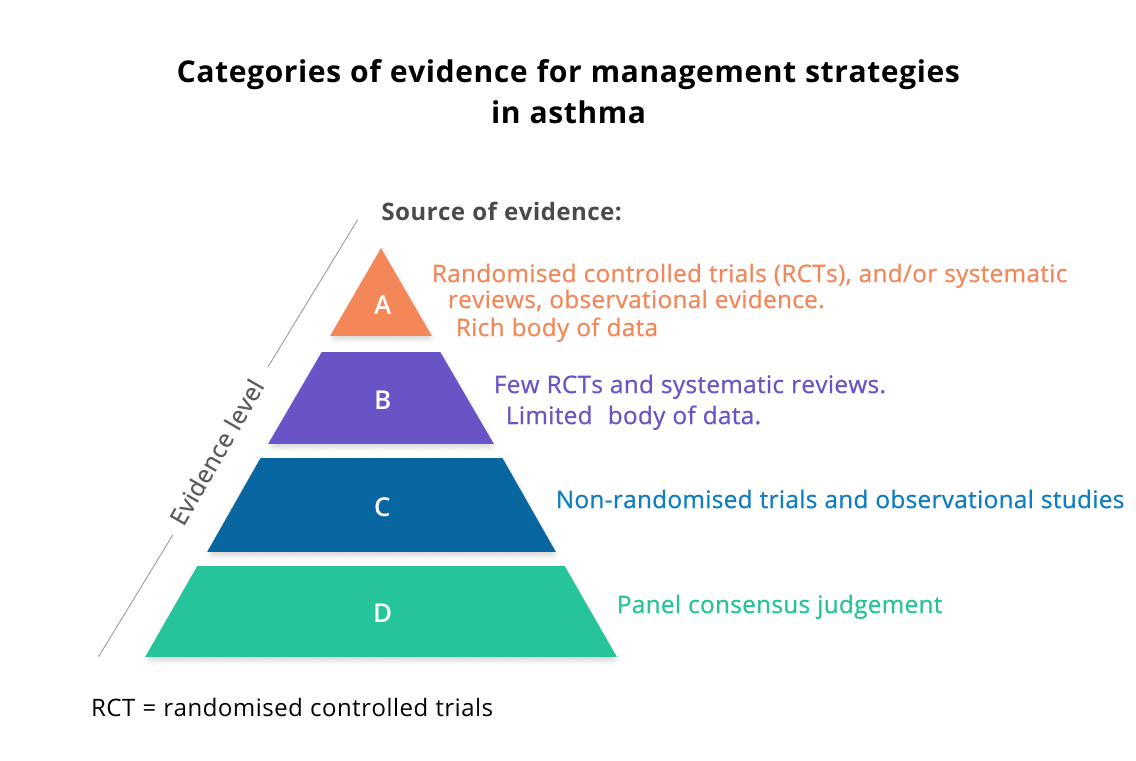
Based on new evidence and clinical trials of asthma treatment, a working group of clinicians and researchers based in SA revised and updated the previous asthma guideline.[4] Changes were based on the levels of evidence outlined in the image below and in accordance with the Global Initiative for Asthma (GINA) 2021 strategy document.[1]
Click on image to enlarge
The field of asthma is changing rapidly, with many new drugs becoming available. The availability of medications and local approvals should be reviewed prior to prescription. The recommendations are guided by the 2021 GINA strategy document and reflect best practice, with alternatives when availability is restricted by registration/cost/ funder restrictions/patient preference.
Guidelines for the management of asthma in adults and adolescents, South African Thoracic Society, 2021