Surveillance of HAIs in the Hospital
Supporting the Antimicrobial Resistance Strategy Framework and the Guidelines on Implementation of the Antimicrobial Strategy in South Africa: One Health Approach and Governance, 2018
Purpose of surveillance for HAIs
Steps for implementing HAI surveillance
HAIs are the most common adverse events related to hospitalisation and have a major impact on morbidity, mortality and healthcare costs. The most common HAIs in low- and middle-income countries (LMICs) were reported to be surgical site infections (SSI) (29%), followed by urinary tract infections (UTI) (24%), bloodstream infections (BSI) (19%) and hospital-acquired pneumonia (HAP) (15%).16, 17 However, these rates diff er considerably by region, hospitals and type of ward.
Surveillance is the first important step in identifying practices that can lead to IPC issues and priorities related to HAIs and IPC. In other countries, national surveillance for HAIs, including mechanisms for timely feedback, has led to significant reductions in HAI rates18.
Purpose of surveillance for HAIs
A standardised surveillance model for HAIs is essential to:
- Establish a baseline prevalence of HAIs in the hospital, in order to guide IPC and AMS activities;
- Compare and benchmark hospitals to one another, where possible;
- Assess the hospital-level impact or effectiveness of interventions, e.g. multimodal IPC strategies including “bundles of care”; and
- Detect clusters or outbreaks, leading to timely action by the healthcare team.
Steps for implementing HAI surveillance
The steps required for implementing HAI surveillance are described below and include:
- Establishing the baseline of HAIs in the hospital – either through point prevalence surveys (PPS) or laboratory reports from the hospital laboratory or from the NICD dashboard and identifying the most relevant AMR patterns;
- Choosing an appropriate intervention or bundle of care to prevent infections;
- Implementing that bundle through repeated quality improvement cycles of plan-do-study-act (PDSA); and
- Monitoring and measuring the impact by measuring HAI rates and compliance to bundle interventions.
HAI surveillance, intervention and improvement cycle
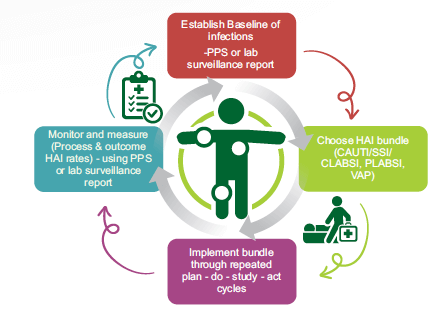
Click on image to enlarge
STEP 1
A baseline of HAI rates and/or AMR should be determined first
A process assessment or audit such as a point prevalence study (PPS) should be conducted to understand the baseline of the HAI rates (see Basic approach in a Point Prevalence Study for HAIs ). This will provide the hospital with a summary of its important HAI syndromes and the commonest bacterial pathogens and their resistance patterns. Ideally, the hospital should participate in a nationwide PPS, to be conducted once a year at the same time. This step is important to set the baseline.
Basic approach in a Point Prevalence Study for HAIs
|
Phase 1: Planning
|
|
|
Phase 2: Training
|
|
|
Phase 3: Conducting the survey
|
|
|
Phase 4: Analysing data and reporting
|
|
|
Global Point Prevalence of Antimicrobial Consumption and Resistance (GLOBAL-PPS) (www.global-pps.com)
The GLOBAL-PPS coordinates surveil- lance of antimicrobial prescribing and resistance in hospitalised adults, children and neonates worldwide. The GLOBAL- PPS supports planning and local stewardship interventions in a range of resources and geographical settings. The GLOBAL-PPS assists with conducting a one-day survey, and provides data- collection forms with anonymous online data entry for validation and reporting. Feedback is provided in the form of a downloadable report, which includes graphs and tables that can used for local communication and presentations. Supplementary longitudinal feedback can be downloaded by hospitals who have participated at least 2 times. An example report can be viewed at: www.global-pps. com/documents/
Participants can receive assistance through the website, including access to all working documents, educational E-learning tool, and networks through which to share experiences.
|
STEP 2
Identify a bundle of care
Step 1 will provide the hospital with the commonest infections in the facility. Based on these results, bundles should be implemented that prevent these infections.
Even if the data are not conclusive as to the commonest infections or a baseline has not been completed, it is recommended that hospitals should immediately implement one of following HAI bundles in the appropriate hospital unit/s:
- Catheter-associated urinary tract infections (CAUTI): intensive care units (ICU), surgical and orthopaedics wards.
- Surgical site infections (SSI): post-caesarean section, surgical wards.
- Central line-associated bloodstream infections (CLABSI): ICU, neonatal ICU, haematology/oncology units and wards where central lines are commonly used.
- Peripheral line-associated bloodstream infections (PLABSI): paediatric and adult general medical and surgical wards.
- Ventilator-associated pneumonias (VAP): ICU, neonatal ICU.
The definitions of each of these HAIs and how to determine them are provided in Annexure D and described in Infection Control Bundles of Care for the Prevention of HAIs
STEP 3
Implement the multimodal strategies including bundles through repeated PDSA cycles
The implementation of these strategies should follow quality improvement methodology as described in the Quality Improvement programme of the National Department of Health (NDOH),21 i.e. the PDSA cycles of repeated small-scale rapid improvements. They should be tested in one ward first, adapted and monitored before scaling up and spreading to other wards.
As part of this quality improvement process, communication to and education and training of health care professionals is necessary throughout all the steps with regular provision of data on impact of the bundles on infection rates. Therefore, it is imperative that there is a small task team that is set up to monitor and support the implementation wards; and regular data is being collected to ensure tracking of progress; and that the identification of gaps can occur.
STEP 4
Continue to monitor HAIs and impact of multimodal strategies
A continuous cycle of monitoring HAI rates through surveillance (either the PPS or laboratory-based surveillance reports), implementation of IPC interventions and specific bundle of care and evaluation of outcomes should be established .
Monitoring bundle compliance rates and HAI rates
| Process measures | Outcome measures |
| Bundle compliance rate = number of patients receiving all components of the bundle / total patients with a device for the day of the sample |
Bundles rates per 1000 device days for CLABSI, CAUTI, VAP, SSI overall as well as in specific disciplines such as caesarean sections, joint replacements, colorectal surgery and coronary artery bypass grafts |
| Goal: 95% of all patients with a device in the unit receive all elements of the bundle | Goal: Decrease in the bundle rate of infections by “X” % per year |
Outcomes measures will need to be determined as per the definitions in the table below and therefore ward-level data such as patient days and device days will need to be collected.
Measure definitions for HAI rates by type
|
Measurement of HAI rates per type
|
|
|
CLABSI rate =
|
(Number of central line-associated bloodstream infections / number of central line days) x 1000
|
|
Goal: Reduce CLABSI rate by 40% in one year
|
|
|
CAUTI rate =
|
(Number of catheter-associated urinary tract infections / number of urinary catheter days) x 1000
|
|
Goal: Reduce CAUTI by 25% in one year
|
|
|
SSI rate =
|
(Number of surgical site infections in a specific discipline / number of surgeries in that discipline) x 1000
|
|
Goal: Reduce SSI rate by 30% in one year OR number of cases between surgical site infections
|
|
|
VAP rate =
|
(Number of ventilator-associated pneumonias / number of ventilator days) x 1000
|
|
Goal: Reduce VAP rate by 25% in one year
|
|
|
PLABSI rate =
|
(Number of Peripheral line-associated bloodstream infections / number of peripheral lines inserted) x 1000
|
|
Goal: Reduce PLABSI by 50% in one year
|
|
For more details of the bundles and how to measure them, refer to the resources outlined under Infection Control Bundles of Care for the Prevention of HAIs
16 Allegranzi B, Nejad SB, Combescure C, Graafmans W, Attar H, Donaldson L, et al. Burden of endemic health-care-associated infection in developing countries: systematic review and meta-analysis. The Lancet. 2011;377(9761):228-41.
17 World Health Organization. Report on the burden of endemic health care-associated infection worldwide. Geneva; 2011.
18 Rosenthal VD, Al-Abdely HM, El-Kholy AA, AlKhawaja SAA, Leblebicioglu H, Mehta Y, et al. International Nosocomial Infection Control Consortium report, data summary of 50 countries for 2010-2015: Device-associated module. American Journal of Infection Control. 2016;44(12):1495-504.
19 Public Health England/ ECDC PPS Data collection forms and flow charts. 2016. https://www.gov.uk/government/uploads/system/uploads/attachment_data/file/541856/PPS_forms_flowcharts.pdf.
20 Point prevalence survey of healthcare associated infections, antimicrobial use and antimicrobial stewardship in England. Protocol 2016. https://www.gov.uk/government/publications/healthcare-associated-infections-hcai-point-prevalence-survey-england
21 National Department of Health. Quality improvement guides: Quality improvement – the key to providing improved quality of care. Pretoria; 2012.