Syphilis
Frequency of syphilis testing Types of Syphilis Tests and their uses HIV & Syphilis Testing Guide for Pregnancy: Which test should be used when? What to do when a facility does not have syphilis rapid tests in stock Syphilis is a sexually transmitted infection that can have multiple different presentations but also be asymptomatic. The signs of secondary syphilis occur six to eight weeks afte
Types of Syphilis Tests and their uses
HIV & Syphilis Testing Guide for Pregnancy: Which test should be used when?
What to do when a facility does not have syphilis rapid tests in stock
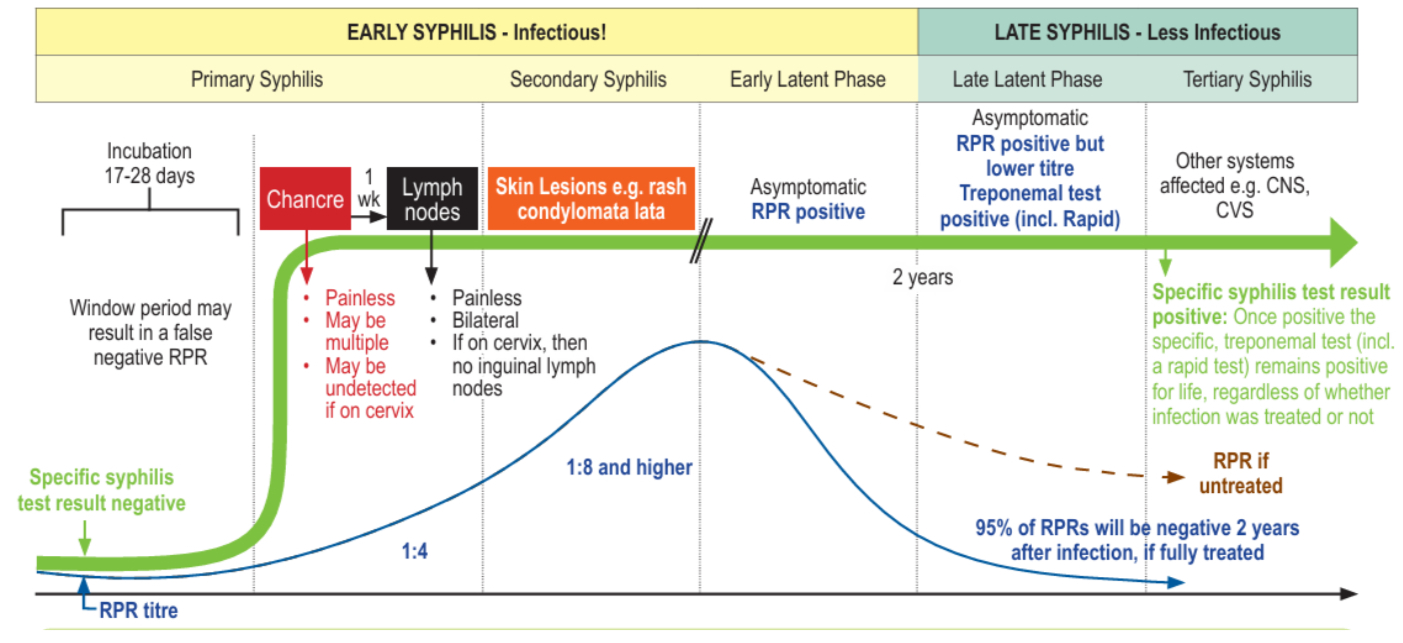
Syphilis is a sexually transmitted infection that can have multiple different presentations but also be asymptomatic. The signs of secondary syphilis occur six to eight weeks after the primary ulcer (chancre) and include a generalized rash (including palms and soles), flu-like symptoms, flat wart-like genital lesions (condylomata lata), mouth ulcers and patchy hair loss. Tertiary syphilis occurs many years later and affects skin, bone, heart and nervous system.


The stages of disease progression of syphilis are illustrated in the figure below, together with the typical clinical presentation in each stage, and the level of the RPR titre (blue graph) if treated. This timeline is an approximation, and may vary from client to client. Note that a genital ulcer caused by syphilis will resolve spontaneously within four to six weeks without treatment; however, the syphilis infection persists, and the ulcer (or other symptoms) resolving does not represent cure.
 Click on the image to enlarge.
Frequency of syphilis testing
A pregnant woman should be screened and tested for syphilis
- at her 1st/booking visit in antenatal care.
- If she tests negative, syphilis testing should be repeated:
- Scheduled antenatal visits, at approximately 4-weekly intervals, e.g., for BANC+ clients, this could be at 20, 26, 30, 34, and 38 weeks gestation
- During her labour/delivery admission
- At the time of diagnosis of an intrauterine death or miscarriage
- At any time, if the mother has clinical symptoms or signs suggestive of syphilis
Syphilis testing should be aligned with the HIV testing schedule:
- If a woman tests positive for HIV, but tests negative for syphilis, repeat syphilis testing should continue at the intervals described above.
- If a woman tests positive for syphilis but tests negative for HIV, repeat HIV testing should continue at recommended intervals
NOTE:
If a client is CURRENTLY being treated for syphilis during their current pregnancy, they should NOT be re-tested for syphilis apart from the recommended RPR titre test which is performed a minimum of 3 months after concluding syphilis treatment.
Types of Syphilis Tests and Their Uses
- Rapid syphilis tests use a type of test known as a specific (or treponemal) test for syphilis. Rapid syphilis tests remain positive for life, even if the infection has been treated.
- RPR type syphilis tests are known as non-specific (or non-treponemal) tests and are usually done in a laboratory. RPR titres change in response to treatment or disease progression.
- If a rapid test is used as the screening test (preferred), a positive result should be confirmed using an RPR test. The RPR will determine if the positive rapid result indicates a current active infection or an earlier infection, and the baseline titre allows the response to treatment to be monitored
- Once a woman has tested positive using a rapid test, a rapid test should no longer be used for routine screening to identify new infections at subsequent visits. A rapid test cannot differentiate between a new and a previous infection. A RPR should then be used as the screening test to identify new infections
When available and appropriate, rapid testing is the preferred first-line test in pregnancy, as it allows for immediate treatment.
Rapid syphilis tests are available as a single rapid diagnostic test (RDT) that tests only for syphilis, and a dual RDT which tests for both syphilis and HIV using the same drop of blood.
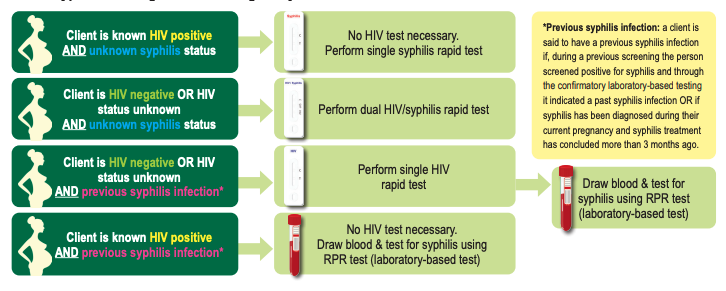
Dual syphilis and HIV rapid tests should only be used in clients
- Whose HIV status is negative or unknown AND
- Who have not had a previous syphilis infection
Clients who are already known to be living with HIV should NOT be re-tested for HIV and should therefore not use a dual syphilis and HIV rapid test!
HIV & Syphilis Testing Guide for Pregnancy: Which test should be used when?
Click on the image to enlarge.
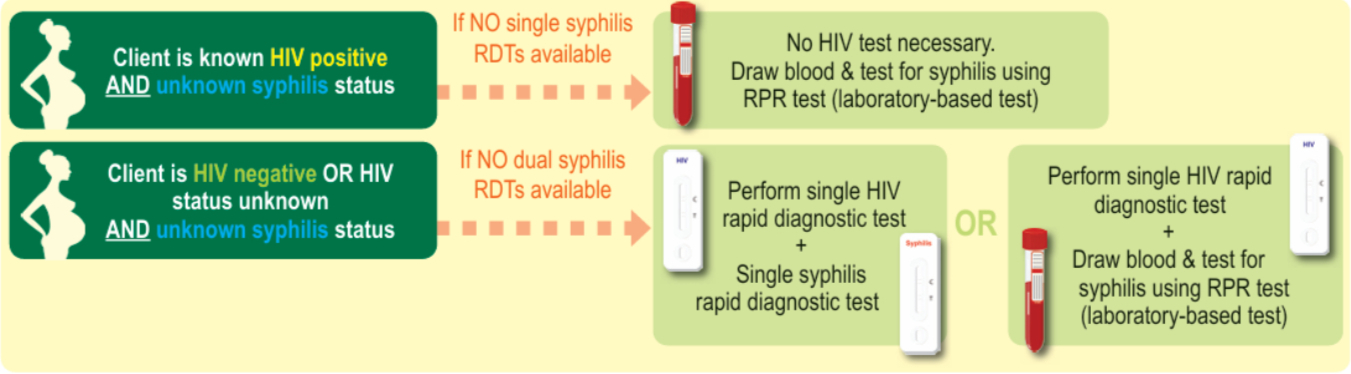
What to do when a facility does not have syphilis rapid tests in stock
 Click on the image to enlarge.
South African National Department of Health, Guideline for Vertical Transmission Prevention of Communicable Infections, Version 2_August 2023