Syphilis Serology and Treatment
Sexually Transmitted Infections
ICD-10 Code: A53.9
Syphilis serology
- The Rapid Plasmin Reagin (RPR) measures disease activity, but is not specific for syphilis
- False RPR-positive reactions may occur, notably in patients with connective tissue disorders (false positive reactions are usually low titre <1:8)
- For this reason, positive RPR results should be confirmed due to syphilis by further testing of the serum with a specific treponemal test, e.g.:
- Treponema pallidum haemagglutination (TPHA) assay
- Treponema pallidum particle agglutination (TPPA) assay
- Fluorescent Treponemal Antibody (FTA) assay
- Treponema pallidum ELISA
- Rapid treponemal antibody test (TPAb)
Screening can also be done the other way around starting with a specific treponemal test followed by a RPR in patients who have a positive specific treponemal test. This is sometimes referred to as the “reverse algorithm”.
- Once positive, specific treponemal tests generally remain positive for life and therefore the presence of specific treponemal antibodies cannot differentiate between current and past infections
- A person with previously successfully treated syphilis will retain lifelong positive specific treponemal test results
The RPR can be used:
- To determine if the patient’s syphilis disease is active or not,
- To measure a successful response to therapy (at least a fourfold reduction in titre, e.g. 1:256 improving to 1:64), or
- To determine a new re-infection
Some patients, even with successful treatment for syphilis, may retain life-long positive RPR results at low titres (≤1:8), which do not change by more than one dilution difference (up or down) over time (so-called serofast patients).
Note:
- Up to 30% of primary syphilis cases, i.e. those with genital ulcers may have a negative RPR
- The RPR is always positive in the secondary syphilis stage and remains high during the first two (infectious) years of syphilis
For syphilis treatment in pregnancy, See: Syphilis in pregnancy
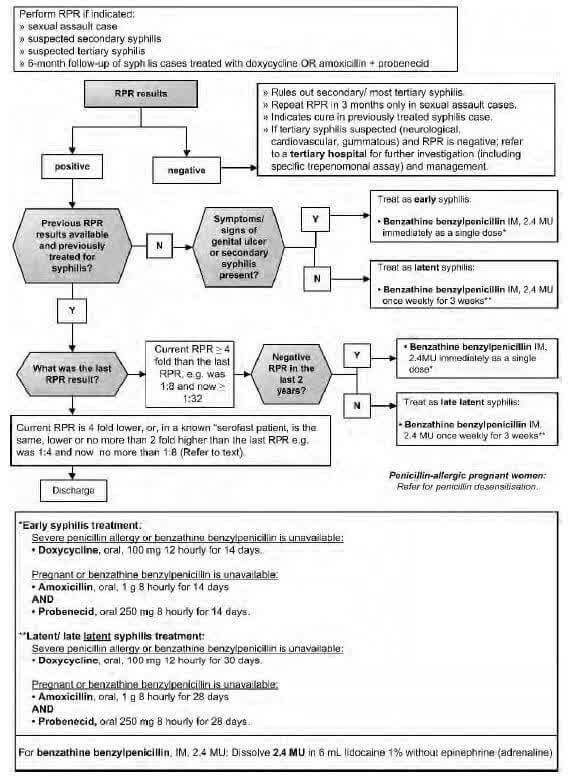
Click on image to enlarge
MEDICINE TREATMENT
Early syphilis treatment
Check if treated at initial visit
- Benzathine benzylpenicillin, IM, 2.4 MU immediately as a single dose
- Dissolve benzathine benzylpenicillin, IM, 2.4 MU in 6 mL lidocaine 1% without epinephrine (adrenaline)
In penicillin-allergic patients if benzathine benzylpenicillin is unavailable:
ICD-10 Code: Z88.0
- Doxycycline, oral, 100 mg twice daily for 14 days
If pregnant and benzathine benzylpenicillin is unavailable:
- Amoxicillin, oral, 1 g, 8 hourly for 14 days (Doctor initiated)
AND
- Probenecid. oral 250 mg, 8 hourly for 14 days (Doctor initiated)
If penicillin-allergic and pregnant: Refer for penicillin desensitisation
Late/ late latent syphilis treatment
Check if treatment was commenced at initial visit.
- Benzathine benzylpenicillin, IM, 2.4 MU once weekly for 3 weeks
- Dissolve benzathine benzylpenicillin, IM, 2.4 MU in 6 mL lidocaine 1% without epinephrine (adrenaline)
In penicillin-allergic patients or if benzathine benzylpenicillin is unavailable
ICD-10 Code: Z88.0
- Doxycycline, oral, 100 mg, 12 hourly for 30 days
If pregnant and benzathine benzylpenicillin is unavailable:
- Amoxicillin, oral, 1 g 8 hourly for 28 days (Doctor initiated)
AND
- Probenecid, oral 250 mg, 8 hourly for 28 days (Doctor initiated)
If penicillin-allergic and pregnant: Refer for penicillin desensitisation
REFERRAL
- Tertiary syphilis: neurosyphilis, cardiovascular syphilis; gummatous syphilis
- Clinical congenital syphilis
Standard Treatment Guidelines and Essential Medicines List for South Africa, Primary Healthcare Level, 2024 Edition