GuidelinesIMCI
TB (Age 2 months up to 5 years)
IMCI - Child (Age 2 months up to 5 years)
Click here to open the above PDF
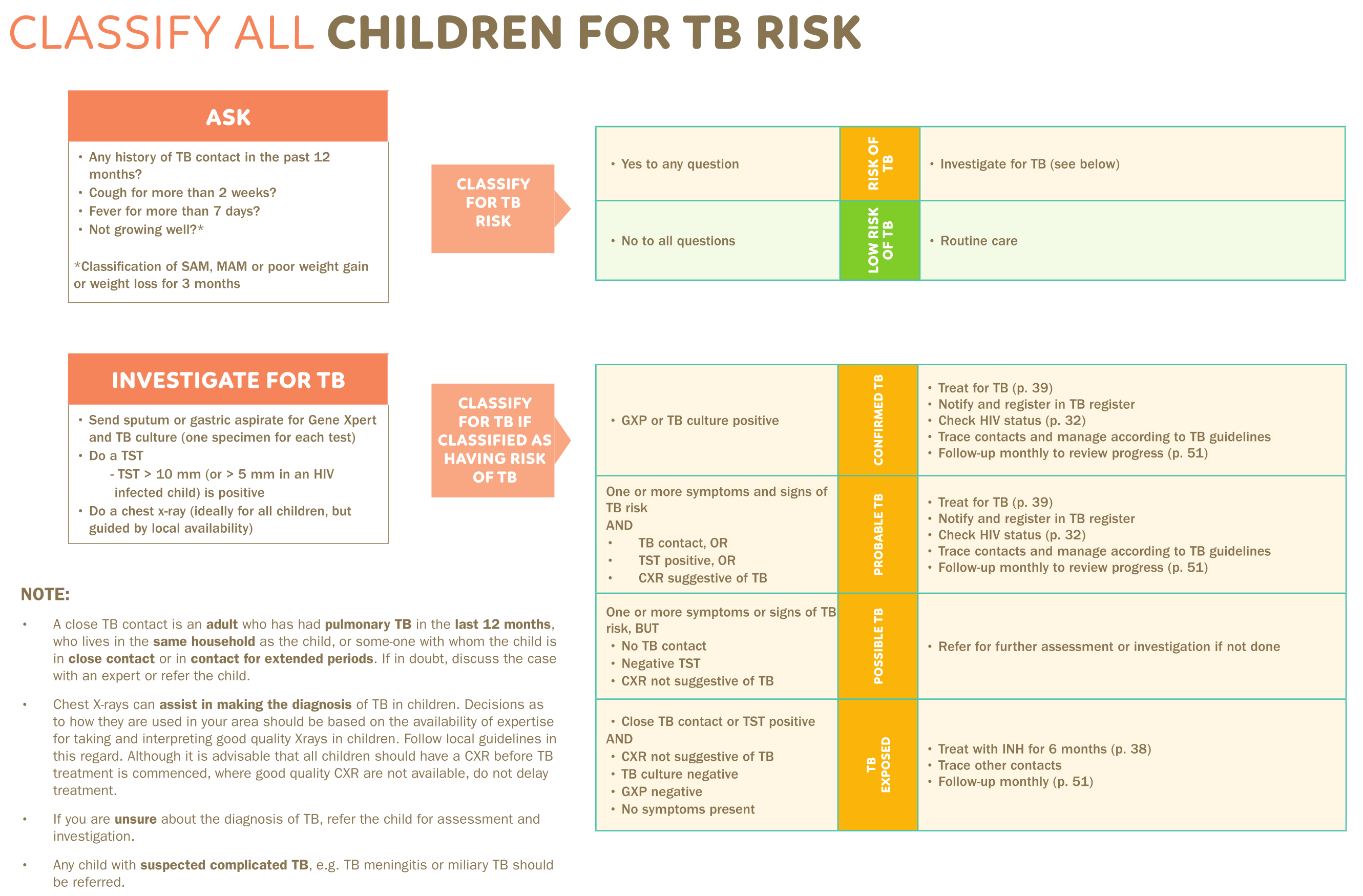
Ask
- Any history of TB contact in the past 12 months?
- Cough for more than 2 weeks?
- Fever for more than 7 days?
- Not growing well? (Classification of SAM, MAM or poor weight gain or weight loss for 3 months)
Classify for TB Risk
| Risk of TB | |
|
• Investigate for TB (see below) |
| Low Risk of TB | |
|
• Routine care |
Investigate for TB
-
Send sputum or gastric aspirate for Gene Xpert and TB culture (one specimen for each test)
-
Do a TST
- TST > 10 mm (or > 5 mm in an HIV infected child) is positive -
Do a chest x-ray (ideally for all children, but guided by local availability)
Classify for TB if Classified as Having Risk of TB
| Confirmed TB | |
|
|
| Probable TB | |
|
One or more symptoms and signs of TB risk
|
|
| Possible TB | |
|
One or more symptoms or signs of TB risk, BUT
|
|
| TB Exposed | |
AND
|
|
NOTE:
- A close TB contact is an adult who has had pulmonary TB in the last 12 months, who lives in the same household as the child, or some-one with whom the child is in close contact or in contact for extended periods. If in doubt, discuss the case with an expert or refer the child.
- Chest X-rays can assist in making the diagnosis of TB in children. Decisions as to how they are used in your area should be based on the availability of expertise for taking and interpreting good quality Xrays in children. Follow local guidelines in this regard. Although it is advisable that all children should have a CXR before TB treatment is commenced, where good quality CXR are not available, do not delay treatment.
- If you are unsure about the diagnosis of TB, refer the child for assessment and investigation.
- Any child with suspected complicated TB, e.g. TB meningitis or miliary TB should be referred
Integrated Management of Childhood Illness 2022; Child (Age 2 months up to 5 years); Assess, Classify and Identify Treatment; TB
Last checked for updates: June 2023