Testing of Allergan Sensitisation
Objective laboratory testing can identify patients at increased risk for severe disease, direct preventative steps to minimise allergen exposure(s) and tailor treatment and allergen immunotherapy (AIT). 29 However, indiscriminate and extensive specific IgE testing is not indicated where history and examination suggest AR. Various recommendations regarding prevailing aero-allergens in South A
Objective laboratory testing can identify patients at increased risk for severe disease, direct preventative steps to minimise allergen exposure(s) and tailor treatment and allergen immunotherapy (AIT).29 However, indiscriminate and extensive specific IgE testing is not indicated where history and examination suggest AR.
Various recommendations regarding prevailing aero-allergens in South Africa have been made and subsequently modified.29,30,31 The 2015 iteration included the pooled specific IgE aeroallergen screen (Phadiatop®) for which there is an extensive evidence base to support its use as a single rule-out test.32
A panel of specific IgEs to aeroallergens deemed most relevant to SA was established in 2014 by the Allergic Rhinitis Diagnostic Working Group (ARDWG). This included indoor allergens (house dust mites (HDM) (Dermatophagoides pteronissinus [Der p] and farinae [Der f]), cat, dog, moulds (including Alternaria, Epicoccum, Cladosporium, and cockroach), and outdoor allergens (Rye grass, Bermuda grass). Since then, specific IgE testing over 3 years (November 2019 – October 2022) from two private laboratories revealed that 36.6% of Phadiatop® tests were negative, confirming its usefulness as a screen-out tool and that testing analysis showed low positivity to the outdoor mould Cladosporium (m2).
On existing evidence, the following are recommended as first line for testing:
- Phadiatop®, although not specific for SA, is a costeffective screen-out tool in patients with a history of possible AR.
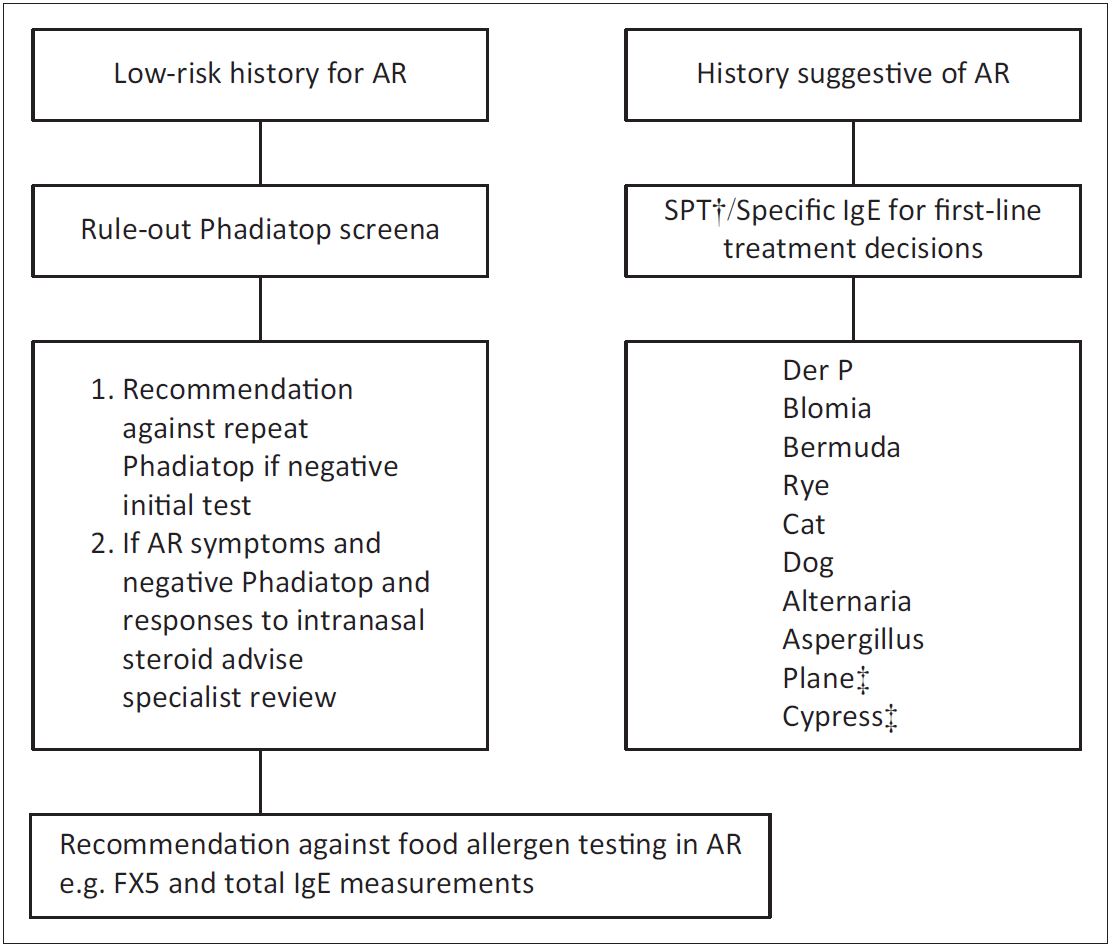
- In patients with a history suggestive of AR, skin prick testing with the suggested ARDWG common allergens or specific IgE testing is indicated (Figure 2).
- If Phadiatop® is positive, further analysis using the modified ARDWG panel may be performed to guide treatment.
- If Phadiatop® is negative, an alternative diagnosis should be sought or local AR should be considered. Further allergy testing is only recommended if history suggests a specific aeroallergen trigger that has no cross reactivity with allergens in the Phadiatop®. Repeat Phadiatop® testing is not recommended.
- Cladosporium has been removed from the ARDWG panel, and Plane and Cypress trees (Figure 2) included as early pollen monitoring data from across SA suggest these are the commonest allergenic tree pollens.33 However, pollen data are not yet comprehensive for all areas across SA, and other allergenic pollens (trees and weeds) may be relevant in certain areas33 (updated pollen data can be found at https://pollencount.co.za/).
- Specific tree panels should be considered based on clinical history, and where available, local sensitisation and pollen data (https://pollencount.co.za/).
- Food allergies very rarely cause AR, and hence, food allergy testing is generally discouraged.
 Click on the image to enlarge
AR, allergic rhinitis; SPT, skin prick testing; CI, contra indication; Der P, D. pteronissinus; Blomia, Blomia tropicalis; IgE, immunoglobulin E.
†, Consider contra indications to SPTs; ‡, consider regional variation in dominant tree species (www.pollencount.co.za)
FIGURE 2: First-line testing recommendations to either rule out allergic rhinitis or guide first-line treatments or allergen avoidance strategies in allergic rhinitis.
Click here to access the PDF.
Richards GA, McDonald M, Gray CL, et al. Allergic rhinitis: Review of the diagnosis and management: South African Allergic Rhinitis Working Group. S Afr Fam Pract. 2023;65(1), a5806. https://doi.org/10.4102/safp.v65i1.5806