Tetanus Prophylaxis
Tetanus Prophylaxis
PART B - Introduction and Description
IF THE PATIENT ALREADY CLINICALLY HAS TETANUS, THIS IS A NOTIFIABLE CONDITION.
ICD9 | ICD10 | Medical Condition |
037 | A35 | Tetanus (ICD10: other) |
7713 | A33 | Tetanus neonatorum |
Contacts details for NOTIFICATION:
Western Cape
Information Management Directorate
23rd Floor, Room 7, 4 Dorp Street, Cape Town
Tel: 021 483 4661
Fax: 021 483 3277
Part A - Algorithm
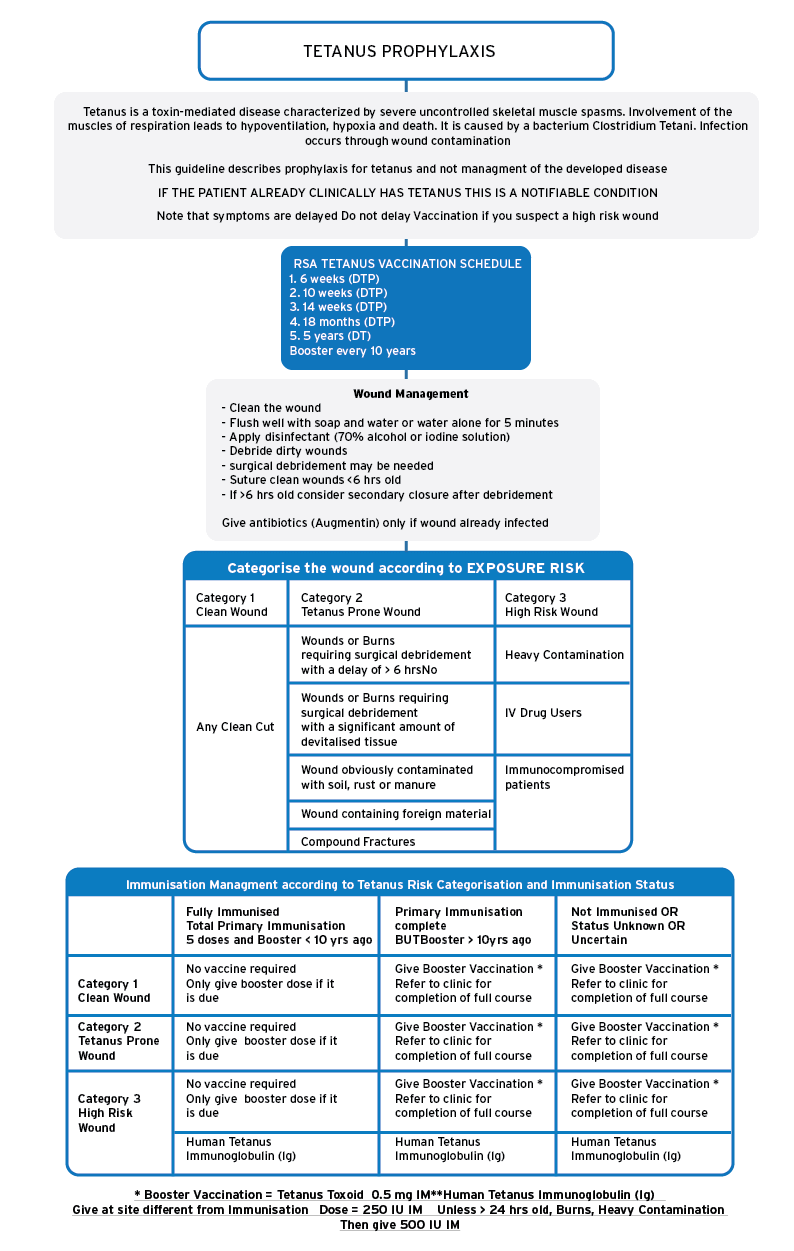
Part B
Introduction/Description
This guideline describes prophylaxis for tetanus and not management of the developed disease. IF THE PATIENT ALREADY CLINICALLY HAS TETANUS, THIS IS A NOTIFIABLE CONDITION.
- Tetanus is a toxin-mediated disease, caused by Clostridium Tetani and characterized by severe uncontrolled skeletal muscle spasms
- Involvement of respiratory muscles leads to hypoventilation, hypoxia and death
- Infection occurs through wound contamination
- Tetanus symptoms are delayed: Do not delay Vaccination if you suspect a high risk wound
Diagnosis of problem and differential diagnosis
Any patient with an open wound or burns should be evaluated for tetanus vaccination status and tetanus risk exposure and vaccinated as required.
The South African Vaccination schedule for Tetanus Prophylaxis is:
- 6 weeks (DTP)
- 10 weeks (DTP)
- 14 weeks (DTP)
- 18 months (DTP)
- 5 years (DTP)
Booster every 10 years
TRIAGE patient using SATS: Triage status will depend on the extent of the injuries.
| Categorise the wound according to EXPOSURE RISK | ||
| CATEGORY 1 | CATEGORY 2 | CATEGORY 3 |
| Clean wound | Tetanus Prone Wound | High Risk Wound |
| Any Clean Cut | Wounds or Burns requiring surgical debridement with a delay of > 6 hrs Wounds or Burns requiring surgical debridement with a significant amount of devitalised tissue Wound obviously contaminated with soil, rust or manure Wound containing foreign material Compound Fractures | Heavy Contamination IV Drug users Immunocompromised patients |
Management (based on severity)
Wound Management
- Clean the wound
- Flush well with soap and water or water alone for 5 minutes
- Apply disinfectant (70% alcohol or iodine solution)
- Debride dirty wounds - surgical debridement may be needed
- Suture clean wounds <6 hrs old
- If >6 hrs old consider secondary closure after debridement
- Give antibiotics only if wound already infected
Immunisation
| Fully Immunised 5 doses AND Booster < 10 yrs ago | Primary Immunisation Complete BUT Booster > 10 yrs ago | Not Immunised OR Status Unknown OR Uncertain | |
| Category 1 Clean Wound | No booster required | Give booster | Give booster Refer to clinic for completion of course |
| Category 2 Tetanus Prone Wound | No booster required | Give booster | Give booster Refer to clinic for completion of course |
| Category 3 High Risk Wound | No booster required GIVE Human Tetanus Immunoglobulin | Give booster Refer to clinic for completion of course AND Human Tetanus Immunoglobulin | Give booster Refer to clinic for completion of course AND Human Tetanus Immunoglobulin |
Dose chart
- Booster Vaccination = Tetanus Toxoid 0.5 mg IM
- Human Tetanus Immunoglobulin (Ig)
- Dose = 250 IU IM
- Unless
- > 24 hrs old
- Burns
- Heavy Contamination
- Then give 500 IU IM
- Give at site different from Immunisation
History
- DMIST Handover from Ambulance
- SAMPLE HISTORY
- Signs and Symptoms
- Allergies
- Medications
- Past Medical history
- Last Meal
- Events
Examination
- Assess ABC’s, injuries and the wound
- Measure and Record Vital Signs
Investigations
Depend on the clinical scenario
Referral Criteria (L1/2/3)
- Admit for injuries requiring inpatient intervention
Discharge and Admission Criteria/Checklist
- Follow up, suture removal and wound care should be done at clinic level.
Emergency Centre Wound Care Advice
- Keep the wound clean and dry for at least 5 days. If you get it wet, dab it dry with some clean tissue. If there is a dressing over the wound, remove it and gently pat the wound dry leaving glue or steri-strips in place.
- Don’t pick or put your fingers in the wound whilst it is healing as this can cause infection.
- Steri-strips: Stay in place for 5-7 days unless you are advised differently. Go to the clinic to remove them and have the wound checked. If the ends of the steri-strips peel back, trim them with scissors to stop them catching and being pulled off.
- Glue: will drop off by itself when the wound is healed. This usually takes 5 days.
- Stitches: Keep stitches clean and dry. The doctor/nurse will tell you how long they have to stay in for. Go to the clinic to get the stitches removes and the wound checked.
- If the wound becomes more painful, despite taking painkillers, red, hot and swollen or if pus comes out of the wound you need to go to your clinic
- If your dressing becomes very dirty or blood stained, go to your clinic for a clean dressing.
References
- Rosens Emergency Medicine 7th edition.
- Tintinallis 4th ed.