The HIV Exposed Infant
Description Management of HIV-Exposed Infants HIV Testing ICD-10 code: Z20.6 DESCRIPTION Infants and children born to mothers living with HIV until HIV infection in the infant or child is reliably excluded and the infant or child is no longer exposed through breastfeeding are defined as HIV-exposed. Transmission of HIV infection may occur during pregnancy, during delivery, or via breastfeed
Description
Management of HIV-Exposed Infants
HIV Testing
ICD-10 code: Z20.6
DESCRIPTION
Infants and children born to mothers living with HIV until HIV infection in the infant or child is reliably excluded and the infant or child is no longer exposed through breastfeeding are defined as HIV-exposed.
Transmission of HIV infection may occur during pregnancy, during delivery, or via breastfeeding. Vertical transmission prevention (VTP) can be effectively carried out with a very high success rate by fully suppressing the mother's viral load with ART and giving prophylactic antiretroviral therapy to the infant. Maternal viral loads must be done, checked, recorded and acted upon during pregnancy and breastfeeding. The risk of breast milk transmission remains significant when the mother's viral load cannot be suppressed.
The VTP strategies include the initiation of ART in the mother (either pre- or post-conception) and the provision of HIV post-exposure prophylaxis to the infant. The mother’s response to ART by the time of delivery is measured by the delivery VL. The delivery VL will determine the risk profile of the infant at birth. The risk profile of the infant (low-risk or high-risk) will determine the appropriate infant prophylaxis regimen that should be prescribed. All HIVexposed infants will be considered high-risk until the results of the delivery viral load are known. Therefore, if the delivery VL result is not available at the time of discharge, the HIV-exposed infant will be considered high-risk until the result can be reviewed at the 3–6 day postnatal visit.
MANAGEMENT OF HIV-EXPOSED INFANTS
| Maternal VL | Risk profile | Prophylaxis | Comment |
|
Maternal delivery VL as yet unknown at discharge from labour ward (results pending). |
High-risk (until maternal delivery VL results become available) |
Provide dual prophylaxis: |
All HIV-exposed infants will be considered high-risk until the final risk profile can be determined by the maternal delivery VL. Dispense a full 6 weeks supply of dual prophylaxis. Ask the mother to return with all medication at the 3–6 day postnatal visit. |
| Maternal delivery VL ≥ 50 copies/mL in a breastfeeding mother. | High-risk | Provide dual prophylaxis: AZT at birth and then twice daily for 6 weeks. NVP at birth and then daily for a minimum of 12 weeks. |
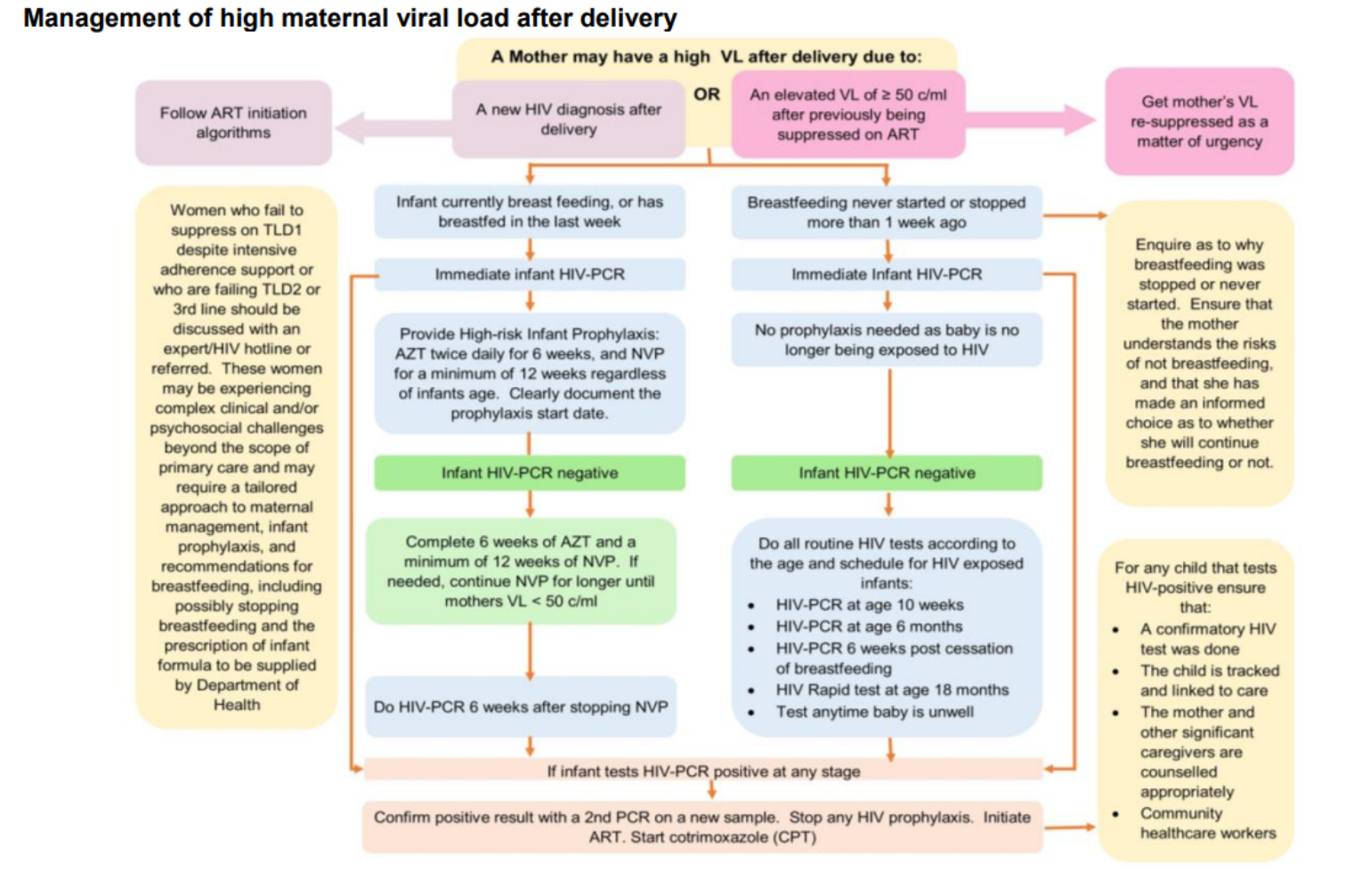
Do an ABCDE assessment and get the mother’s VL re-suppressed as a matter of urgency. Stop infant NVP only after confirmation of maternal VL being < 50 copies/mL, or until 4 weeks after cessation of all breastfeeding. |
| Maternal delivery VL ≥ 50 copies/mL in a mother who is exclusively formula feeding her infant from birth.* | High-risk | Provide dual prophylaxis: AZT at birth and then twice daily for 6 weeks. NVP at birth and then daily for 6 weeks. |
Do an ABCDE assessment and get the mother’s VL resuppressed as a matter of urgency. |
| Maternal delivery VL < 50 copies/mL regardless of feeding choice. | Reclassify as low risk. | Change to low risk prophylaxis: NVP at birth and then daily for 6 weeks. | Affirm and encourage good adherence. Repeat maternal VL 6- monthly during breastfeeding. |
*Non-breastfeeding mother diagnosed HIV-positive > 72 hours after delivery: Do not start the infant on prophylaxis. Start maternal ART. Perform an HIV PCR test on the infant and, if positive, initiate ART, if negative, continue to monitor HIV risk and perform HIV testing as above.
Click on image to enlarge
Click on image to enlarge
Nevirapine (NVP) and Zidovudine (AZT) doses for infant on PMTCT
- Nevirapine, oral, daily (syrup 10 mg/mL) and zidovudine, oral, twice daily (syrup 10 mg/mL).
- Newborns ≥ 2 kg and term infants:
| Birth–6 weeks | 6 weeks– 6 months | 6–9 months | 9–24 months | ||
| 2.0– 2.49 kg | ≥ 2.5 kg | ||||
| NVP (Daily) |
1 mL (10 mg) daily | 1.5 mL (15 mg) daily | 2 mL (20 mg) daily | 3 mL (30 mg) daily | 4 mL (40 mg) daily |
| AZT (Twice daily) |
1 mL (10 mg) twice daily | 1.5 mL (15 mg) twice daily | 6 mL (60 mg) twice daily | Children > 6 months of age requiring AZT prophylaxis should use treatment doses. | |
- Preterm newborn < 2 kg:
- Nevirapine, oral, daily:
| Weight | First 2 weeks after birth (mg of NVP) | After first 2 weeks after birth (mg of NVP) |
| 500 to < 625 g | 1 mg | 2 mg |
| 625 to < 850 g | 1.5 mg | 3 mg |
| 850 to < 1200 g | 2 mg | 4 mg |
| 1.2 to < 1.5 kg | 3 mg | 5 mg |
| 1.5 to < 2 kg | 3.5 mg | 6 mg |
| If the infant at the time of discharge is severely underweight-for-age (3 SD or 3 z-scores below the mean), give NVP according to weight (i.e. 4 mg/kg/dose daily) until in the normal weight-for-age range. | ||
- Zidovudine, oral, twice daily:
| Gestational age at birth | First 2 weeks after birth | 2–4 weeks after birth | 4–6 weeks after birth | > 6 weeks after birth |
| 30–35 weeks | 2 mg/kg | 3 mg/kg | 4 mg/kg | |
| < 30 weeks | 2 mg/kg | 3 mg/kg | 4 mg/kg | |
See table above.
- Ideally, the birth HIV PCR test should be done before administration of infant NVP and AZT, but any delay in testing should not delay administration.
- Repeat the dose if the baby vomits.
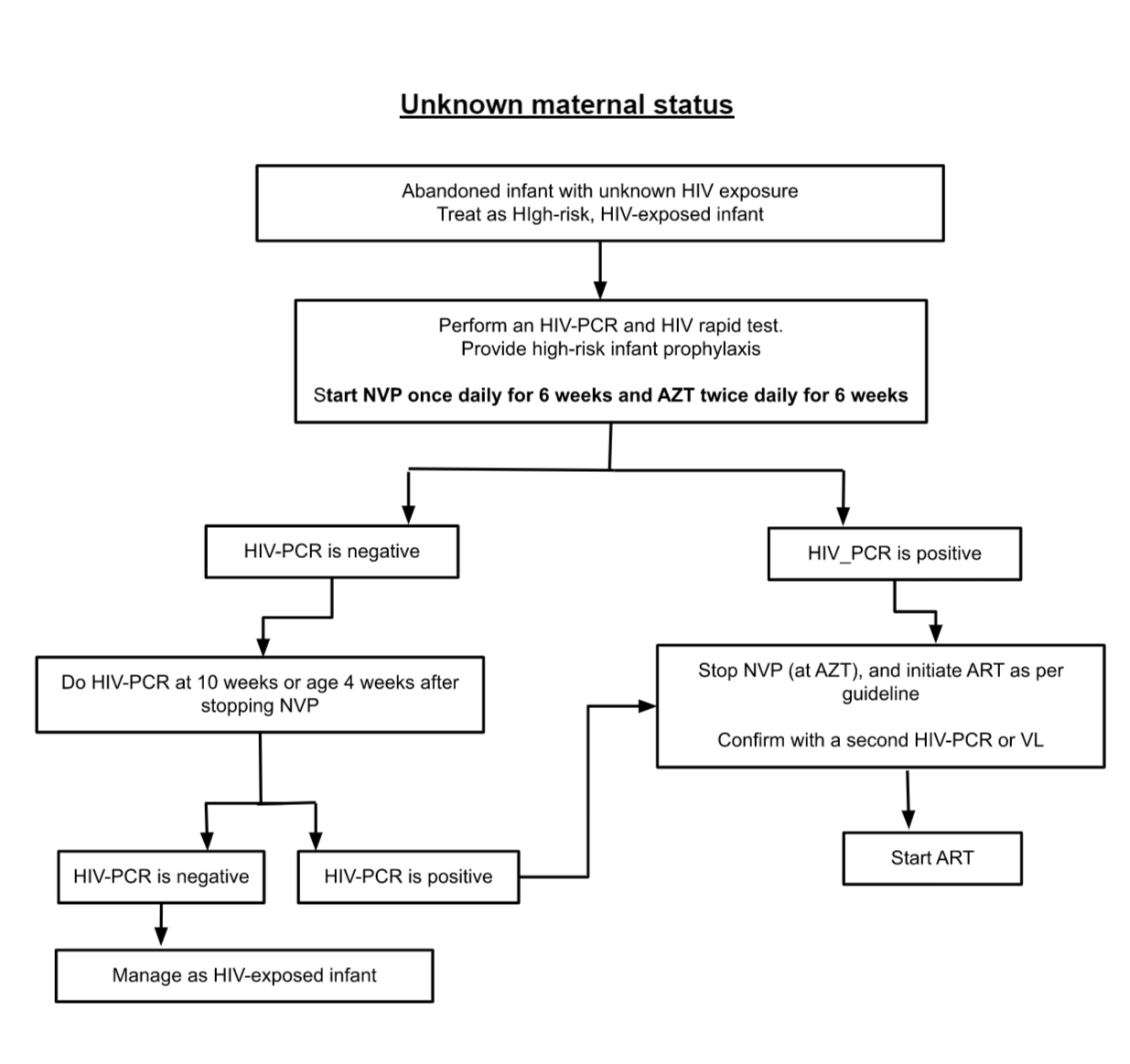
- If the infant's HIV PCR is positive at any time, stop NVP and AZT, perform a second HIV PCR test and initiate ART immediately. Counsel the mother to continue breastfeeding.
ART Prophylaxis for infants who are unable to tolerate oral medication
Infants who are unable to tolerate oral medication/feeds should be initiated on intravenous zidovudine (AZT). On re-establishment of oral feeds/ medications, intravenous zidovudine should be stopped, and the infant should commence on the appropriate oral infant prophylaxis regimen. Ideally, gestational age should be used to determine the optimal dose.
| Gestational Age | Approximate birth weight | AZT IV dosing for first 14 days (If unable to tolerate oral agents) |
| ≥ 35 weeks | ≥ 2.5 kg | 3 mg/kg body weight IV every 12 hours |
| < 35 weeks | < 2.5 kg | 1.5 mg/kg body weight IV every12 hours |
HIV TESTING
Age appropriate testing
- < 18 months – do an HIV PCR.
- ≥ 18 months – do a rapid HIV antibody test or ELISA.
- Confirm the HIV test in children between 18–24 months with an HIV PCR.
- Confirm the HIV test in children > 24 months with an HIV rapid test.
Routine testing for HIV-exposed children < 18 months:
- Birth: Do an HIV PCR at birth in all HIV-exposed infants.
- 10 Weeks: Do an HIV PCR at 10 weeks of age (chronological age) in all HIV-exposed infants.
- 6 Months: Do an HIV PCR at 6 months of age in all HIV-exposed infants.
- The HIV status of all children not already known to be HIV-exposed should be established by offering the mother an HIV test at any time point.
- Post cessation of breastfeeding: If the child is breastfed and previous HIV PCRs were negative, repeat testing 6 weeks after complete cessation of breastfeeding. (If the child is 18 months or older, do an HIV ELISA or rapid test).
Routine testing for all children ≥ 18 months:
- 18 months: Universal HIV testing at 18 months (HIV rapid test for ALL infants regardless of HIV exposure, except in those who previously tested HIV-positive and are on ART).
- If the first rapid test is positive, confirm the result with:
- An HIV PCR test if the infant is between 18–24 months.
- A second rapid test using a different manufacturer kit, preferably on a different blood specimen, if the infant is > 24 months.
Testing for all children regardless of age or HIV-exposure status:
- Symptomatic child/infant: If the child has evidence suggesting HIV infection at any time, even if the child has had a previous negative HIV PCR test, the child should be tested for HIV infection using an ageappropriate HIV test (HIV PCR or rapid test).
- If the HIV test is positive at any time point:
- Confirm with a repeat age-appropriate HIV test.
- Initiate treatment while awaiting the second HIV test result.
Note:
- Repeat HIV PCR testing at 10 weeks and 6 months should be done on all HIV-exposed infants with a prior negative or indeterminate HIV PCR.
- Any infant with a positive birth HIV PCR should be urgently initiated on ART as per: The HIV-Infected neonate.
- A child cannot be confirmed as HIV-negative until at least 4–6 weeks after other potential HIV exposure (including cessation of breastfeeding). Exposure to ART through prophylaxis (NVP/AZT) or maternal ART may affect the sensitivity of HIV PCR tests.
- Rapid tests may be less reliable in children with advanced disease. If clinical findings suggest HIV infection, but the rapid test is negative, send a further blood specimen to the laboratory for formal HIV ELISA testing. If test results are still equivocal, do an HIV PCR test.
- Patients already on ART should not have a repeat HIV antibody (rapid) test.
If an HIV PCR test is indeterminate or discordant, refer to the National Department of Health Guidelines for prevention of Mother to Child Transmission of Communicable Infections. 2023.
All HIV PCR results need to be followed-up as a matter of urgency.
Feeding advice
- It is strongly recommended that exclusive breastfeeding be initiated within 1 hour of birth and continued for the first 6 months of life, after which the child's nutritional requirements will require the introduction of complementary foods in addition to breastfeeding.
- Women living with HIV should be fully supported for ART adherence during the breastfeeding period and thereafter.
- Women with a VL > 50 copies/mL on TLD1 should continue breastfeeding while every effort is made to regain viral suppression. Their infants should receive high-risk prophylaxis during breastfeeding.
- The following may be indications to discontinue breastfeeding:
- Infants of mothers who are failing TLD2.
- Infants of mothers who are failing third-line PI-based treatment.
- Discuss appropriate feeding practices with the mother regarding the risks and benefits of continuing breastfeeding vs replacement feeding.
- The use of flash pasteurisation or ‘Pretoria’ pasteurisation to reduce HIV transmission is supported but may pose significant barriers to successful breast milk feeding due to the effort involved. For instance, it can be used as an interim measure during maternal mastitis.
Cotrimoxazole prophylaxis Indications:
- According to the current guideline, only babies with a positive HIV PCR should be started or continued on cotrimoxazole prophylaxis as per: The HIV-Infected neonate, medicine treatment, cotrimoxazole prophylaxis below.
Standard Treatment Guidelines and Essential Medicines List for South Africa, Hospital Level, Paediatrics, 2023 Edition
Chapter 9: Human Immunodeficiency Virus Infections, 9.1.1 The HIV-Exposed Infant