The HIV-Exposed Infant
Please click on the link below to access the most up-to-date version of this guideline. The content on this page is currently being updated to align with the latest publication. Always check the version number at the bottom of the screen to confirm which version you are using. Click here to access the Primary Health Care - PHC Chapter 11: Human Immunodeficiency Virus and Acquired Immune Deficienc
Please click on the link below to access the most up-to-date version of this guideline. The content on this page is currently being updated to align with the latest publication. Always check the version number at the bottom of the screen to confirm which version you are using.
Click here to access the Primary Health Care - PHC Chapter 11: Human Immunodeficiency Virus and Acquired Immune Deficiency Syndrome (HIV and AIDS) - 26 February 2026
Description
Medicine Treatment
Referral
Z20.6
DESCRIPTION
An HIV-exposed infant or child is one born to a mother living with HIV, until HIV infection in the infant or child is reliably excluded and the infant or child is no longer exposed through breastfeeding.
Transmission of HIV infection from mother to child may occur during pregnancy, during delivery or via breastfeeding. Transmission of infection from mother to child can be effectively prevented with a very high success rate by means of suppressing the mother’s VL and giving post-exposure prophylaxis to the infant, a strategy now known as Vertical Transmission Prevention (VTP; formerly termed Prevention of Mother to Child Transmission).
The risk of transmission from breast milk is low when the mother is virally suppressed. Ensure maternal VL monitoring is done every 6 months while breastfeeding and offer enhanced adherence counselling to ensure viral suppression is achieved and maintained.
When to test HIV-exposed children
- Birth (HIV PCR).
- For recommendations on when to perform additional tests, refer to the guidance on “HIV Testing in Children” (See HIV infection in children (<10 years old)).
Feeding advice
- It is strongly recommended that exclusive breastfeeding be initiated within 1 hour of birth and continued for the first 6 months of life, after which the child's nutritional requirements will require the introduction of complementary foods in addition to breastfeeding.
- Women living with HIV should be fully supported for ART adherence during the breastfeeding period and thereafter.
- Women with a VL > 50 copies/mL on TLD1 should continue breastfeeding while every effort is made to regain viral suppression. Their infants should receive high-risk prophylaxis during breastfeeding.
- The following may be indications to discontinue breastfeeding:
- Infants of mothers who are failing TLD2.
- Infants of mothers who are failing third-line PI-based treatment.
- Discuss appropriate feeding practices with the mother regarding the risks and benefits of continuing breastfeeding versus replacement feeding.
- The use of flash pasteurisation or 'Pretoria' pasteurisation to reduce HIV transmission is supported, but may pose significant barriers to successful breast milk feeding due to the effort involved. For instance, it can be used as an interim measure during maternal mastitis.
NOTE: For the above,
- TLD1 = TLD as a first-line ART regimen.
- TLD2 = TLD in patients who have failed a previous ART regimen.
MEDICINE TREATMENT
Mother
The VTP plan starts with initiation of ART in the mother (either pre or post conception). See HIV in pregnancy.
Infant
Thereafter, the HIV-exposed infant may be classified into one of the following categories which determines the appropriate infant prophylaxis regimen:
- Low risk.
- High risk.
- Unknown risk, e.g. abandoned infant (manage as high risk).
LoE:IIa45
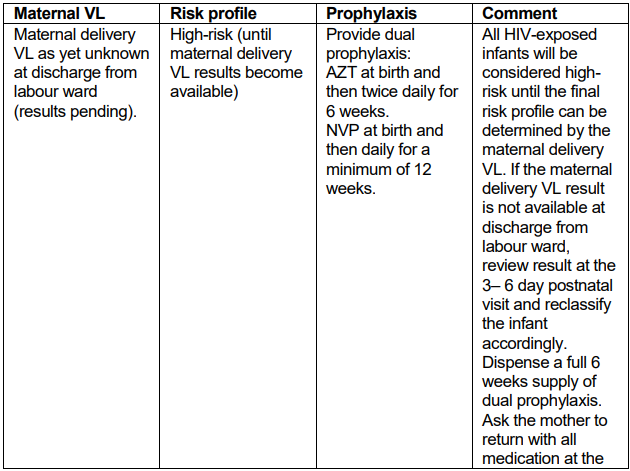
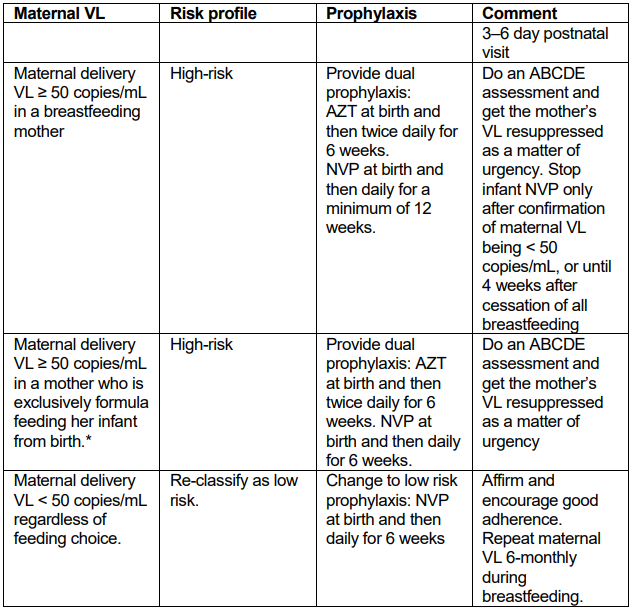
Click on image to enlarge
*Non-breastfeeding mother diagnosed HIV-positive > 72 hours after delivery: Do not start the infant on prophylaxis. Start maternal ART. Perform an HIV PCR test on the infant and, if positive, initiate ART. If negative, continue to monitor HIV risk and perform HIV testing as above.
Table 1: Risk categories for HIV-exposed infants
HIV PROPHYLAXIS IN HIGH-RISK INFANTS
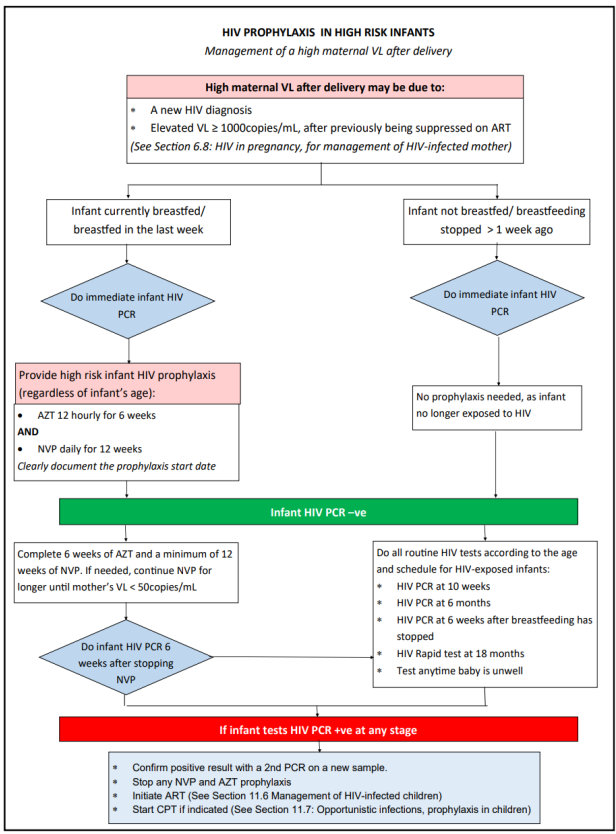
Click on image to enlarge
Figure 1: HIV prophylaxis in HIV-exposed infant at high risk after delivery
Sections mentioned in figure 1:
See HIV in pregnancy, for management of HIV-infected mother.
See Management of HIV-Infected Children (<10 Years).
See Opportunistic infections, prophylaxis in children.
LoE:IIIb46
MANAGEMENT OF INFANT OF UNKNOWN RISK
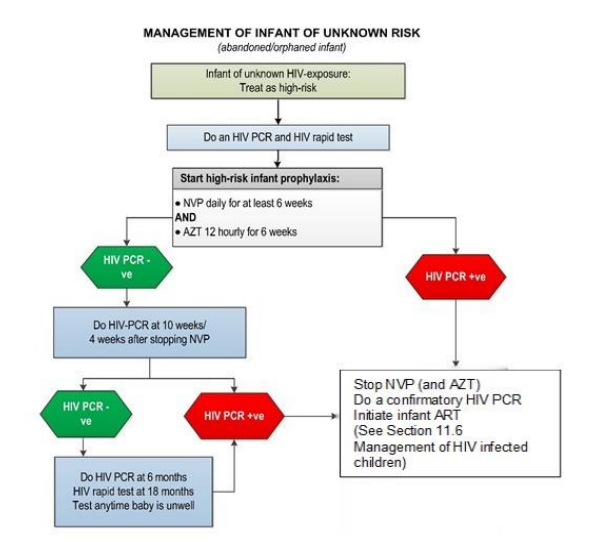
Figure 2: Management of HIV-exposed infant of unknown risk
Click on image to enlarge
Sections mentioned in figure 2:
See Management of HIV-Infected Children (<10 Years).
LoE:IIIb47
Non-breastfeeding mother diagnosed HIV positive > 72 hours after delivery:
Do not start NVP. Perform an HIV PCR on infant and if positive initiate ART.
Infant VTP dosages:
Daily prophylaxis for 6 or 12 weeks administered to infants, as indicated above:
- Give 1st dose as soon as possible after birth.
- If baby vomits: Repeat dose once only.
- If infant HIV PCR is positive at any time, stop prophylactic ARV, confirm with 2nd PCR and initiate/refer for ART, while awaiting 2nd PCR result.
- Continue normal breastfeeding.
Nevirapine (NVP) and Zidovudine (AZT) doses for infant on VTP:
Newborns and infants:
- Nevirapine, oral, 4 mg/kg daily.
- Zidovudine, oral, 4mg/kg/dose 12 hourly.
LoE:IIb48
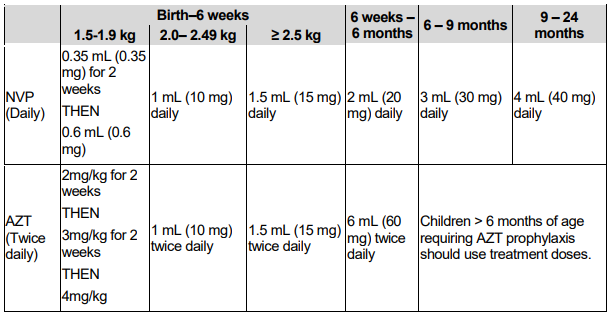
Table 2: Dose bands for NVP and AZT in VTP.
REFERRAL
Mother declines infant ARV prophylaxis.
Standard Treatment Guidelines and Essential Medicines List for South Africa, Primary Healthcare, 2020-2024_Version 2.1_09 December 2024
Chapter 11: Human Immunodeficiency Virus and Acquired Immune Deficiency Syndrome (HIV AND AIDS)_ 11.5 The HIV-exposed Infant