Tiered Approach to Interventions
Supporting the Antimicrobial Resistance Strategy Framework and the Guidelines on Implementation of the Antimicrobial Strategy in South Africa: One Health Approach and Governance, 2018
Implementation of an AMS is best executed with the application of quality improvement science.
The 6-step process described in the NDoH Quality Improvement Guide46 has been adapted below for application to the AMS programme (see the figure below: Quality improvement steps for AMS interventions)
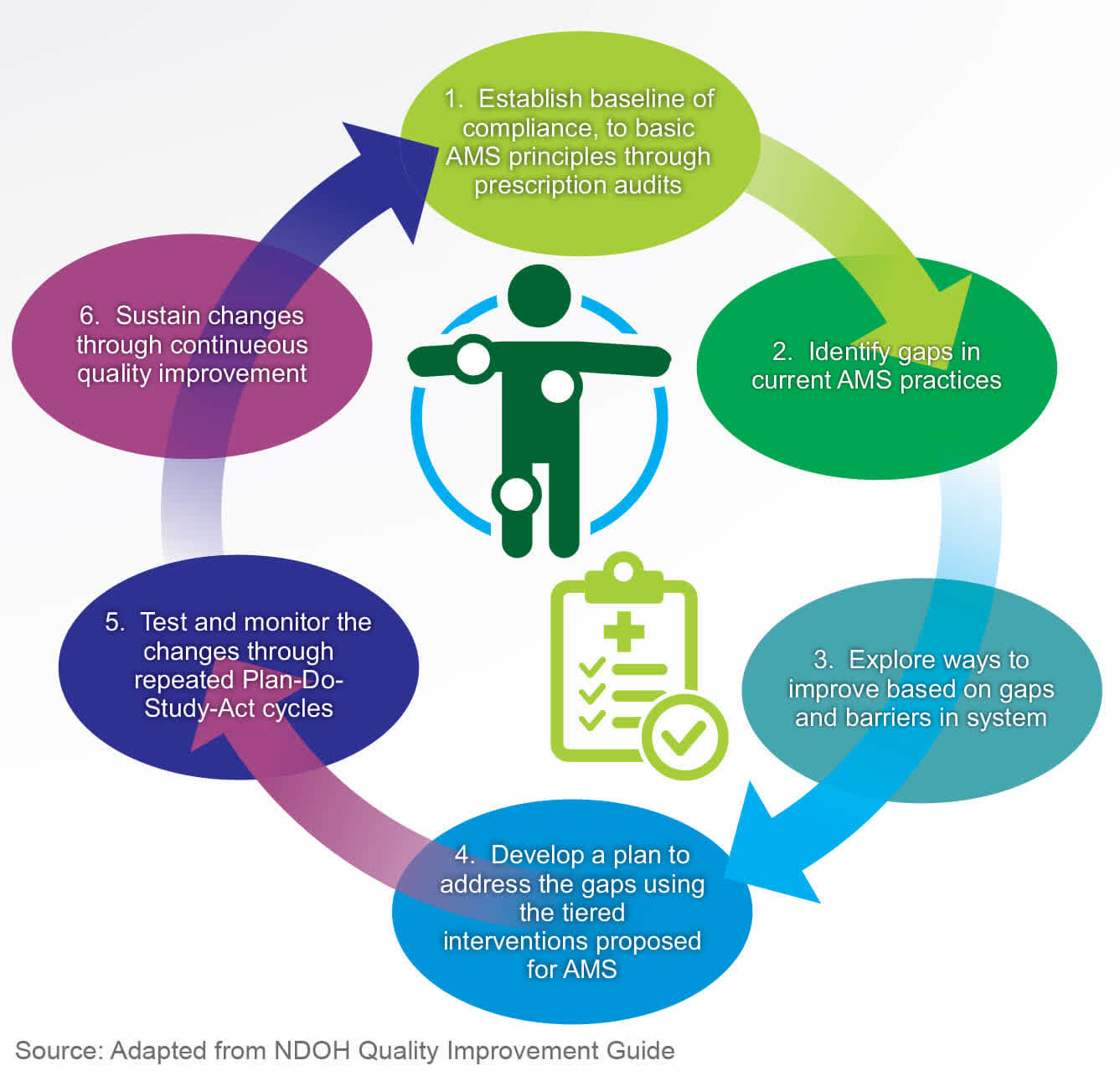
Click on image to enlarge
Tiered approach to interventions
The table below describes the different interventions which have been shown to improve AMS at hospital level. Interventions have been tiered according to ease of implementation and greatest impact with tier one considered ‘low hanging fruit’ or easier to implement stewardship interventions. It is recommended that the AMS committee agrees on the most applicable interventions to implement based on gaps or non-compliances noted regarding antibiotic prescribing in the local setting. Implementation of interventions should be done in a stepwise manner and the implementation of too many interventions at once is cautioned against.
Tiered interventions for AMS quality improvement
| Intervention |
Action
|
| Appropriate culture prior to starting antibiotics | Establish whether an appropriate culture was taken prior to the commencement of antibiotics according to recommended guidelines of the infection being managed. |
| Distribution / administration | Time to administration of antibiotic (“hang-time”) is the time elapsed between antimicrobial prescription and actual antimicrobial administration which should aim to be less than one hour. |
| It is important for prescribers to note the time of antimicrobial prescription on the prescription chart to assist with the measurement of this intervention.47 | |
|
Dose
|
Optimising antimicrobial dosing according to guideline recommendations, and pharmacokinetic/ pharmacodynamic (PK/ PD) principles is critically important in ensuring best patient care. |
| For those antimicrobials that require a loading dose, ensuring that these loading doses are prescribed and administered is essential in optimising the antimicrobials’ efficacy. | |
|
Duration
|
Inappropriate extended duration of antimicrobial therapy is unnecessary and can render unintended consequences, such as multidrug-resistance selection or Clostridium difficile infection. Antibiotic therapy that extends for longer than seven days for immuno-competent patients, or for acute conditions, should be monitored and intervened upon. |
| Duration of therapy for patients who are culture negative should be monitored for appropriateness based on other clinical signs and symptoms. | |
|
Duplicate cover
|
When more than one antimicrobial is prescribed, evaluation of the spectrum of activity of these agents is necessary to ensure that there is no duplication in spectra, which could be considered redundant therapy. |
| Duplicate cover can refer to double Gram-positive, Gram-negative and/or anaerobic therapy. Knowing the antimicrobials’ spectrum of activity is important to execute this intervention. | |
| Co-administration of more than four antimicrobials | Review patients who receive more than four antimicrobials simultaneously to minimise redundancy in therapy according to antibiotic spectrum. |
| Intravenous-to-oral- switch (IVOS) | To decrease the infection risk and higher cost due to unnecessary IV medication it is recommended that a patient is switched from IV antibiotics to oral bioequivalent antibiotics if clinically stable and suitable (e.g. patient can tolerate oral medication intake). |
| De-escalation/ escalation of antibiotic therapy (drug-bug match) | Antibiotic therapy should be tailored according to the sensitivity profile of the organism cultured. De-escalation to the narrowest spectrum agent or escalation of therapy should be considered as soon as culture sensitivity results are available. |
| Therapeutic drug monitoring (TDM) | Therapeutic drug monitoring is recommended for aminoglycosides and vancomycin to ensure optimal therapeutic drug concentrations in individual patients. Refer to the Hospital Level: Adult STGs and EML.48 |
| Monitoring the implementation of the prescription chart | Measuring compliance to the completion of the following indicators of the prescription chart is recommended to enhance stewardship assessment of antibiotic therapy prescribed for patients. Documentation of: • Diagnosis; • Indication of treatment; • Culture taken before/after antibiotic administration; • Prescription time; and • Duration of therapy. |
Steps to consider when implementing a quality improvement AMS strategy for any of the interventions listed in Tiered interventions for AMS quality improvement:
- Obtain approval, commitment and endorsement from the HAMSC. Be clear on the purpose and collective goal of the desired process and communicate this message.
- Create awareness through the necessary training and education of frontline team members and provide the applicable guidelines, evidence and toolkits required to execute the implementation of the intervention, e.g. standardised data collection sheets.
- Test the implementation of the desired intervention in a ward (or within the pharmacy) to establish the appropriate methodology of monitoring.
- Measurement or the monitoring of compliance to an intervention should be standardised, accurate, consistent and ongoing to authentically reflect hospital practice. Weekly or monthly measurement is recommended.
- When measuring compliance, it is important to note that not all patients in a hospital need to be monitored but a suitable sample size to reflect hospital practice is the desired aim. A ‘start small then spread’ approach is recommended.
- Always report on the infection prevention and AMS indicators to the clinicians and hospital management and leadership team.
- A period of four to six weeks should be set aside to establish baseline compliance to a particular intervention.
- The PDSA methodology should be used to render rapid process improvements or to test change ideas in order to improve compliance.49
46 National Department of Health. Quality improvement guide: Quality improvement – the key to providing improved quality of care. Pretoria; 2012.
47 Messina AP, van den Bergh D, Goff DA. Antimicrobial stewardship with pharmacist intervention improves timeliness of antimicrobials across Thirty-three Hospitals in South Africa. Infect. Dis. Ther 2015; 4(Suppl. 1): 5–14. 10.1007/s40121-015-0082-x
48 National Department of Health. Standard Treatment Guidelines and Essential Medicines List for South Africa: Hospital level, adults, 2015 edition. http://www.health.gov.za/index.php/standard-treatment-guidelines-and-essential-medicines-list
49 Institute for Healthcare Improvement, The Breakthrough Series: IHI’s Collaborative Model for Achieving Breakthrough Improvement, 2003.