Total Body Cooling for Hypoxic Ischemic Encephalopathy
Total Body Cooling for Hypoxic Ischemic Encephalopathy
Neonates with suspected birth asphyxia should be assessed to determine whether they meet the criteria for cooling.
Criteria for considering treatment with cooling:
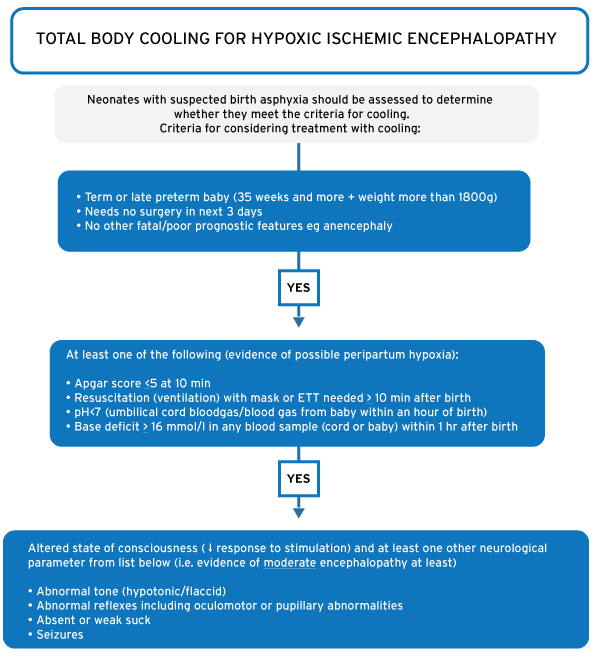
Consider cooling in babies not fulfilling the criteria but after at least 30 minutes duration of amplitude integrated EEG recording shows abnormal background aEEG activity or seizures. There must be one of the following:
- normal background with some seizure activity
- moderately abnormal activity
- suppressed activity
- continuous seizure activity
Babies with only mild or babies with very severe HIE (ie not moderate) does not qualify for cooling (see Sarnat Staging table below). Also not babies that had no signs of life and that had asystole after 10 min of resuscitation. Babies that made no attempt at breathing/gasping at 30min of resuscitation are also not for cooling.
If in doubt about severity of neurological impairment, also see Sarnat staging below or discuss with consultant-on-call.
Sarnat Staging of HIE: Need 3 out of the 6 categories in Stage 2 for moderate encephalopathy.
| Stage 1 (mild) | Stage 2 (moderate) | Stage 3 (severe) | |
| Level of consciousness | Hyperalert/irritable | Lethargic/obtunded | Stuporous/comatose |
| Neuromuscular control Posture Muscle tone Deep tendon reflexes | Overreactive Mild distal flexion Normal Overactive | Diminished Strong distal flexion Mild hypotonia Overactive | Diminished/Absent Intermittent decerebrate Decreased/absent Decreased/absent |
| Primitive reflexes Suck Moro | Normal Weak Strong | Suppressed Weak or absent Weak/incomplete | Absent Absent Absent |
| Autonomic function Pupils Respiration Heart Rate | Sympathetic Dilated Spontaneous Tachycardia | Parasympathetic Constricted Spontaneous Bradycardia | Both systems depressed Midposition/often unequal, poorly reactive Periodic/apnoea Variable |
| Seizures | None | Common (onset 6-24 hrs of age) | Uncommon (excluding decerebration) |
| Outcome | About 100% normal | About 70% normal; 25% abnormal; 5% die | About 80% die; remainder with severe sequelae |
Start cooling within 6 hrs of life (consider up to 8hrs). Switch off overhead heater.
- Set up the Blanketrol machine with patient on blanket and rectal probe inserted 3cm (pictures and instructions pasted to side of machine)
- Set initial mattress temp to 33.5°C and record time cooling was started
- Fill out the observation pack booklet
- Bloods to be done on admission and daily: FBC, diff, INR,PTT, U+E, ALT (blood culture on admission)
- Keep rectal temperature 33-34°C
- If baby shows signs of discomfort eg shivering, consider sedation (Phenobarbitone 10-20mg/kg – can be repeated OR lorazepam (Ativan) 0.05mg-0.1mg/kg/dose OR morphine 50mcg/kg bolus over 10 min. then 50mcg/kg/dose 6 hrly)
- Cooling can be reversed after 72hrs (increase temp not > 0.5°C/hr)
Connect the aEEG (amplitude integrated EEG) machine (before or after cooling was initiated). Quick start guide with instructions attached to machine. Quick start guide with instructions and pictures attached to machine. Post monitoring, please ask sister to stock up again with needle and gel electrodes (there should be at least 5 gel electrodes and 4 needle electrodes available at all times). Ensure that the parent(s) are aware that the results from studies have shown improved outcome for many of these babies, but that poor outcome is still possible in about 40% of babies. This is a new therapy where long-term outcomes beyond 2 years of age are not known. All babies that were cooled, needs high risk clinic follow-up until 18 months of age and need a screening test for hearing to be done at discharge or shortly thereafter.
During cooling expect:
- Decreased heart rate.
- Increased blood pressure initially due to increases in peripheral vasoconstriction.
- Increase in urine output initially due to shunting of blood to the internal organs, cold, and diuresis.
- Decrease in calcium, magnesium, phosphorus and potassium.
- Labile glucose due to relative insulin resistance decreased metabolic rate, and shivering.
- Possible anticoagulant effects (contraindicated if intracranial bleed is suspected).
Remember that the half-life of certain medications is decreased during cooling. QT interval can be prolonged: use medication known to prolong QT time with caution.
Indications for aEEG (amplitude integrated electro-encephalographic) monitoring
- Any infant with neonatal encephalopathy
- Eg secondary to - Asphyxia (moderate/severe) - Meningitis/meningo-encephalitis - Electrolyte abnormalities - Metabolic disorders -Congenital malformations
- In predicting outcome after brain injury
- Detection of seizures (clinical and subclinical)
- To help with decision-making regarding cooling/not